
How to Measure a Wheel Bolt Pattern: Step-by-Step
This post contains affiliate links. As an Amazon Associate, we earn from qualifying purchases.
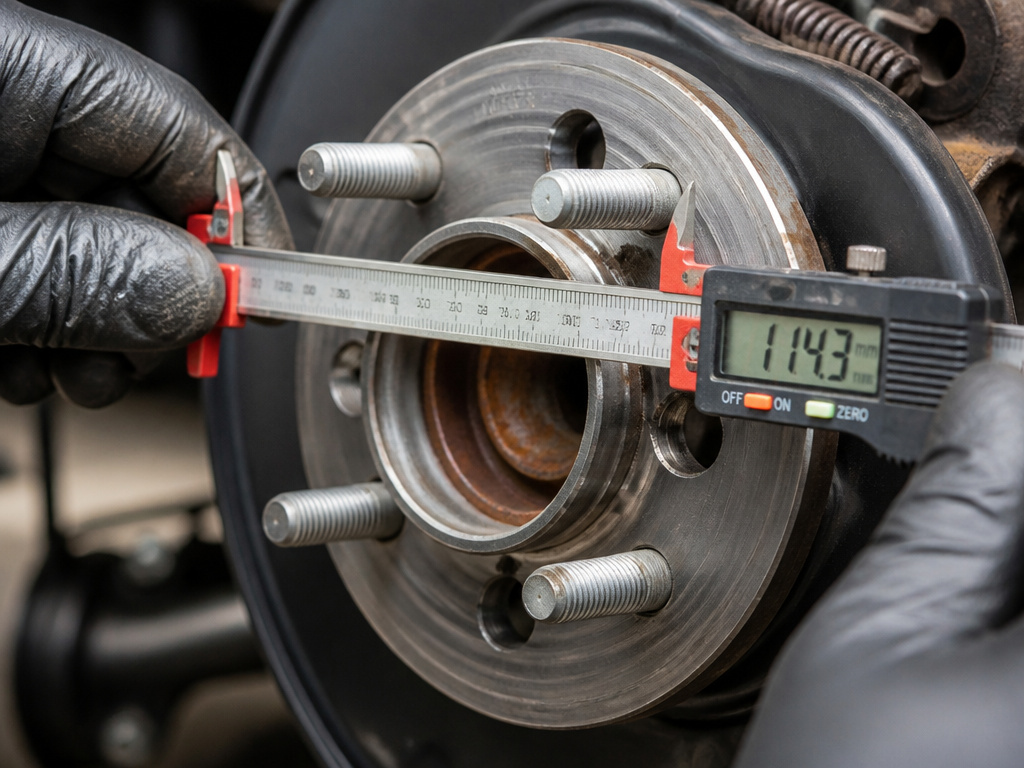
To measure a wheel bolt pattern, you need two numbers: the lug count and the bolt circle diameter. For wheels with 4, 6, or 8 lugs, measure from the center of one lug hole straight across to the center of the opposite hole. For a 5-lug wheel, measure from the center of one lug hole to the outer edge of the farthest lug hole. This diameter, combined with the lug count (e.g., 5×114.3), is your bolt pattern.
The catch is those two methods, center-to-center for even lugs, center-to-edge for five lugs, are not interchangeable. Use the wrong one and your measurement will be off by enough to order the wrong wheels. The difference between a 5×112 and a 5×114.3 pattern is only 2.3mm, but it’s enough to prevent the lug nuts from seating correctly. Understanding how to measure a wheel bolt pattern is therefore critical.
What follows is a walkthrough of both measurement methods for how to measure a wheel bolt pattern, the one tool that makes it foolproof, and a look at the real-world specs that change even within a single car model. We will also address the measurement disagreement you will find online, so you know which method to trust.
Key Takeaways
- Bolt pattern is a two-number code: lug count (like 5) and bolt circle diameter (like 114.3mm).
- For 4, 6, or 8 lugs, measure center-to-center across opposite holes.
- For a 5-lug pattern, the most reliable field method is center of one hole to the outer edge of the farthest hole.
- Patterns are not interchangeable, a 5×112 wheel will not safely fit a 5×114.3 hub.
- Always measure your specific vehicle; trim level or model year can change the bolt pattern.
The Tools You Actually Need
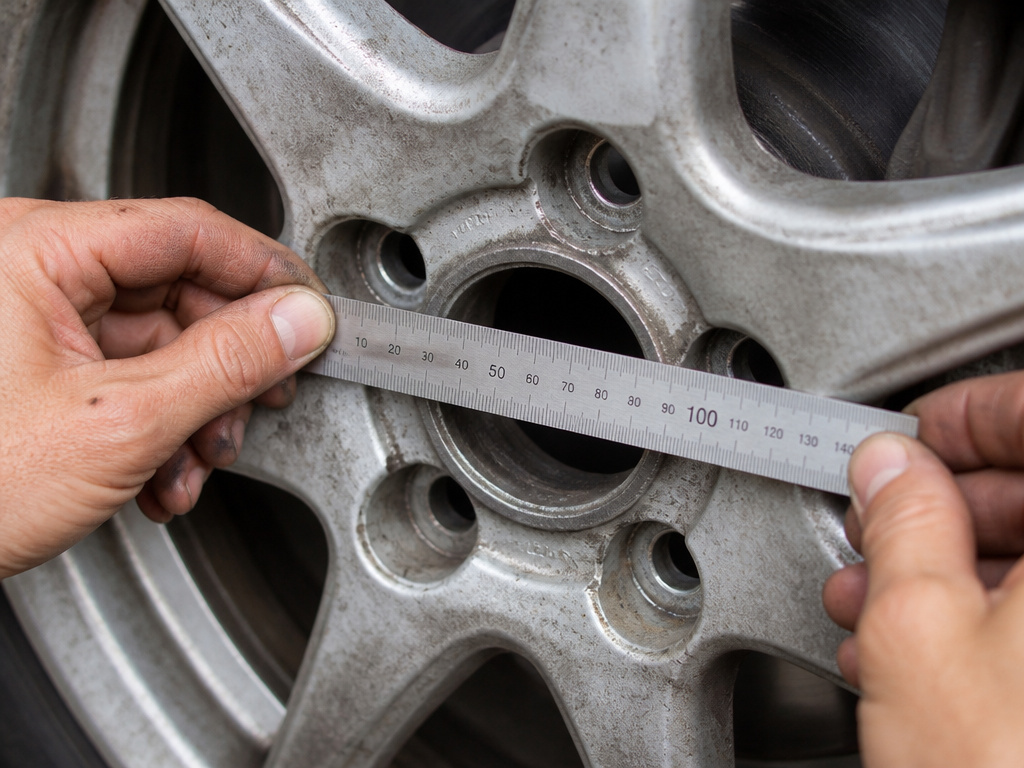
You do not need a specialty shop. A standard tape measure or ruler with millimeter markings will do the job. A digital caliper is better for precision, especially on a dirty or corroded wheel where visual centering is tricky. If you plan to measure wheels regularly, a stamped steel bolt pattern gauge is an inexpensive purchase that eliminates the math and the guesswork.
The most important tool is the surface you are measuring. If the wheel is on the car, you are measuring the brake rotor or drum face through the lug holes, awkward, but possible. If the wheel is off, turn it over. The back of the wheel barrel is flat, and many aftermarket wheels have the pattern stamped there. Look for markings like 5×114.3 or 5×4.5 engraved near the center.
How to Measure a 4, 6, or 8-Lug Bolt Pattern
Even-numbered lug patterns are straightforward because every hole has another directly opposite it. Your job is to find the diameter of the circle those holes form.
For wheels with 4, 6, or 8 lugs, measure from the center of one lug hole to the center of the lug hole directly across from it. That distance is the bolt circle diameter (BCD). Combine it with the lug count to state the pattern: a 6-lug wheel with a 139.7mm measurement is a 6×139.7.
Here is the step-by-step breakdown:
- Identify Opposing Holes: On a 4-lug wheel, you have two pairs directly across from each other. On a 6-lug or 8-lug wheel, pick any hole and find the one opposite it.
- Measure Center-to-Center: Place your ruler or caliper so one end is at the center of the first lug hole. Stretch it straight across the hub to the center of the opposite hole. Do not measure from the inner or outer edges, center point to center point.
- Convert if Necessary: The measurement will be in either inches or millimeters. The industry standard is millimeters. If you measure in inches, multiply by 25.4 to convert (e.g., 5.5 inches x 25.4 = 139.7mm).
- State the Pattern: Combine the lug count with the diameter. A 4-lug wheel with a 100mm measurement is a 4×100 pattern.
This method works because the geometry is simple. The holes sit at opposite ends of the circle’s diameter. It is the one part of this process that is genuinely hard to mess up.
The 5-Lug Measurement Debate. And the Method That Works
Five-lug wheels have no hole directly opposite another, so you cannot measure a pure center-to-center diameter. This is where the confusion, and the conflicting advice online, begins.
Sources disagree on the simplified field method for how to measure a wheel bolt pattern. Some, like the guide from NeoTires, suggest measuring from the center of one lug hole to the outer edge of the farthest lug hole. Others may suggest different methods. The difference in these instructions leads to different final numbers.
So, which is right? For the purpose of identifying a common bolt pattern to order a wheel, the center-to-far-edge method (center of one to the outer edge of the farthest hole) is the most commonly referenced and will get you close enough to match a chart. For absolute, engineering-grade precision, you need a bolt pattern gauge or the geometric calculation the pros use.
Where this goes sideways: Using the wrong reference chart for your measurement method. If you used a center-to-far-edge measurement of 4.5 inches, that correlates to a 5×114.3mm pattern. If you used a center-to-opposite-outer-edge measurement and got 2.75 inches, that also correlates to a 5×114.3mm pattern. Mixing up the charts will point you to the wrong size.
Here is the safest field procedure for a 5-lug wheel:
- Pick a Hole: Choose any lug hole as your starting point.
- Find the Farthest Hole: Identify the lug hole that is farthest from your starting point, this is the one that is not adjacent.
- Measure to the Edge: Place your ruler at the center of your starting hole. Measure to the outer edge (the side farthest from the wheel center) of that farthest hole.
- Convert and Consult a Chart: Convert inches to millimeters by multiplying by 25.4. Then, use a 5-lug specific conversion chart from a retailer like NeoTires that states which measurement method it is based on.
The alternative is to skip the math entirely. A bolt pattern gauge has templates for all common 5-lug sizes. You lay it over the wheel, see which set of five holes aligns perfectly, and read the pattern stamped next to it. It is the most reliable method for a novice.
Why “Close Enough” Is a Dangerous Rule
A wheel is not a decorative hubcap. It is a critical structural component that transfers all the vehicle’s forces, acceleration, braking, cornering, through a handful of lug studs. The bolt pattern ensures the load is distributed evenly across every lug nut. A mismatch concentrates stress.
According to the NeoTires guide, a mismatched bolt pattern leads to angled contact between the lug nut and the wheel hole. The clamping force becomes uneven. Some studs take more load than others. The result is not always an immediate, dramatic failure.
A mismatched bolt pattern can lead to angled contact, uneven stress, inconsistent clamping force, and risk of loosening; failure may not be immediate. The difference between a 5×112 and a 5×114.3 is only 2.3mm. It is not enough to see with the naked eye, but it is enough to compromise the entire connection.
This is why verifying your measurement twice matters. It is also why you must check more than just the bolt pattern for proper wheel fitment, including offset and hub size.
Beyond the Pattern: Hub Diameter and Stud Size
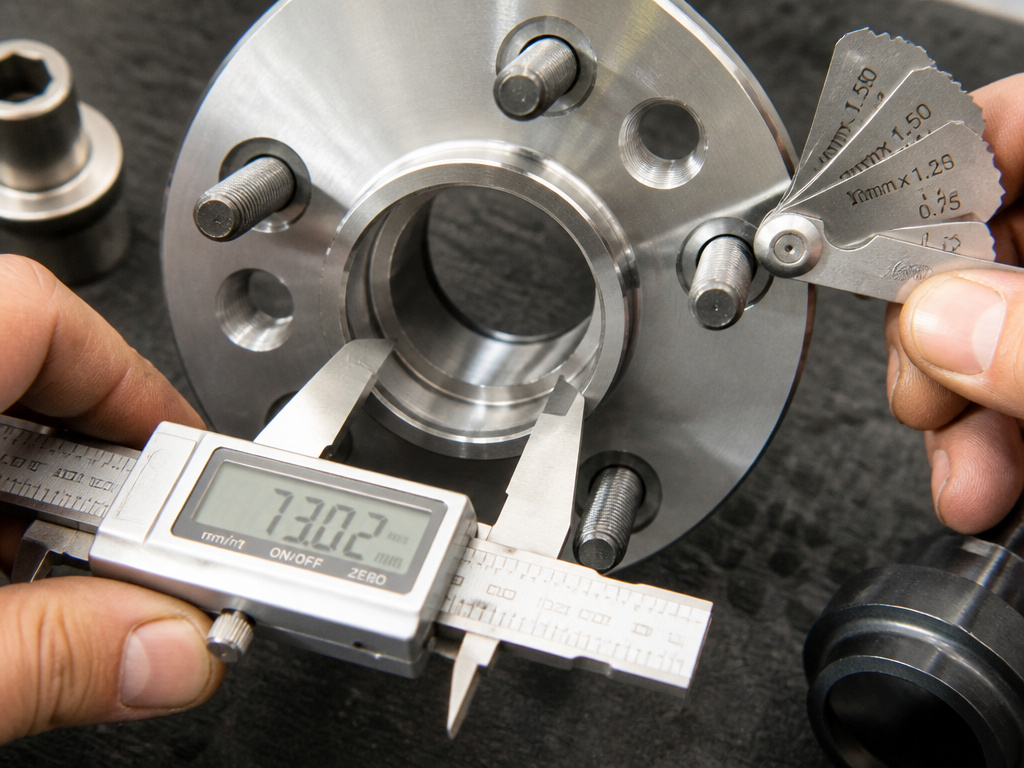
The bolt pattern gets the wheel onto the hub, but two other specs ensure it sits and clamps correctly: the center hub diameter and the lug nut thread size.
The hub diameter (or center bore) is the hole in the middle of the wheel. If it matches the vehicle’s hub perfectly, the wheel is “hub-centric”, the hub itself centers the wheel, and the lug nuts just clamp it. If the wheel’s center bore is larger, you need a hub-centric ring to fill the gap. Without it, the wheel is centered only by the lug nuts (“lug-centric”), which can cause vibration.
The stud size and thread pitch (e.g., 12×1.5) must match your lug nuts. A mismatch means the nuts will not thread on, or they will feel tight but not actually clamp the wheel. This is a separate but equally critical check, detailed in our guide to lug nut thread sizes.
Common mistake: Assuming all wheels for your car model share the same specs. The US Wheel Adapters guide shows how specs change. A 1997-1999 Acura CL 2.2 has a 4×114.3 pattern. The 2001-2003 Acura CL 3.2 has a 5×114.3 pattern. Same car line, different year, different engine, completely different wheel.
When to Trust a Database, and When to Measure
Online wheel fitment databases are a great starting point. You enter your vehicle’s year, make, model, and trim, and it spits out the expected bolt pattern, wheel offset, and hub size. They are built from guides like the detailed US Wheel Adapters Bolt Pattern & Hub-Centric Guide.
But they are not infallible. As WheelsASAP notes, trim level, brake size, or a mid-cycle refresh can change the pattern. Trim level, brake size, or model year may change the bolt pattern on the same vehicle model. The only way to be certain is to measure the physical vehicle or wheel you have.
This is especially true if you are buying used wheels, working on a modified vehicle, or have a model that underwent a running change. The time it takes to confirm with a tape measure can save you the cost and hassle of a return.
Bolt Pattern Conversion Between Millimeters and Inches
Bolt circle diameter is expressed in either millimeters or inches. To convert a measurement from inches to millimeters, multiply the inch value by 25.4. This conversion is necessary because wheel specifications from different manufacturers or regions may use different units. Always verify which unit of measurement is being used for your specific wheel. The bolt pattern itself, such as 5×114.3, indicates the diameter is in millimeters, while a pattern like 5×4.5 indicates inches. Using the wrong unit or an incorrect conversion will result in a pattern that does not fit your vehicle’s hub.
Common Bolt Patterns by Vehicle Type
Vehicle type influences common bolt patterns, but specifications can vary widely even within a category. For example, passenger cars like the Acura CL may use a 4×114.3 or 5×114.3 pattern depending on the model year and trim. Trucks and larger vehicles, such as the Chevrolet Astro Van, can use patterns like 5×127 or 6×139.7. You cannot assume a pattern based solely on vehicle type. Always measure your specific vehicle’s hub directly, as factors like brake size, trim level, or model year can change the required bolt pattern.
Existence of Dual-Drill/Multi-Fit Wheels
Some aftermarket wheels are manufactured with multiple sets of lug holes to fit different bolt patterns. These are often called dual-drill or multi-fit wheels. They provide flexibility for wheel manufacturers and retailers. When inspecting such a wheel, you may see two or more bolt patterns stamped on the inner barrel or rear face. It is critical to ensure the correct set of holes is used for your vehicle’s specific pattern. Using the wrong set on a multi-fit wheel can lead to the same safety issues as using a completely mismatched wheel, including uneven stress and potential loosening.
Frequently Asked Questions
How do you measure a 5 lug bolt pattern without a gauge?
The most common field method is to measure from the center of one lug hole to the outer edge of the farthest lug hole (two positions away). Convert that inch measurement to millimeters by multiplying by 25.4, then match it to a 5-lug conversion chart. For precision, use a bolt pattern gauge.
What is the most common 5-lug bolt pattern?
For passenger cars, 5×114.3mm (which is equivalent to 5×4.5 inches) is extremely common across Japanese, Korean, and many domestic vehicles. For trucks and SUVs, 5x127mm (5×5 inches) and 5×139.7mm (5×5.5 inches) are prevalent.
Can I put a 5×114.3 wheel on a 5×115 hub?
No. The 0.7mm difference, while tiny, means the lug nuts will not seat flat against the wheel. This creates angled contact and uneven clamping force, which can lead to vibration, loosening lugs, or stud failure. Bolt patterns are not interchangeable.
Where is the bolt pattern stamped on a wheel?
Many aftermarket wheels have the pattern stamped or engraved on the back of the wheel barrel, the inner lip or the flat surface around the center bore. Look for something like “5×114.3” or “5×4.5”. If it is not there, you must measure it.
Do I need to worry about hub diameter?
Yes. The hub diameter ensures the wheel is centered correctly on the axle. If your wheel’s center bore is larger than your vehicle’s hub, you need plastic or metal hub-centric rings to fill the gap. This prevents vibration and ensures the lug nuts are not bearing the centering load.
The Bottom Line
Measuring a bolt pattern is a basic skill, but the details matter. Use the center-to-center method for even lugs. For five lugs, use the center-to-far-edge method and a conversion chart from a source like NeoTires, and know that a dedicated gauge is the best ten dollars you will spend on this project.
The real work starts after you have the number. Cross-check it against your vehicle’s hub diameter and stud size. Understand that a pattern like 5×114.3 is a global standard, referenced in documents like the ISO wheel and rim standard, for a reason, it works when matched correctly.
Finally, torque matters as much as fitment. Once you have the right wheel, follow the correct lug nut torque procedure with a calibrated wrench. A perfectly measured bolt pattern is worthless if the wheel is not clamped to the hub properly. Do the measure twice, torque once.
