
How to Read Motorcycle Tire Sizes: A Sidewall Decoder
This post contains affiliate links. As an Amazon Associate, we earn from qualifying purchases.
To read a motorcycle tire size, decode the sidewall markings in order: the metric size (e.g., 120/70R17) gives width, profile, construction, and rim diameter; the service description (e.g., 58W) provides load capacity and speed rating; and the DOT code reveals the week and year of manufacture. The UK MOT legal tread minimum is 1.0mm, but wear bars signal 0.8mm (1/32”). However, sources disagree on the minimum tread depth for replacement: the UK sets a legal minimum of 1.0mm, while the USTMA notes wear bars appear at ~0.8mm and some manufacturers recommend replacement at 2/32 or 3/32 inches.
That sequence of numbers and letters is a spec sheet. Miss one piece, and you risk a tire that doesn’t fit, can’t handle your bike’s weight, or was made a decade ago. The sidewall tells you everything, but only if you know the language, which is why you need to know how to read motorcycle tire sizes.
What follows is a decoder. We’ll walk through a real sidewall code piece by piece, tackle the inch-based sizes for older bikes, and clear up the two most common points of confusion when you compare a how to read motorcycle tire sizes guide: the legal vs. Practical tread depth, and the critical difference between radial and bias-ply construction.
Key Takeaways
- The metric code 120/70R17 breaks into width (120mm), aspect ratio (70%), construction (Radial), and rim diameter (17 inches).
- The DOT code’s last four digits are the manufacture date (e.g., 4523 = 45th week of 2023); Michelin recommends replacement after ten years from this date.
- Never mix radial and bias-ply tires on the same motorcycle; the UK MOT manual explicitly prohibits specific construction mismatches for safety.
- The load index (e.g., 58 = 520 lbs) and speed rating (e.g., W = 168 mph) must meet or exceed your motorcycle manufacturer’s specification.
- Tread depth rules conflict: the UK legal minimum is 1.0mm, but wear bars appear at 0.8mm (1/32”). Sources disagree on the minimum tread depth for replacement: the UK sets a legal minimum of 1.0mm, while the USTMA notes wear bars appear at ~0.8mm and some manufacturers recommend replacement at 2/32 or 3/32 inches.
The Metric Tire Size Breakdown (120/70R17 58W)
Start with the most common format. A code like 120/70R17 58W isn’t random. It follows the international standard ISO 5751-2:2010 and each segment answers a specific question about the tire’s physical and performance limits.
120/70R17 58W Decoded: 120 = section width in millimeters. 70 = aspect ratio (sidewall height is 70% of width). R = Radial construction. 17 = rim diameter in inches. 58 = load index (520 kg / 1146 lbs). W = speed rating (168 mph / 270 km/h).
The first number is the section width. This is the distance from the widest point of one sidewall to the other, measured in millimeters, a fundamental part of how to read motorcycle tire sizes. A 120 is narrower than a 180. This width must match your rim’s approved range.
Next is the aspect ratio. This two-digit number is a percentage, not a measurement. It tells you the sidewall’s height as a proportion of the section width. On a 120/70 tire, the sidewall height is 70% of 120mm, which is 84mm. A lower number (like a 50-series) means a shorter, stiffer sidewall for sportier handling. A higher number (like an 80-series) means a taller, more compliant sidewall, often found on cruisers or adventure bikes.
The letter after the aspect ratio indicates construction. An ‘R’ means radial. If there’s no letter, it’s a standard bias-ply (or cross-ply) tire. A ‘B’ denotes bias-belted. This isn’t a suggestion. Mixing a radial front with a bias-ply rear is prohibited by the UK MOT inspection manual because the different flex characteristics can create unpredictable handling in corners.
The final number in the size block is the rim diameter in inches. This must match your wheel. A 17-inch tire goes on a 17-inch wheel.
Load Index & Speed Rating: The Performance Ceiling
After the size, you’ll find the service description, like 58W. This is the tire’s performance passport. The number is the load index; the letter is the speed rating. Both are mandatory. They must meet or exceed the specifications in your motorcycle’s owner’s manual.
The load index is a code that corresponds to a maximum weight capacity. You need a chart to translate it. An index of 58 means the tire can support 520 pounds when properly inflated. For a rear tire carrying a rider, passenger, and luggage, this number is critical. Exceeding it risks overheating and failure.
The speed rating is a letter indicating the maximum sustained speed the tire is designed to handle. Common ratings include H, V, W, and Y, each indicating a different maximum sustained speed the tire is designed to handle. Here’s the nuance most guides miss: a ‘W’ in parentheses has a different rating than a ‘W’ without parentheses. According to the USTMA motorcycle tire guide, tires with a ‘W’ or ‘(W)’ rating are also identified by a ‘Z’ in the size designation (e.g., ZR). Fitting a tire with a lower speed rating than your bike can reach means operating beyond its design limits.
| Speed Symbol | Max Sustained Speed (mph) | Max Sustained Speed (km/h) | Common Use |
|---|---|---|---|
| H | 130 | 210 | Sport-touring |
| V | 149 | 240 | Performance sport |
| W | 168 | 270 | High-performance sport |
| Y | 186 | 300 | Ultra-high-performance |
How to Find and Read the Tire’s Birthday (DOT Date Code)
A tire’s age matters as much as its tread. Rubber degrades. The DOT Tire Identification Number tells you when it was born. Look for the letters “DOT” followed by a long string of characters. The last four digits are the date code.
The first two of these four digits are the week of manufacture (01 to 52). The last two are the year. A code ending in 4523 means the tire was made in the 45th week of 2023.
Michelin recommends replacing motorcycle tires after ten years from the manufacture date regardless of tread condition. They also advise a professional inspection annually after five years of use.
That ten-year rule is a hard line for a reason. Old rubber loses elasticity and can crack internally, a condition called dry rot that’s often invisible until the tire fails. Always check this code, even on a “new” tire from a warehouse. A tire made five years ago is already halfway through its recommended service life.
Alphanumeric & Inch-Sized Tires (MT90-16)
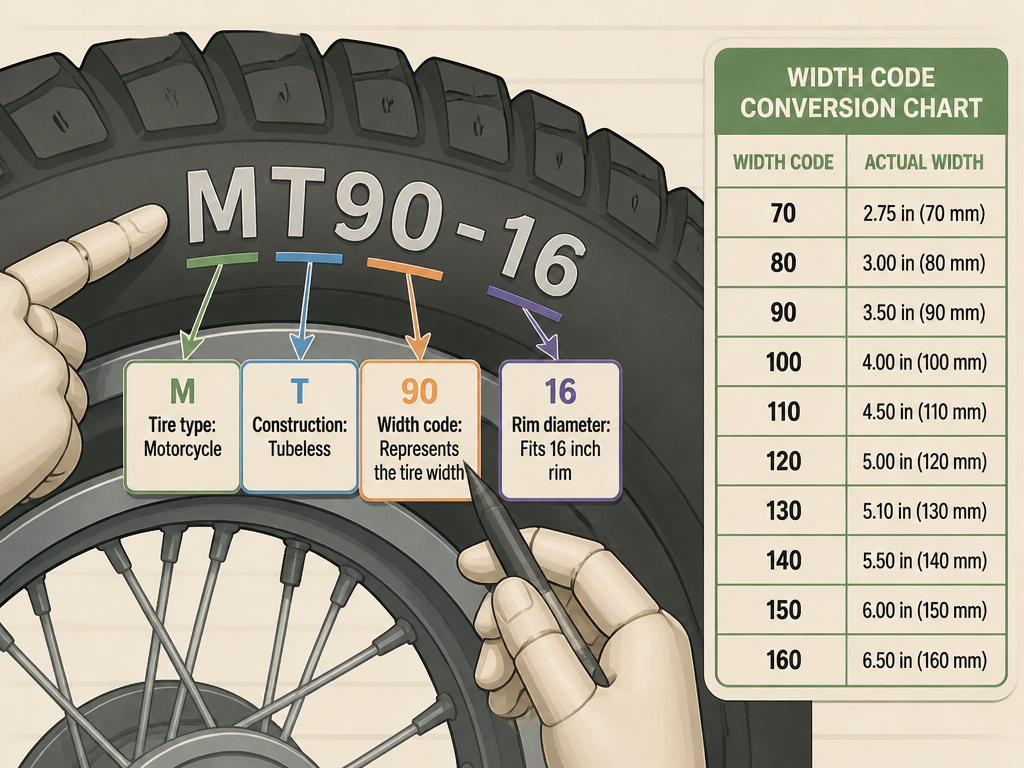
Older motorcycles, cruisers, and some off-road bikes use an alphanumeric or inch-based sizing system. It looks different, but it conveys the same information: width, aspect ratio, and rim diameter.
A size like MT90-16 works like this:
- M: Stands for “Motorcycle”.
- T: A width code. You need a conversion chart. A ‘T’ is a width code; you need a conversion chart to find the corresponding width.
- 90: The aspect ratio, again a percentage. A 90 means the sidewall height is 90% of the tire’s width.
- 16: The rim diameter in inches.
Another common format is the simple inch size, like 4.00-18. Here, the first number is the approximate cross-section width in inches (4.00 inches). The second number is the rim diameter (18 inches). The aspect ratio is assumed to be roughly 100%, meaning the tire’s height and width are about equal—a classic “balloon” profile.
Three-number tire sizes for ATVs, like those explained here, work on a similar principle but are even simpler, stating height, width, and rim diameter directly.
Construction Types: Radial vs. Bias-Ply
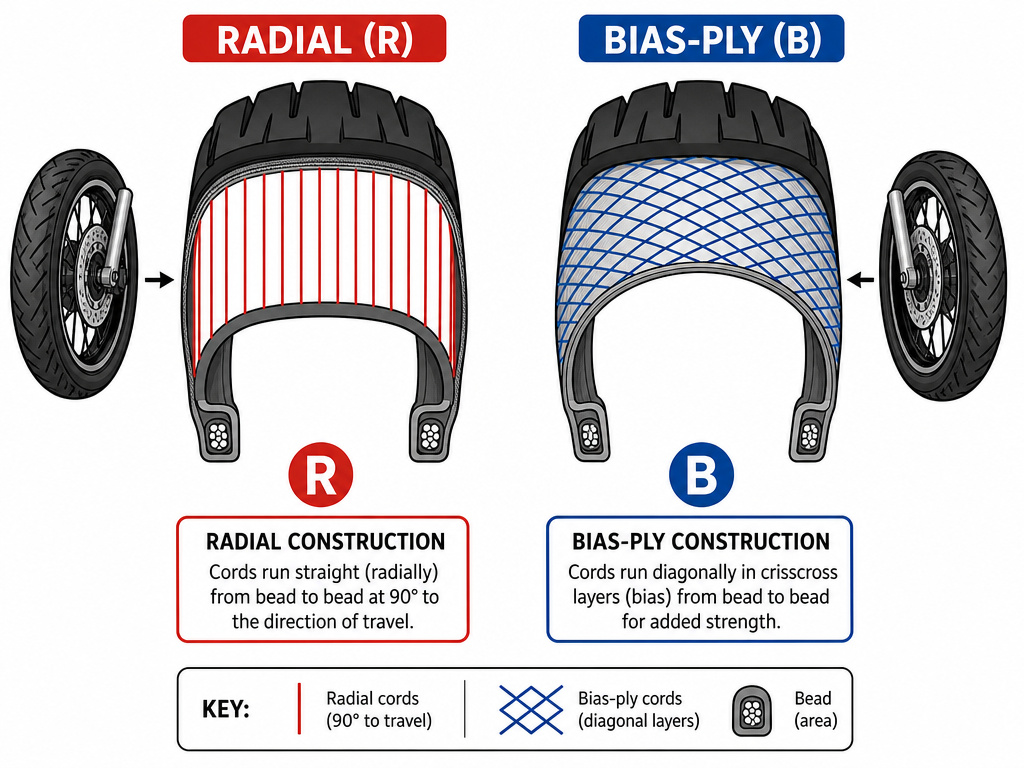
The construction letter changes how the tire works. It’s not just a material choice; it’s a fundamental design philosophy that affects grip, wear, and feel.
A radial tire (marked with ‘R’) has ply cords that run perpendicular to the direction of travel. This allows the crown to stay rigid for stability and grip, while the sidewall remains flexible for comfort. You get better high-speed stability and a larger contact patch when leaned over. Most modern sport and touring bikes use radials.
A bias-ply tire (often with no letter or marked ‘B’ for bias-belted) has ply cords that crisscross at angles. The entire structure is more uniform, making it durable and good for carrying heavy loads. They’re common on cruisers, classics, and some off-road bikes.
Never mix radial and bias construction on the same motorcycle. The UK MOT manual spells out illegal combinations: a bias-belted front with a cross-ply rear, or a radial front with a cross-ply/bias-belted rear. The different flex rates can make the bike feel vague or unpredictable mid-corner.
Tread Depth, Wear Bars, and When to Replace
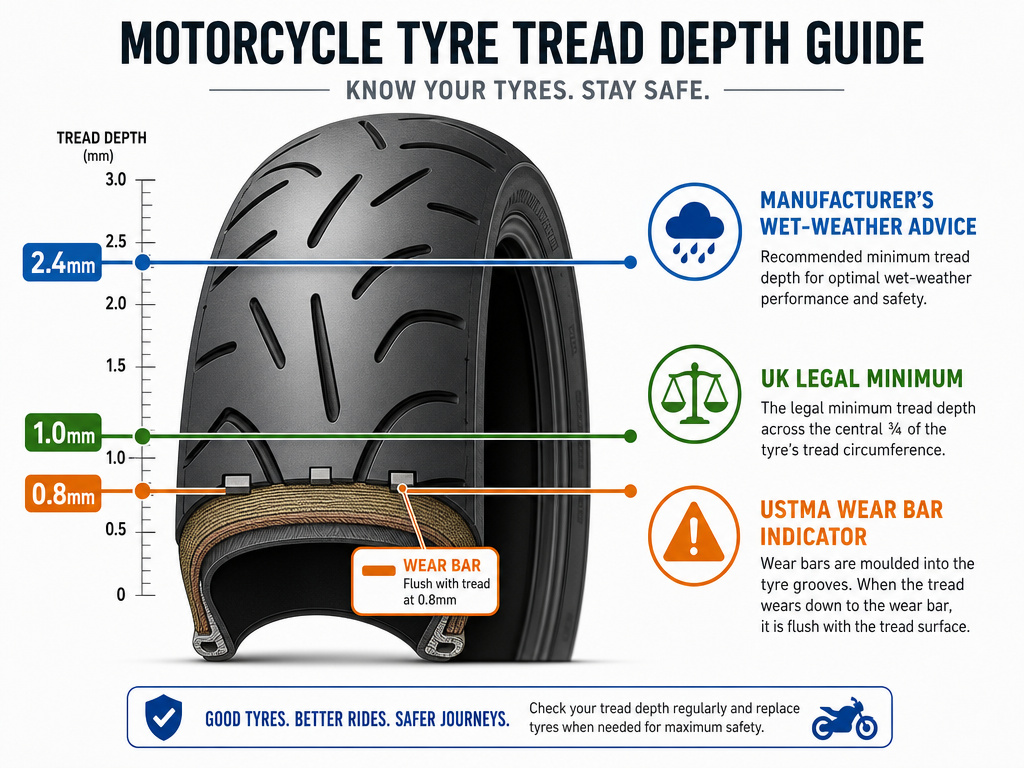
This is where official advice splits. Knowing the numbers keeps you legal and safe.
The UK Government MOT manual sets the legal minimum tread depth at 1.0mm. This must be present across 3/4 of the tread’s breadth and around the entire circumference. For bikes 50cc and under, a visible tread pattern is required instead of a measured depth.
Meanwhile, the U.S. Tire Manufacturers Association guide states that the wear bars (those little rubber bridges in the tread grooves) become flush when tread depth reaches 1/32 of an inch, which is approximately 0.8mm. That’s below the UK legal limit. The USTMA also notes that some manufacturers recommend replacement at 2/32″ or 3/32″ before the wear bars are even exposed.
| Tread Depth Guideline | Measurement | Who Says It | What It Means |
|---|---|---|---|
| Legal Minimum (UK) | 1.0 mm | UK MOT Manual | Below this depth, the tire fails its safety inspection. |
| Wear Bar Indicator | ~0.8 mm (1/32″) | USTMA Guide | Visual cue that tread is very low. |
| Early Replacement Advice | 1.6 – 2.4 mm (2/32″ – 3/32″) | Some Manufacturers | Recommended replacement point for optimum wet-weather safety. |
The takeaway? The wear bar is your absolute minimum. For the best wet-weather grip, plan to replace your tires when you have about 2/32″ of tread left. A worn tire channels less water, increasing the risk of hydroplaning.
Other replacement triggers are absolute. Replace the tire if you see any cracks (dry rot), bulges in the sidewall, or if the cords are exposed in a cut. Any puncture in the sidewall is unrepairable. And remember the age rule: ten years from the DOT date, no matter what.
Direction, Rotation, and Other Critical Markings
The sidewall has other mandatory information. Missing it can make a correctly sized tire unsafe.
Directional Arrows: Many performance tires have an arrow on the sidewall with the word “Rotation.” This tire must be mounted so it rolls in the direction of the arrow. Mounting it backwards ruins its water-evacuation design and grip.
Tubeless vs. Tube-Type: Look for the words “Tubeless” or “Tube Type.” A tubeless tire seals directly against the rim. A tube-type tire requires an inner tube, common on bikes with spoked wheels. The USTMA guide is clear: install a new tube every time you replace a tube-type tire.
OE Markings: Some tires have extra codes like “MO” for Mercedes-Benz. For motorcycles, you might see a specific manufacturer’s approval marking. These original-equipment (OE) tires were developed with the bike maker for specific handling traits. Switching to a non-approved tire of the same size can subtly change the bike’s feel.
Checking your motorcycle tire pressure is the final, crucial step. Use the motorcycle manufacturer’s recommended PSI, found on a sticker on the swingarm or in the manual, and always check when the tires are cold.
How to read tubeless or tube-type markings
Look for the word ‘Tubeless’ or ‘Tube Type’ molded on the sidewall. A tire designed for tubeless use will typically have the word ‘Tubeless’ molded into it. A tire requiring an inner tube will be marked ‘Tube Type’ or may have no specific marking, which generally indicates it needs a tube. For a tubeless rim, you must replace the rubber valve stem or the valve core and grommet when mounting a new tire. If you’re replacing a tube-type tire, always install a new inner tube. Certain spoked rims designed for tubeless use, identified as ‘MTM’, require a special rim seal for proper fitment.
What are OE or homologation markings
Some motorcycle manufacturers specify tires developed specifically for their models. These original equipment (OE) tires will carry a manufacturer’s approval marking on the sidewall. This marking indicates the tire meets the exact performance and handling criteria set by the bike’s maker. Replacing an OE-approved tire with a non-approved alternative of the same size may change the motorcycle’s handling characteristics. Your owner’s manual or the bike’s tire information label will specify the required speed and load ratings, which any replacement tire must meet or exceed.
Frequently Asked Questions
What does the 2.75 mean on a motorcycle tire?
Size like 2.75-18 is an inch-based measurement. The 2.75 is the tire’s approximate cross-section width in inches. This format is common on older and classic motorcycles.
How wide is a 140/80-18 motorcycle tire?
The first number in a metric size is the width in millimeters. A 140/80-18 tire is 140 millimeters wide. The 80 is the aspect ratio, meaning the sidewall height is 80% of the width (112mm). The 18 is the rim diameter in inches. If you need to convert tire measurements to inches for comparison, the process is straightforward.
Can I put a wider tire on my motorcycle rim?
Not without checking. The tire width must be compatible with your rim’s width. A tire that’s too wide for a narrow rim can pinch, distorting its profile and reducing the contact patch. A tire that’s too narrow for a wide rim can stretch, making it more vulnerable to damage. Always consult your motorcycle’s manual or a tire fitment guide for the approved range of tire widths for your specific rim size.
What’s the difference between a ZR and an R tire?
The ‘Z’ in a size like 120/70ZR17 is a legacy speed rating indicator. It signifies the tire is rated for speeds over 149 mph. Today, the exact speed capability is defined by the speed rating letter (like W or Y) in the service description. So, a ZR tire will always have a high speed rating (V, W, or Y), while a standard R tire could have a lower rating like H. Always confirm the actual speed symbol.
Before You Go
Reading a tire sidewall is a transferable skill. Once you can decode a 120/70R17, you can apply similar logic to read tire sidewall markings on a car or truck. The formats differ, but the logic—width, profile, construction, rim size, load, speed—is consistent.
The most common mistake is focusing only on the big size numbers and ignoring the load index, speed rating, and DOT date. A tire that fits the rim but can’t handle the weight or speed of your bike is dangerous. And a tire that’s already six years old when you buy it has lost a significant portion of its safe service life before it’s even mounted.
Check the date code. Match the load and speed. Never mix constructions. Those three rules filter out the majority of bad tire decisions. The rest is about matching the types of motorcycle tires—sport, touring, adventure—to how you actually ride.
