
Minus Sizing for Winter Tires: The 3% Rule Explained
This post contains affiliate links. As an Amazon Associate, we earn from qualifying purchases.
Minus sizing for winter tires means installing smaller-diameter wheels with taller, narrower tires to keep the vehicle’s overall rolling diameter within 3% of the original. This narrower tread cuts through snow better, the extra sidewall absorbs potholes, and the smaller wheels are often cheaper. The critical rules: match or exceed the original load index, stay within the ±3% diameter tolerance, and install winter tires on all four wheels.
That 3% figure isn’t a suggestion. It’s the threshold Continental Tire sets before your speedometer, anti-lock brakes, and stability control start reading the road wrong. Go outside it, and you’re not just risking a ticket for incorrect speed, you’re disabling the electronic systems that keep you pointed straight on black ice.
What follows is the spec-first method. We’ll walk through the three essential numbers on your door placard, untangle the conflicting advice from manufacturers, and show you how to use a calculator to find a size that’s both safe and effective. By the end, you’ll know exactly how to trade width for grip without gambling on your car’s electronics.
Key Takeaways
- The load index on your replacement tire must be equal to or greater than the factory specification, a lower number risks tire failure under load.
- Stay within ±3% of the original overall tire diameter to avoid throwing off your speedometer, odometer, and vehicle stability systems.
- Install winter tires on all four wheels; putting them only on the drive axle dangerously unbalances the car’s handling, especially during braking.
- Swap to winter tires when daytime highs consistently sit at or below 7°C (45°F), the temperature where summer tire compounds harden and lose grip.
- For All Wheel Drive and 4 Wheel Drive vehicles, replace all tires on the vehicle with the same size tire unless the vehicle came from the vehicle manufacturer with a “staggered” tire fitment.
What Minus Sizing Actually Does (And Why It Works)
Forget looks. This is a physics swap. You’re trading a wide, low-profile summer tire for a narrower, taller winter one on a smaller wheel. The goal is to keep the total tire height almost identical.
A narrower tire concentrates the vehicle’s weight onto a smaller contact patch. This increases pressure per square inch, helping the tread blocks bite down through slush and soft snow to find pavement underneath. The taller sidewall isn’t just for pothole protection, it provides more flex, which can help the tread conform to uneven, frozen surfaces.
I used to think wider was always better for grip. Then I watched a test in a snowy parking lot. A car on narrower winter tires pulled away cleanly from a stop, while one on wider all-seasons just spun its wheels, floating on top of the snow. The wider tire had more surface area, but it was the wrong kind of grip for the job. It was trying to float; the narrow tire wanted to dig.
The benefits are straightforward:
- Improved Snow Traction: The narrower footprint cuts through rather than planes over.
- Pothole and Curb Protection: More rubber between the rim and the road.
- Cost Savings: Smaller diameter tires, especially in common 16- or 17-inch sizes, are typically 30–40% cheaper per tire than larger, low-profile sizes. Steel wheels for your winter set also cost a fraction of alloy replacements.
The Non-Negotiable Specs: Load, Speed, and Diameter
This is where you read the sidewall, not the brochure. Your vehicle’s door placard holds the three numbers that can’t be compromised.
1. Load Index: The Floor, Not a Target
This number (e.g., 95, 101, 115) represents the maximum weight each tire can carry. The rule from Continental Tire and CarWheelData is that your replacement tire’s load index must be equal to or greater than the original, while Kia specifies snow tires should have the same load capacity as the original tires. Going lower is a safety risk. A narrower winter tire might need an “XL” (Extra Load) or “Reinforced” construction to meet this number, don’t settle for less.
2. Speed Rating: The Winter Exception
Your original tire has a speed symbol (T, H, V, W). For winter, the rules relax, with a caveat. Both Continental Tire and the USTMA state it is generally acceptable to use a winter tire with a lower speed rating than the OE tires, with the caveat that the vehicle’s speed must be restricted accordingly. However, you must restrict your driving to the maximum speed of that lower-rated tire. Some manufacturers, like Porsche, mandate using tires with the same speed index. The safe move is to match it if you can, but if you opt for a lower rating like a ‘T’ (118 mph), you must drive accordingly.
3. Overall Diameter: The 3% Rule
This is the core of minus sizing for winter tires. The new tire’s overall height must be close to the old one’s.
| Source | Recommended Tolerance | Consequence of Exceeding It |
|---|---|---|
| Continental Tire | ±3% rolling circumference | Speedometer error, potential ABS/ESP system interference |
| CarWheelData | ±2% overall diameter | Stricter recommendation for winter fitments |
Sources disagree on the acceptable tolerance: Continental Tire states a change within ±3% rolling circumference usually doesn’t require adjustments, while CarWheelData recommends staying within ±2% overall diameter. Use a tire size calculator to check any new size against your original.
Where this goes sideways: Choosing a size that changes the diameter by more than 3%. Your speedometer will be off by a measurable amount (showing 60 mph when you’re actually doing 62), and your anti-lock brakes might react a fraction of a second late because the wheel speed sensors are getting false data. That fraction matters on ice.
Step-by-Step: How to Find Your Safe Winter Size
Follow this sequence. Skipping a step is how you end up with a set of tires that don’t fit or void a part of your vehicle warranty and tire size coverage.
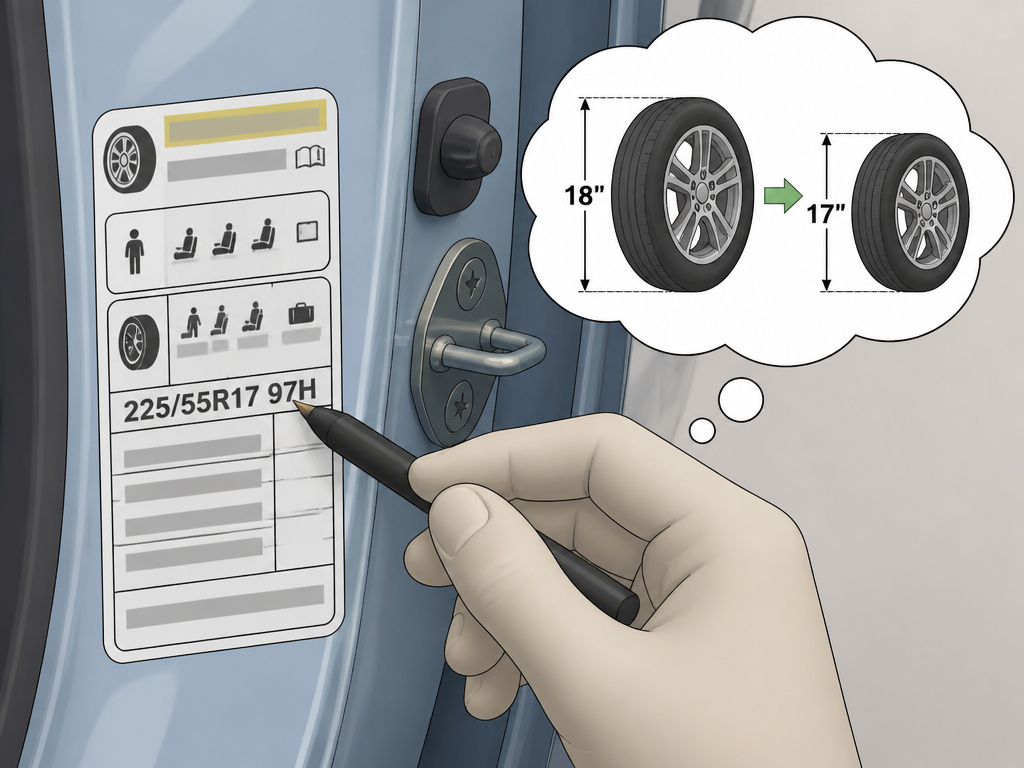
- Read Your Door Placard. Find the original tire size (e.g., 225/55R17 97H). Note the load index (97) and speed rating (H). This is your bible.
- Check Your Owner’s Manual or OEM List. Some manufacturers, like Kia, explicitly recommend the same size for snow tires. Others publish a list of approved alternative sizes. This list is your safest starting point for finding equivalent sizes.
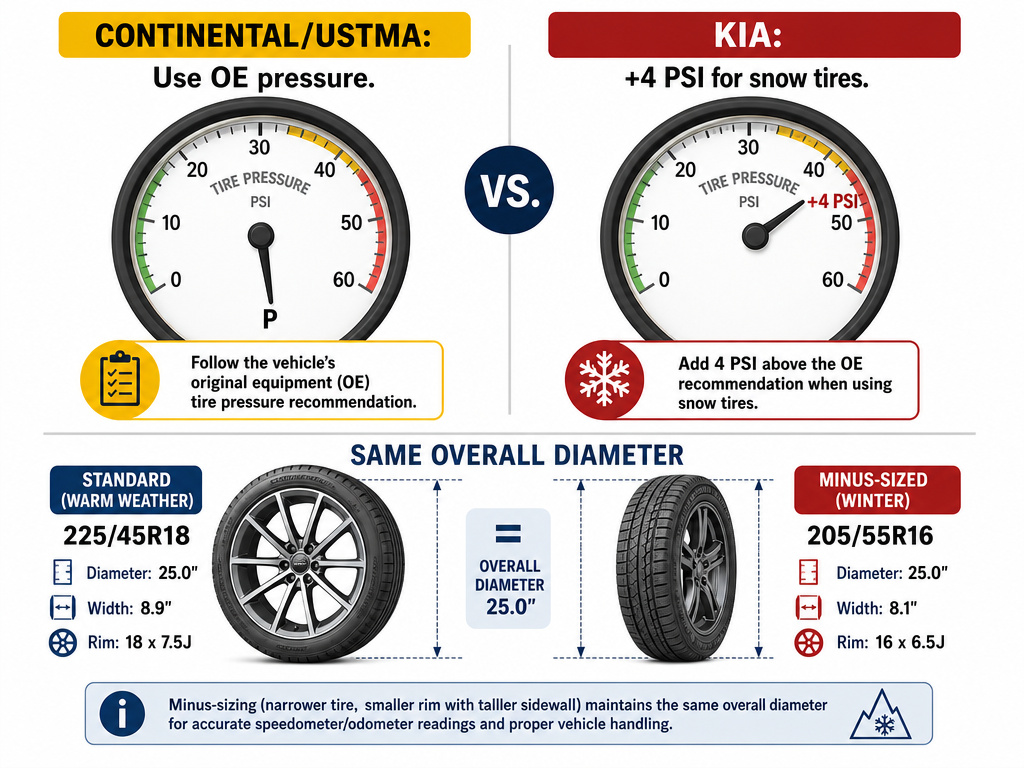
- Apply the “Minus-One” Concept. The common practice is to reduce the wheel diameter by one inch (e.g., from 18″ to 17″) and increase the tire’s aspect ratio (the middle number) to maintain overall height. Simultaneously, reduce the width to maintain an appropriate fit and performance. Example: 235/50R18 → 225/55R17.
- Verify with a Calculator. Input both the original and proposed sizes into a reliable tire size calculator tool. Confirm the overall diameter change is within 3%. Double-check that the new tire’s load index meets or beats the original.
- Confirm Rim Compatibility. Your new tire must be mounted on a rim width approved for its size. The new, smaller steel or alloy wheel must also clear your vehicle’s brake calipers. This information is often in the owner’s manual or available from the wheel retailer.
Navigating the Contradictions: Pressure, Diameter, and Philosophy
Manufacturers and industry bodies don’t always agree. Here’s how to parse the conflicting advice.
Tire Pressure: To Add or Not to Add?
- Continental/U.S. Tire Manufacturers Association Stance: Never use a pressure lower than the OE recommendation. Maintain the front/rear pressure relationship.
- Kia’s Stance: Snow tires should carry 4 psi (28 kPa) more than the standard tire pressure on the label.
Sources disagree on recommended pressure for winter tires: Continental Tire and USTMA advise never using a pressure lower than the OE recommendation, while Kia recommends snow tires carry 4 psi (28 kPa) more than the standard tire pressure.
The “Same Size” vs. “Minus Size” Debate
Kia’s manual says snow tires should be “the same size.” Meanwhile, technical guides from CarWheelData and the entire concept of plus sizing in reverse endorse minus sizing for winter tires. This isn’t a true contradiction. Kia’s statement is a simplified, fail-safe rule. The technical practice of minus-sizing, using an approved, smaller rim with a taller, narrower tire that maintains overall diameter, is the engineered method for better winter performance. It’s permitted as long as the final specs (load, diameter) are correct.
Winter Tire Rules Beyond the Size
Getting the size right is only half the job. These rules govern how you use them.
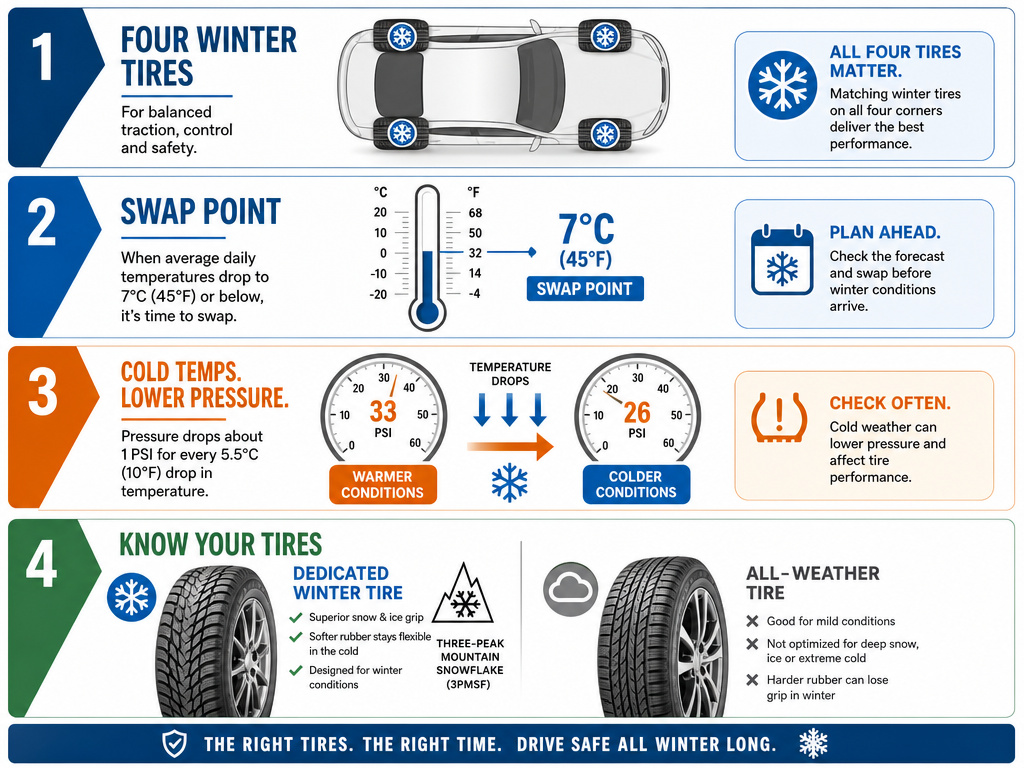
- All Four Corners: This is a strict requirement. The U.S. Tire Manufacturers Association bulletin is blunt: if winter tires go on the front, they must also go on the rear. Installing them only on the drive axle creates a dangerous traction imbalance that can cause spin-outs during braking or cornering.
- The 7°C (45°F) Swap Rule: This isn’t an arbitrary date. Summer tire compounds begin to harden and lose elasticity below this temperature. The industry rule of thumb for swapping to winter tires is when daytime highs consistently sit at or below 7°C. Swap back when overnight lows stay above 7°C in spring.
- Pressure Drops with Cold: A tire set to 33 PSI in a warm garage (+20°C) will read about 26 PSI on a -20°C morning. The standard rule is a loss of roughly 1 PSI per 10°F (5.6°C) drop in ambient temperature. Check and adjust pressures frequently through the winter.
- Dedicated Winter vs. All-Weather: Know what you’re buying. Dedicated winter tires (with the Three-Peak Mountain Snowflake symbol) outperform all-weather tires below -10°C and on ice. All-weather tires with the 3PMSF symbol are a compromise for milder climates.
Frequently Asked Questions
Do you size up or down for winter tires?
You size down. The practice is called “minus-sizing” or “downsizing.” You install a smaller-diameter wheel with a taller, narrower tire to maintain the vehicle’s original overall tire diameter. This improves snow traction and pothole protection.
What is the 3% rule for tire size?
The 3% rule states that the replacement tire’s overall rolling circumference should be within plus or minus 3% of the original tire’s circumference. Staying within this limit, according to Continental Tire, generally prevents issues with the speedometer, odometer, anti-lock brakes (ABS), and electronic stability control systems.
What is the 7°C rule for winter tires?
The 7°C rule (also 45°F) is the temperature threshold for changing tires. Summer tire compounds begin to harden and lose grip below 7°C. You should install winter tires when daytime high temperatures consistently reach 7°C or lower, and remove them when overnight low temperatures stay above 7°C in spring.
Which size wheels are better for winter, 17-inch or 18-inch?
For winter driving, the smaller wheel size is almost always better, provided it fits over your brakes. A 17-inch wheel allows for a tire with a taller sidewall than an 18-inch wheel using the same overall diameter. This taller sidewall improves ride comfort over rough winter roads and offers better protection against pothole damage to the wheel itself.
The Bottom Line
Minus sizing works because it trades dry-road bragging rights for actual cold-weather competence. The narrower tire cuts, the taller sidewall cushions, and the smaller wheel saves money. It’s the engineering-correct answer for the hard season.
Sources disagree on snow tire size: Kia states snow tires should be the same size as the original, while technical guides from CarWheelData and trustedlocalauto.com endorse minus-sizing with a diameter-matched alternative. But never, ever ignore the three hard numbers: load index, speed rating, and the 3% diameter window. They are the guardrails.
Finally, match the tire to the season, not to the car’s summer personality. A high-performance summer compound is a liability on a frosty morning, just as a deep winter tread is a waste on a dry, hot road. The right tool for the job isn’t a cliché here, it’s what keeps your car facing the right direction.
