
Summer Tires Pros and Cons: Which Trade-Offs Matter?
This post contains affiliate links. As an Amazon Associate, we earn from qualifying purchases.
Summer tires pros and cons include strong warm-road grip and a narrow cold-weather window. They can offer strong dry and wet handling in mild conditions, but GM says capability drops below 5 C (40 F), and Ford says performance is reduced near 45 F (7 C). You need a plan for storage, swapping, and tread life.
The 5 C and 45 F gap is the practical part. It means a clear forecast, a garage, and a swap plan decide whether the grip is a benefit or a liability.
What follows covers grip benefits. It covers cold limits, two-set logistics, and tire specs.
Key Takeaways
- GM puts traction risk at 5 C (40 F), while Ford warns near 45 F (7 C).
- GM says to avoid driving Corvettes equipped with Michelin Pilot Super Sport ZP and Pilot Sport 4S ZP tires below 20 F (-7 C).
- GM recommends warming cold-stored summer tires to at least 40 F (5 C) for 24 hours or more before inflating.
- NHTSA says traction grades miss cornering grip
What summer tires do well in warm, dry, and wet conditions
Dry grip is the clearest benefit. Kia’s 2024 owner manual summer tire section says summer tires provide superior performance on dry roads. Nissan’s 2025 Qashqai summer tyres manual page says they perform well in typical mild weather.
Summer tire advantages appear mainly in mild, dry, and warm wet conditions, where tread patterns and rubber compounds can support braking and steering response. The drawbacks appear when pavement temperature falls, because the same compound hardens and reduces grip. Manufacturer guidance places the practical caution zone near 5 C (40 F), with some guidance near 7 C (45 F).
When the pavement is warm, a summer tire can feel firm and direct through the steering wheel. That matters. The tread pattern and rubber compound are where the differences show up, but the published grades here don’t rate those features directly.
NHTSA’s traction grade is a braking grade. It measures straight-ahead braking only. That means a high traction letter doesn’t prove cornering grip or hydroplaning resistance.
One forum claim says summer tires are only for dry roads. Kia says they provide superior performance on dry roads, and Nissan says they perform well in mild weather. The claim gets the dry part right. It misses the warm wet part.
A review of performance tires should cover dry grip, wet braking, and cold limits. The best summer performance tires fit warm, dry roads, and they need a storage plan before cold weather arrives.
Where Do Summer Tires Lose the Argument?
5 C (40 F) is where GM starts to worry. GM’s technical service bulletin 13-03-10-001J states the 5 C (40 F) limit. Ford puts its use threshold near 45 F (7 C). The difference matters when mornings swing around 40 F.
| Threshold | GM guidance | Ford guidance |
|---|---|---|
| Reduced capability | Below 5 C (40 F) | Approx. 45 F (7 C) |
| Damage or no-drive | Below 20 F (-7 C) | Not stated |
| Storage minimum | GM: Above 20 F (-7 C) | Ford: Above 19 F (-7 C) |
| Warm-up target | At least 40 F (5 C) for 24 hours | Above 41 F (5 C) for 24 hours |
The line for too cold for summer tires is easier to miss when the forecast says ‘mild’ but the pavement is near 40 F (5 C) or 45 F (7 C), depending on the manufacturer. This is harder than it looks. A 40 F morning can feel mild, and the tire won’t signal lost grip.
Before you start: GM says to avoid driving, moving, or test-driving Corvettes equipped with Michelin Pilot Super Sport ZP and Pilot Sport 4S ZP tires below 20 F (-7 C), as operating at such temperatures can cause damage. Inflate only after the tire is above 40 F (5 C), as GM recommends inflating tires only after they have been warmed above that temperature. Never warm tires with direct heat, because GM says heated air can damage them.
Simple. Don’t drive below 20 F (-7 C). GM gives a hard no-drive line below 20 F (-7 C) for Corvettes with Michelin Pilot Super Sport ZP or Michelin Pilot Sport 4S ZP tires.
- Store the set indoors above 20 F (-7 C). If it sits in a garage that dips below that, GM says the tire can be subjected to damage.
- Warm the tires in a heated space to at least 40 F (5 C) for 24 hours or more. Skipping this can leave the tire too stiff for safe mounting or driving.
- Inflate only after the tire is above 40 F (5 C).
- Inspect the tires before use. GM says cold cracks may not lose air, but tires used cold with tread cracks should be discarded.
GM says cold cracks in tires may be cosmetic and not cause air loss, but are damaging. That’s the part people miss. The tire can look usable and still be compromised.
How Do Summer Tires Compare With All-Season and All-Weather Options?
Decide by the coldest mornings you drive in. When you compare summer vs all-season tires, the real question is seasonal grip, not marketing. Kia says summer tires don’t have the M+S rating on the sidewall. Nissan recommends snow or all-season tires on all four wheels for snowy or icy conditions.
Why two sets change the math
Two sets mean more storage space, more mounting work, and another inspection step (the kind that gets skipped).
A summer tire is like a trail-running shoe. It works well on dry rock, but it is the wrong shoe in a snowstorm. The analogy is rough, but it is useful. Match the tire to the road you will actually drive.
All-season, all-weather, and snow ratings
Forum threads often bring up all-weather tires as a middle ground. Kia’s manual lists M+S as a mud and snow marker. Before buying a one-set tire, verify its specific snow rating on the sidewall or product page. The choice of all-season tires is often simpler when you cannot manage a seasonal swap.
What Do Tire Grades and Wear Data Actually Tell You?
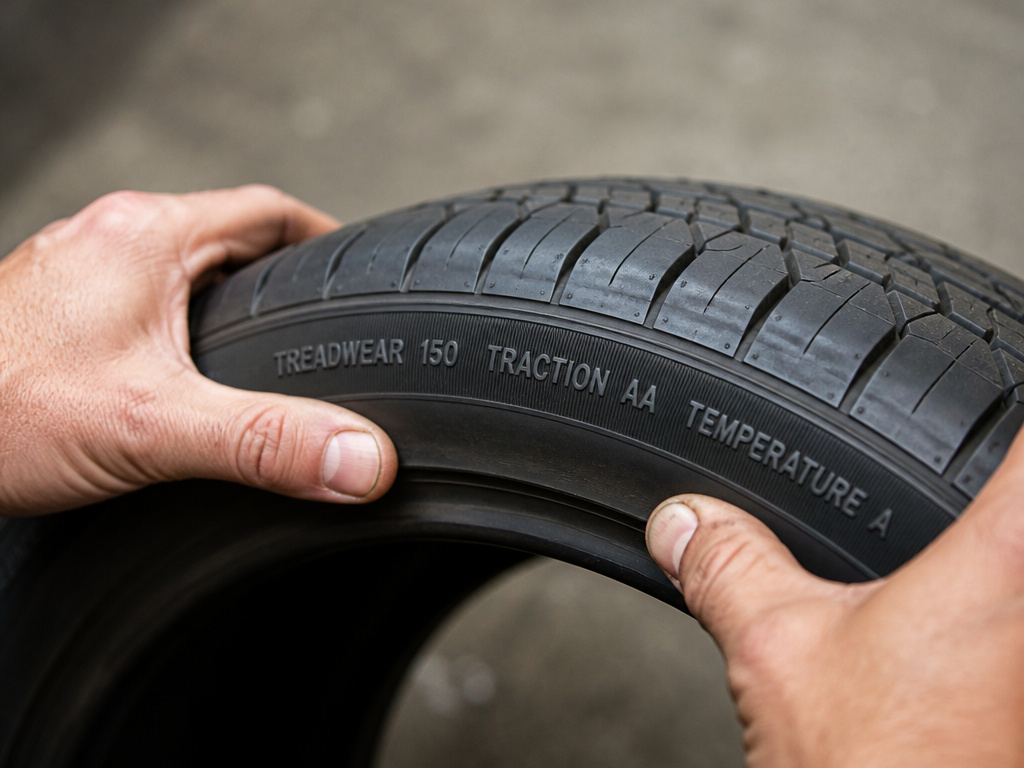
The Uniform Tire Quality Grading system, or UTQG, compares grades. It doesn’t promise mileage. NHTSA’s Uniform Tire Quality Grading guide gives treadwear, traction, and temperature grades. It also says UTQG applies to passenger car tires, except deep tread winter-type snow tires and some other categories.
A 150 grade is 1.5 times a 100 grade, but it doesn’t tell you when grip fades.
| Spec | What it means | What it misses |
|---|---|---|
| Treadwear 150 | 1.5 times grade 100 distance | Real road conditions |
| Traction AA, A, B, C | Straight-ahead braking grade | Cornering traction |
| Temperature A, B, C | Heat resistance grade | Winter grip |
| M+S | Mud and snow marker | Snow rating proof |
Check tire pressure monthly. NHTSA says the correct pressure is on the vehicle tire information label. Use the label as the pressure target. NHTSA’s UTQG gives three grades: treadwear, traction, and temperature.
The Traffic Safety Research study compares warm-weather tire choices. It says cars with at least one winter tire had a 106% higher relative risk of fatal grip-related accidents than cars with four summer tires. The range reflects uncertainty. For newer cars aged 0 to 10 years, it reports a 236% increased risk.
The TSR study reports a 106% higher relative risk of fatal grip-related accidents for cars with at least one winter tire compared to cars with four summer tires.
Summer Tires Pros and Cons: The Climate Line That Decides It
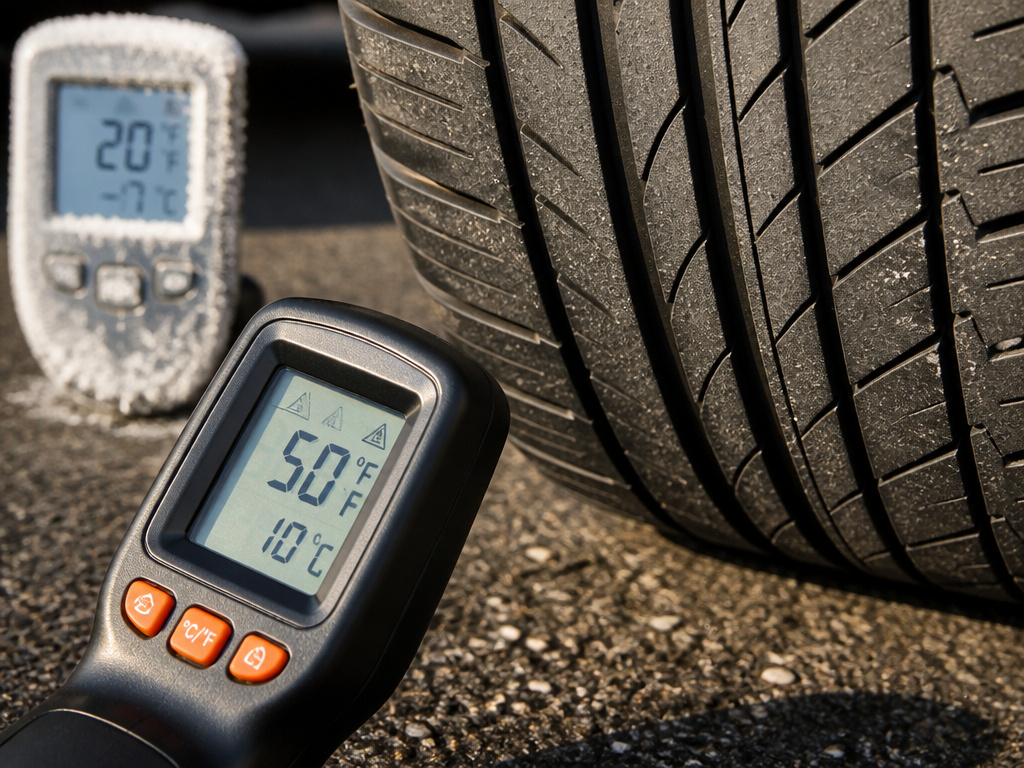
This choice is a climate test. Summer tires make sense when warm roads are the default and cold storage is easy. GM names ultra high performance tires on the 2014-2017 Chevrolet SS, and it says they have reduced capability below 5 C (40 F). That is the core trade-off: strong warm grip, strict cold limits.
Best for performance and sports cars
A Corvette can come with Michelin Pilot Super Sport ZP or Michelin Pilot Sport 4S ZP. GM gives a hard no-drive line below 20 F (-7 C).
I would buy a Michelin Pilot Sport 4S ZP set only for a warm climate with a heated garage. A discussion of track day tires vs street tires can help if you want grip beyond the factory summer set.
Climate-based recommendation
For a dry, mild climate, summer tires can be a choice. For a region with regular sub-40 F mornings, driving on summer tires in winter is the wrong plan. I would rather match the tire to the coldest temperature you actually drive in.
Here’s what actually matters. The storage rule is stricter than the driving rule. It takes work. If you can’t store the tire above 20 F (-7 C), warm it before inflating, and inspect it before use, the summer tire becomes a liability.
Do summer tires improve fuel economy?
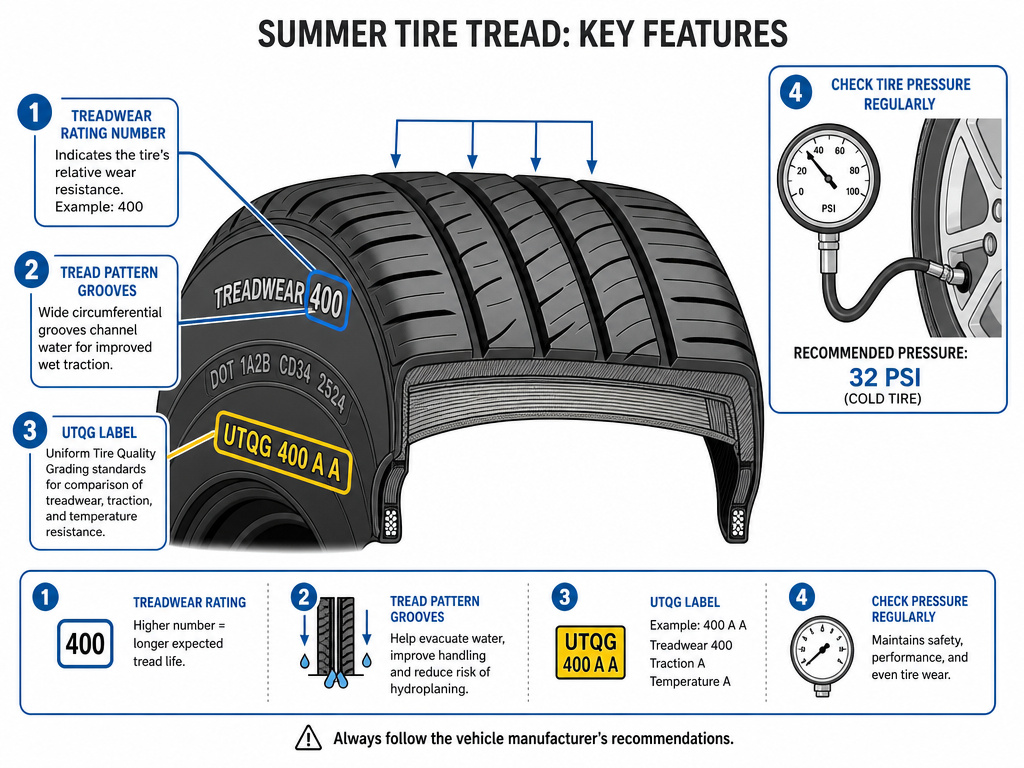
Summer tires do not have a specific fuel economy rating. Their advantage comes from the Uniform Tire Quality Grading (UTQG) system, which includes a treadwear grade. A higher treadwear grade indicates a tire that should last longer, which can be a practical form of economy. The UTQG also provides traction and temperature grades for comparison. To maximize any potential efficiency, maintain the correct tire pressure as listed on your vehicle’s tire information label and check it monthly.
Frequently Asked Questions
What are the main downsides of summer tires?
Cold weather is the main downside. GM says capability drops below 5 C (40 F), and Ford warns near 45 F (7 C). They also need storage and warm-up steps.
Is it better to have all-season tires or summer tires?
It depends on your climate. Summer tires can offer better warm-road grip, while all-season tires are simpler for drivers who can’t manage a seasonal swap. Kia recommends snow or all-season tires for snow and ice.
Can I use summer tires all year round?
No, if you see cold weather. GM says summer tires have reduced capability below 5 C (40 F), and it recommends suitable winter tires below that point. Ford’s threshold is near 45 F (7 C).
What tires should you stay away from?
Avoid summer tires if you can’t store them above 20 F (-7 C) or warm them before use. Also avoid trusting M+S alone as proof of winter capability.
Why do some sources warn about winter tires in summer?
Study published in Traffic Safety Research compares warm-weather tire choices. It reports a 106% higher relative risk of fatal grip-related accidents for cars with at least one winter tire, compared with four summer tires. The study covers warm-weather use. Snow use is outside the comparison.
Before You Go: Summer Tires Pros and Cons in One Decision
If your morning pavement regularly sits below 45 F (7 C), make the swap decision before the first frost. This week, check your garage temperature and the vehicle tire information label. If you live in a mild, dry area and can store tires warm, summer tires can be worth it.
I would rather see a matched set of all-season tires than a neglected summer set on a cold commute. The warm grip is real. The cold warning is also real.
