
Tire Cupping Causes and Fixes: What Your Tread Says
This post contains affiliate links. As an Amazon Associate, we earn from qualifying purchases.
Tire cupping causes and fixes start with one truth: cupping signals a mechanical problem upstream. The scalloped tread you feel means worn suspension, imbalance, or misalignment is bouncing the tire off the road. Fix the mechanical cause first, then evaluate whether the tire can be saved or needs replacement.
That bounce is the key mechanism. When a strut loses damping force or a tire assembly goes out of balance, the contact patch hits the pavement in a repeating pattern of pressure and release. Each impact removes a small amount of rubber. Over a few thousand miles, those small removals become the scooped-out scallop you can feel with your palm.
Below: the three mechanical causes ranked by likelihood, a diagnostic sequence you can run in your driveway, the fix order that prevents you from wasting a tire set, and the maintenance numbers that keep cupping from coming back.
Key Takeaways
- Run your hand across the tread in the direction of rotation; cupping shows up as smooth dips every few inches that a visual glance misses.
- Fix the suspension or alignment first, then evaluate the tire; replacing rubber without addressing the cause just buys you another set of cupped tires in a few thousand miles.
- Bridgestone estimates that balancing alone can extend tire life up to 20%, making it the cheapest cupping-prevention step most owners skip.
- Hyundai recommends rotation every 7,500 miles; Goodyear says 3,000 to 6,000. Follow your vehicle manufacturer’s number, not the tire brand’s.
- Sidewall indentations are cosmetic; sidewall bulges are not. Confusing the two wastes money on a tire that’s fine, or worse, ignores one that isn’t.
Can You Feel Cupping Before You See It?
You pull into a gas station, crouch down, and squint at the tread. Nothing looks wrong. But run your hand across the rubber in the direction the tire rolls, and you feel it: a series of shallow scoops, smooth in one direction, rough in the other, spaced roughly three to four inches apart. That’s cupping, and your fingers caught it before your eyes did.
Bridgestone describes this pattern as looking “as if someone took an ice cream scoop and removed part of the tread every few inches around the tire.” The scoops are the worn spots. The raised sections between them are where the rubber never quite got enough contact pressure to wear evenly.
Tire cupping, also called tire scalloping, is an irregular tread wear pattern where sections of the tread appear scooped out every few inches around the circumference. The pattern results from repeated uneven contact between the tread and the road surface, typically caused by worn suspension components, tire imbalance, or wheel alignment outside factory specification.
The Hand-Check Beats the Penny Test
Here’s the short version. The penny test tells you whether tread depth is uniform. It does not tell you whether tread depth is even around the circumference. A penny inserted into a groove at the three-inch mark reads fine; the groove two inches away is worn a full millimeter shallower. The penny hides that.
Run your flat palm across the entire tread face instead. You’re feeling for the transition from high spot to low spot. Cupped tread has a distinct texture: one direction feels like smooth glass, the opposite direction catches your skin like a file. That directional difference is the diagnostic signature.
For a proper measurement, use a tread depth gauge at multiple points across each tire’s width and around the circumference. Log the numbers. You’re building a baseline that catches cupping at its second or third rotation, not its seventh.
Fair warning: an out-of-round tire can mimic cupping’s vibration. The difference is that cupping shows up in the tread surface itself, while an out-of-round condition shows up as a wobble in the wheel’s rotation. Spin the tire off the ground to check.
What Causes Tire Cupping? Three Mechanical Culprits
The NHTSA technical service bulletin on tire maintenance best practices lists three causes of scalloped wear: worn suspension components, tire imbalance, and wheel alignment out of specification. That’s the full list from the federal service documentation, and it matches what Bridgestone, Goodyear, and USTMA all describe.
Let me walk through each one with the actual mechanism, because “your suspension is bad” is not a diagnosis. It’s a starting point.
The Suspension Connection: Why a Worn Strut Eats Rubber
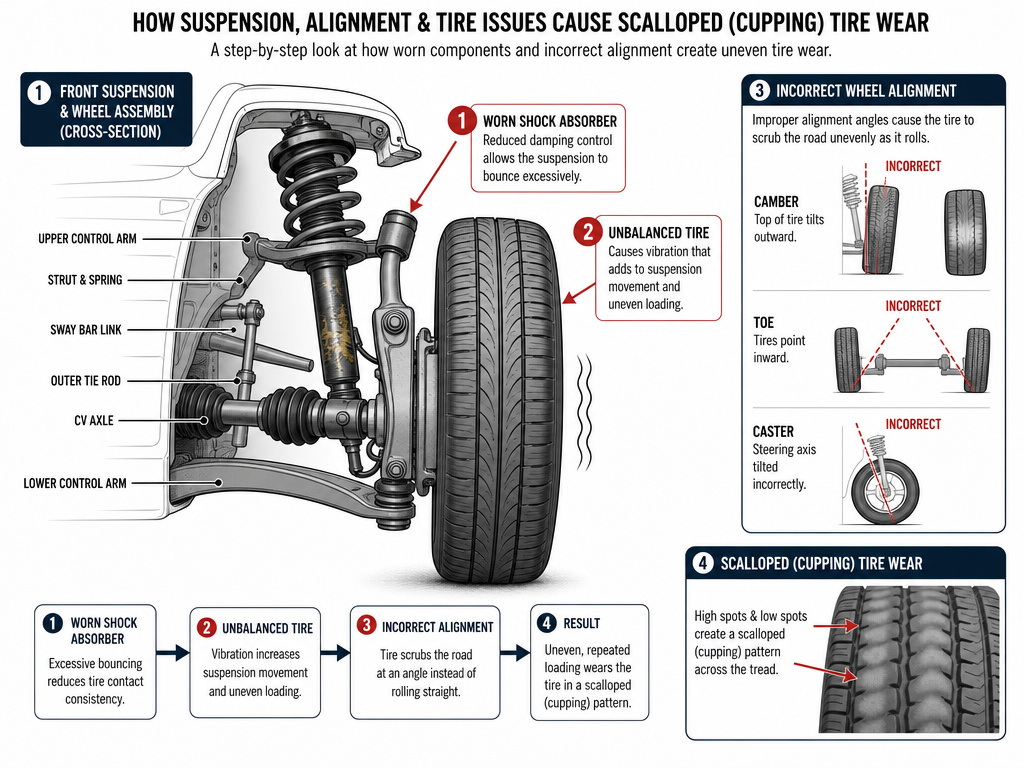
Your shocks and struts exist to keep the tire pressed against the road through bumps. When the internal valving wears out, the strut loses damping force. The tire stops following the pavement and starts bouncing off it. Each bounce is a micro-impact that removes rubber in a concentrated spot. Over hundreds of thousands of revolutions, those spots connect into the scalloped pattern.
The same logic applies to worn suspension components like ball joints and tie-rod ends. USTMA’s tire care documentation specifically names worn tie-rod ends and ball joints as causes of rapid abnormal tread wear. When these joints develop play, the wheel’s contact angle shifts by fractions of a degree on every bump. The tire scrubs instead of rolling.
Goodyear adds a detail worth noting: if the suspension isn’t controlling the wheel properly, “that wheel/tire of the vehicle can bounce more than was designed,” and that excess bounce is what produces the cupping pattern.
Tire Imbalance: The Centrifugal Bounce
An unbalanced tire and wheel assembly creates uneven centrifugal force as it spins. The heavy spot pulls the tire down harder at one point in its rotation, then lifts it slightly at the opposite point. That repeating pressure-release cycle is the bounce that removes rubber in scallops.
Goodyear notes that vibration from unbalanced tires often shows up first as a steering-wheel buzz at specific highway speeds, then later as visible tread cupping. The USTMA tire care manual confirms that out-of-balance wear may be worse at specific speeds, meaning you might feel nothing around town but get a rhythmic hum on the interstate.
Bridgestone puts a number on the value of fixing this: merely having tires balanced can extend their life up to 20%. That’s not a marketing claim; it’s a manufacturer technical page statement. Twenty percent more tread life from a balance job is a valuable cupping-prevention step.
Misalignment: The Scrub That Creates Scallops
When bad alignment pushes toe or camber angles outside spec, the tire doesn’t roll straight. It scrubs sideways against the pavement on every revolution. The scrub removes rubber unevenly across the tread blocks, and the blocks closest to the ground at that moment wear faster than the ones lifting into the air.
The NHTSA pneumatic tire handbook associates abnormal wear features including heel-and-toe and cupping with misalignment. A professional alignment machine measures toe and camber to tight specifications, which is necessary to catch the drift that can produce cupping.
You can often spot the alignment signature before the cupping gets deep: run your hand across the tread and feel for a feathered edge, where the rubber is smooth in one direction and sharp in the other. That feathering is toe wear announcing itself. Cupping is what feathering can become if left unaddressed.
The Fix Sequence That Prevents a Wasted Tire Set
Replacing a cupped tire without fixing the cause is like patching a leak without turning off the water. You’ll do it twice.
The correct order, supported by every primary source I checked:
- Diagnose the mechanical cause. Check signs you need a wheel alignment first (pulling, off-center steering, feathered tread), then inspect struts, ball joints, and tie-rod ends for play or leaks, then verify balance.
- Repair the suspension, alignment, or balance issue. A technician should inspect these parts for looseness, wear, leaks, or damage before deciding what service is needed.
- Evaluate the tire. Measure tread depth at multiple points. Check for the directional hand-feel described above.
- Decide: rotate or replace. This is where sources disagree, and you need to know why.
Common mistake: Rotating tires before fixing a worn strut. The tire moves to a new position, bounces differently, and develops a second cupping pattern. You now have two sets of unevenly worn tires and a suspension that still isn’t fixed.
When Sources Disagree on Repairability
Bridgestone states that the uneven tread wear from cupping “usually cannot be fully restored, but the cause can often be corrected.” USTMA’s documentation says rotation can correct abnormal wear patterns “that were starting to develop.” A retailer blog (TireAgent) flatly says cupping “cannot be reversed” and that noise or vibration means replacement.
These aren’t contradictions. They’re describing different stages of the same problem.
| Stage of Cupping | Bridgestone Position | USTMA Position | Practical Action |
|---|---|---|---|
| Early, barely felt | Cause can be corrected | Rotation may correct starting patterns | Fix cause, rotate, monitor |
| Moderate, visible scoops | Cannot be fully restored | Mechanical problems must be corrected first | Fix cause, evaluate if tire is still safe |
| Severe, noise and vibration | Replacement is practical next step | Emphasizes cause correction | Replace tires, fix cause before new set |
The pattern across all three sources on the tire cupping causes and fixes: fix the mechanical problem first. The disagreement is only about whether the tire itself can be saved, and that depends on how deep the scallops are.
When Replacement Wins
Bridgestone’s manual is specific about the threshold: when the tire is worn to the built-in indicators at 2/32 inch (1.6 mm) or less tread groove depth, the tire is dangerously worn and must be replaced immediately. Hyundai’s service bulletin echoes this: tires should be replaced before the tread reaches the wear indicator.
If cupping has reduced tread depth in the low spots to near 2/32, the tire is done regardless of how much rubber remains in the high spots. The low spots are where traction fails.
Age matters too, and here the sources split again. Hyundai recommends a maximum tire service period of 6 years from new-vehicle purchase. Bridgestone’s manual says tires more than 10 years old should be taken out of service. A spare tire over 10 years old may look like a new tire but should be replaced. These represent different recommendations from vehicle and tire manufacturers.
5,000 or 7,500 Miles? Your Rotation Interval Is a Disagreement
Rotation is the single most effective cupping-prevention habit, because it moves each tire to a position where it wears differently. NHTSA’s Hyundai bulletin states that heel-toe wear “can be minimized by moving the tire to the opposite side of the vehicle.”
But the interval numbers conflict, and you need to know which one to trust:
| Source | Rotation Interval | Condition |
|---|---|---|
| Hyundai (via NHTSA TSB) | Every 7,500 miles | Or sooner if irregular wear develops |
| Goodyear | Every 3,000 to 6,000 miles | Rotation and balance together |
| USTMA | Every 5,000 to 8,000 miles | If no rotation period is specified |
| Bridgestone manual | Every 5,000 miles | If no vehicle manufacturer recommendation |
Sources provide different rotation intervals. Hyundai (via NHTSA) recommends every 7,500 miles for most models, Goodyear recommends 3,000 to 6,000 miles, USTMA recommends 5,000 to 8,000 miles if no period is specified, and Bridgestone recommends 5,000 miles if no vehicle manufacturer recommendation exists. Consult your vehicle’s manual for its specific recommendation.
Bridgestone adds a critical step most people skip: after rotation, check and adjust individual tire pressures for the new position. Front and rear axles often carry different loads, so the correct PSI changes when a tire moves from one axle to the other.
The Pressure Check That Takes Two Minutes
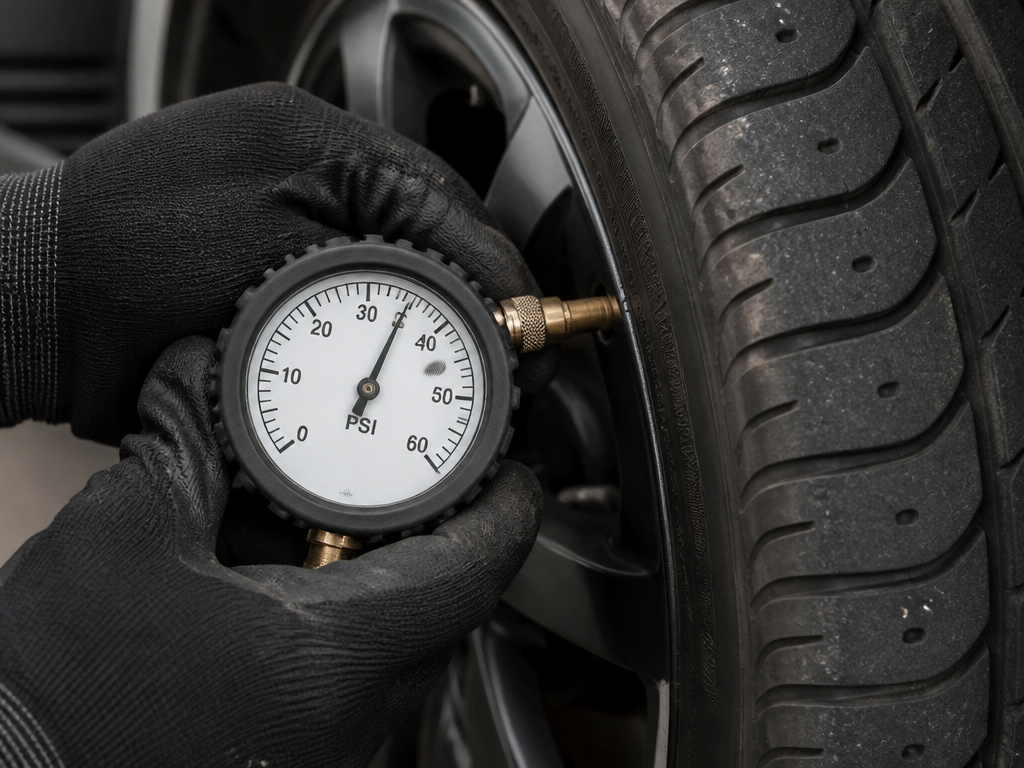
The USTMA tire care manual is blunt about inflation: check pressure at least once per month, before each trip, and each morning during a trip. A cold tire is one that hasn’t been driven for at least 3 hours, or has been driven less than 1 mile. During driving, pressure increases by 4 to 6 psi as the tires warm. Never bleed pressure from a warm tire.
They bought a basic dial-type gauge on my suggestion. After inflating to spec, they wrote back saying the steering felt noticeably different. They hadn’t realized how much a low-pressure tire changes the contact patch until they felt the correction.
That’s the mechanism behind pressure-related cupping. Underinflation increases the sidewall flex and the contact-patch footprint, which shifts where the rubber meets the road. Combined with a tired strut, it accelerates the bounce pattern that carves scallops.
Before you start: Check tire pressure only when tires are cold (parked 3+ hours or driven under 1 mile). A hot-tire reading is 4 to 6 psi higher than the placard spec; adjusting to spec while warm underinflates the tire by that margin. Use an accurate tire gauge for repeatable readings.
Cupping vs. Feathering vs. Heel-Toe: Know the Difference
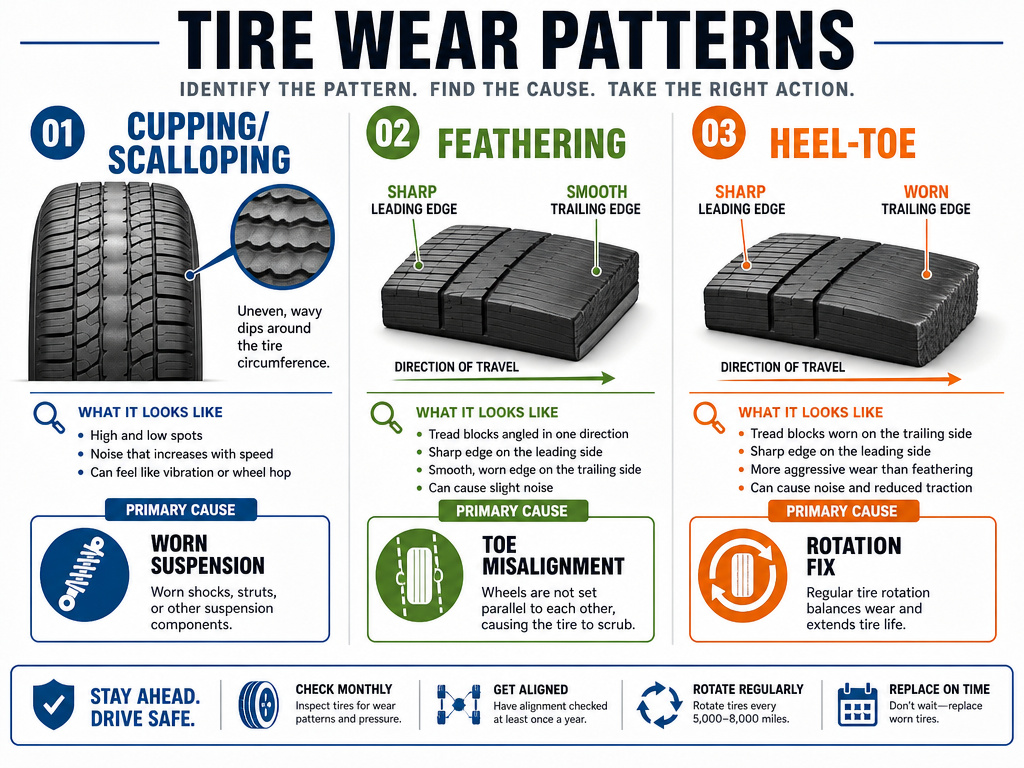
Not every irregular wear pattern is cupping. The NHTSA bulletin documents five distinct wear patterns, and misidentifying them leads to the wrong fix.
| Wear Pattern | What It Looks/Feels Like | Primary Cause | Fix |
|---|---|---|---|
| Cupping/scalloping | Scooped dips every 3-4 inches around the tire | Worn suspension, imbalance, or misalignment | Address mechanical cause, then evaluate tire |
| Heel-toe | Tread blocks worn unevenly front-to-back (leading vs. Trailing edge) | Directional wear on a single axle position | Rotate to opposite side |
| Feathering | Smooth one way, sharp the other across the tread | Toe misalignment | Wheel alignment correction |
| Shoulder wear | Inner or outer edge worn faster than center | Camber or toe out of spec | Alignment correction |
| Center wear | Middle of tread worn more than edges | Overinflation | Correct cold PSI to placard spec |
Feathering and cupping share a mechanism (uneven contact pressure) but differ in geometry. Feathering is a directional edge on each tread block. Cupping is a circumferential scoop across the whole tread face. If you feel feathering, you have an alignment problem that hasn’t yet escalated into cupping. That’s the good news.
The signs your tires need balancing overlap with cupping symptoms: vibration, rhythmic noise, and uneven wear. The difference is that balancing issues show up at specific speeds and produce a smooth bounce, while cupping produces a textured, directional feel in the tread itself.
It points to a different suspension geometry issue than cupping does, and the alignment correction is different too.
Can cheap tires cause cupping?
Tire quality itself is not listed as a direct cause of scalloped wear in the technical bulletins. The documented causes point to mechanical issues like worn suspension components, tire imbalance, or incorrect wheel alignment. A tire’s construction can influence how it responds to these underlying problems. For instance, sidewall indentations are more noticeable on tires with taller sidewalls and higher inflation pressures, but these are considered cosmetic and do not affect performance. The practical guidance is to focus on the vehicle’s mechanical condition and maintenance, as correcting those root causes is what stops cupping from developing, regardless of the tire brand or price point.
Does overloading a vehicle cause tire cupping?
The fact sheets do not specifically cite overloading or aggressive driving as a direct cause of scalloped wear. The primary technical causes identified are worn suspension parts, tire imbalance, and misalignment. However, consistently overloading a vehicle or driving on underinflated tires places extra stress on suspension components, which can accelerate their wear. This indirect effect can lead to the conditions that cause cupping. To prevent this, check your cold tire inflation pressure at least once a month and before long trips, using the pressure listed on your vehicle’s door jamb. Properly inflated tires help the suspension work as designed.
Frequently Asked Questions
What is the most common cause of tire cupping on a single wheel?
Worn shock absorbers or struts on that specific wheel are the most frequent culprit. When the damper fails, it cannot control the spring’s oscillation, causing the tire to bounce and repeatedly impact the road with excessive force in the same spots. This focused impact wears down those specific tread blocks faster than others, creating the scalloped pattern.
Can I just rotate my tires to fix a cupping problem?
No, rotation is a prevention step, not a cure. Moving a cupped tire to another axle will only transfer the vibration and irregular wear, potentially damaging other suspension components. The underlying mechanical fault must be diagnosed and repaired first; only then can you determine if the tire is smooth enough to be rotated or is too damaged and needs replacement.
If I fix the suspension, can the cupped tire wear evenly again?
Once a tire has developed a pronounced cupping pattern, the tread is permanently physically altered. Even after fixing the root cause, the uneven surface will not “wear down” to become smooth. The tire will continue to cause vibration and noise. Its only remaining service life depends on whether the remaining tread depth is sufficient and the roughness is tolerable to the driver.
How often should I check my suspension to prevent cupping?
Incorporate a basic suspension check into every other oil change or tire rotation. Look for visible fluid leaks on shocks or struts, and perform a simple “bounce test” by pushing down firmly on each corner of the vehicle. If it bounces more than once or twice after releasing, the dampers are likely worn. Catching wear early is far cheaper than replacing a full set of prematurely cupped tires.
The Bottom Line
Specs over adjectives. All numbers here came from a manufacturer bulletin, a federal service document, or an industry association manual. The disagreement between sources on rotation intervals and age limits in the tire cupping causes and fixes isn’t sloppy; it reflects different engineering philosophies between vehicle makers and tire makers. Your job is to pick the more conservative number for your situation and write it on a card you keep in the glovebox.
If you notice scalloped tread, the sequence is always the same: diagnose the mechanical cause, fix it, then evaluate the tire. A tire with cupping that still has adequate tread depth in the low spots and a confirmed-good suspension can be rotated and monitored. A tire with severe cupping, persistent noise or vibration, and low tread depth may need replacement, and the mechanical cause should be fixed.
One limitation I’ll flag honestly: my experience is with passenger and light-truck tires. If you’re diagnosing cupping on a fleet vehicle, the numbers above need a fleet-specific service manual, not a consumer blog.
And if your sidewall has wavy indentations, don’t panic. USTMA’s November 2024 service bulletin and a 2024 NHTSA bulletin both confirm that sidewall waviness is a cosmetic characteristic of radial construction, more noticeable on taller sidewalls and at higher pressures. But if you see a bulge, that’s a different problem entirely. Bulges require professional examination and, on a recently installed tire, removal from service. Indentations stretch. Bulges mean separation. Know which one you’re looking at before you spend money.
