
Why Are My Tires so Loud? How to Diagnose Without Buying
This post contains affiliate links. As an Amazon Associate, we earn from qualifying purchases.
If you ask why are my tires so loud, check tread design, wear pattern, pressure, alignment, bearings, and road surface. A federal DOT report says tire noise may become significant at 35-40 mph (56.3-64.6 km/hr), and new tires stabilize after 200 miles (321.8 km).
That list matters because several causes are cheap to rule out before you buy tires. A shop can check pressure, wear, and runout in one visit. A wet-road test can separate tread noise from bearing noise.
The rest walks through seven checks, the speed patterns the data supports, and the self-tests I use before recommending a swap.
Key Takeaways
- 35-40 mph is the DOT speed range where tire noise may become significant.
- 200 miles is the break-in point for tire noise stabilization, per the DOT report.
- Rotate the tires first; if the noise moves, the tire is the suspect.
- Pirelli PNCS with N0 can have foam detachment; NHTSA’s fix is N-Spec replacement.
- Wet-road hiss is normal, but a new thump or one-side whine is not.
Why Are My Tires So Loud? Start With the Noise Type
You hear a steady hum at highway speed. Then a wet road turns it into a hiss. That shift is useful.
Tire noise is produced by tire-pavement interaction, tread block deformation, and air pumping in tread channels. A federal DOT report says tire noise may become significant at 35-40 mph (56.3-64.6 km/hr). A Volkswagen service manual notes wet-road noise is much higher than dry-road noise.
The sound type narrows the search. A hum, a thump, and a whine point to different parts of the tire, wheel, or vehicle.
| Sound | Clue | First test |
|---|---|---|
| Steady hum | Tread pattern or road texture | Note speed and surface |
| Rhythmic thump | Imbalance or tread damage | Inspect tread and wheel |
| One-side whine | Bearing or alignment wear | Turn test at low speed |
| Wet-road hiss | Water in tread channels | Compare dry and wet |
If the sound is a steady drone, the difference between tire humming and bearing noise is worth checking.
New Tires, Break-In, and the 200-Mile Window
200 miles is the number I keep coming back to.
A government pilot study on tire noise cites a 1978 study by Veres. It found tire noise levels stabilize after 200 miles (321.8 km) and do not vary significantly up to 1,000 miles (1,609 km).
So if the tires are brand new and the noise settles by the 200-mile mark, you are hearing normal break-in.
Check these before judging new tires:
- Press the sidewall cold and read the door jamb sticker. Underinflation changes contact shape and can hide wear.
- Drive on dry and wet pavement. The Volkswagen service manual says wet-road noise is much higher.
- Look at the tread pattern. Open shoulders and big blocks can make noise, especially on coarse roads.
If the pattern is aggressive, read about why mud tires are loud before assuming the tires are defective.
Tread Pattern, Compound, and the Aggressive Tire Trap
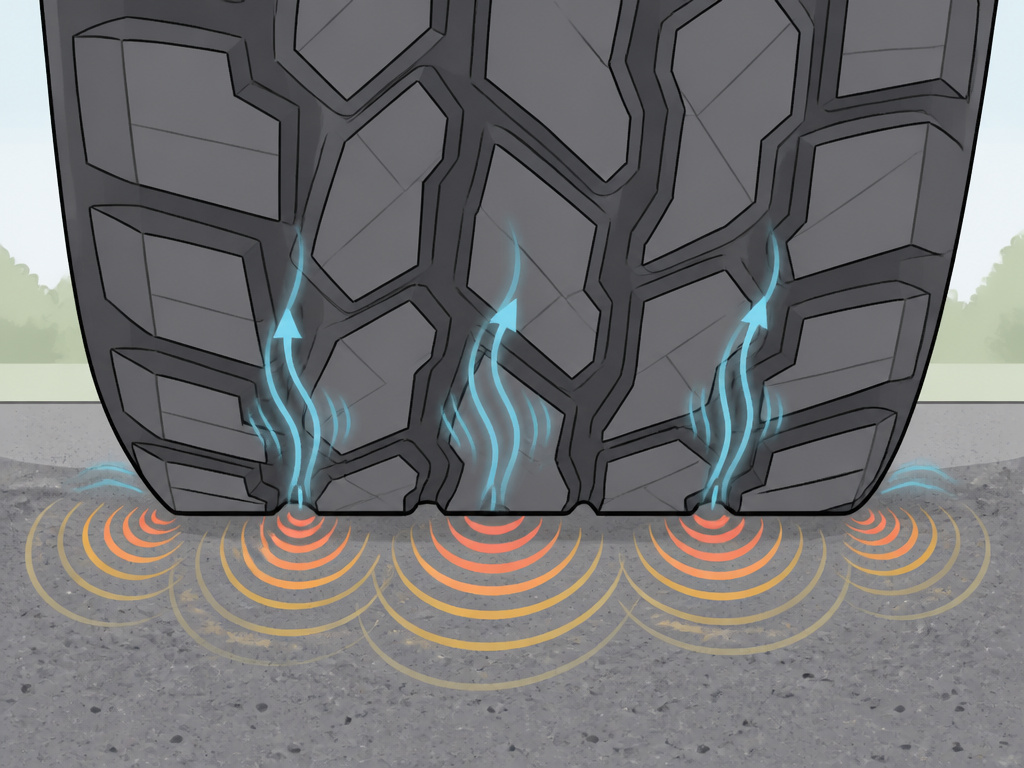
Groove depth is a bad proxy for quiet. Early in my tire-buying years, I recommended a very aggressive pattern for a commuter because the grooves looked deep. On the highway it turned loud, and fuel economy dropped. I learned to weigh pattern, compound, and noise together instead of trusting tread depth alone.
The mechanism is simple. Tread blocks hit the road and deform. Air trapped in channels also pumps in and out. The Volkswagen service manual calls tire vibration the principal cause, while other research, such as a 1978 JASA study, identifies tire vibration and ‘air pumping’ as two co-dominant mechanisms.
That trade-off is the heart of tread pattern noise, and it explains why two tires with the same width can sound different.
What to look for:
- A quiet touring pattern has smaller, staggered blocks and more continuous ribs.
- An open off-road pattern moves more air and slaps more rubber against the road.
- Silica-rich compounds can improve wet grip, but the recipe always costs something.
A coarse open shoulder can sound like gravel pouring under the wheel. The DOT report also says automobile snow tires are noisier than rib tires when new and show more noise increase with wear.
Which Speed Does Tire Noise Become Loud?
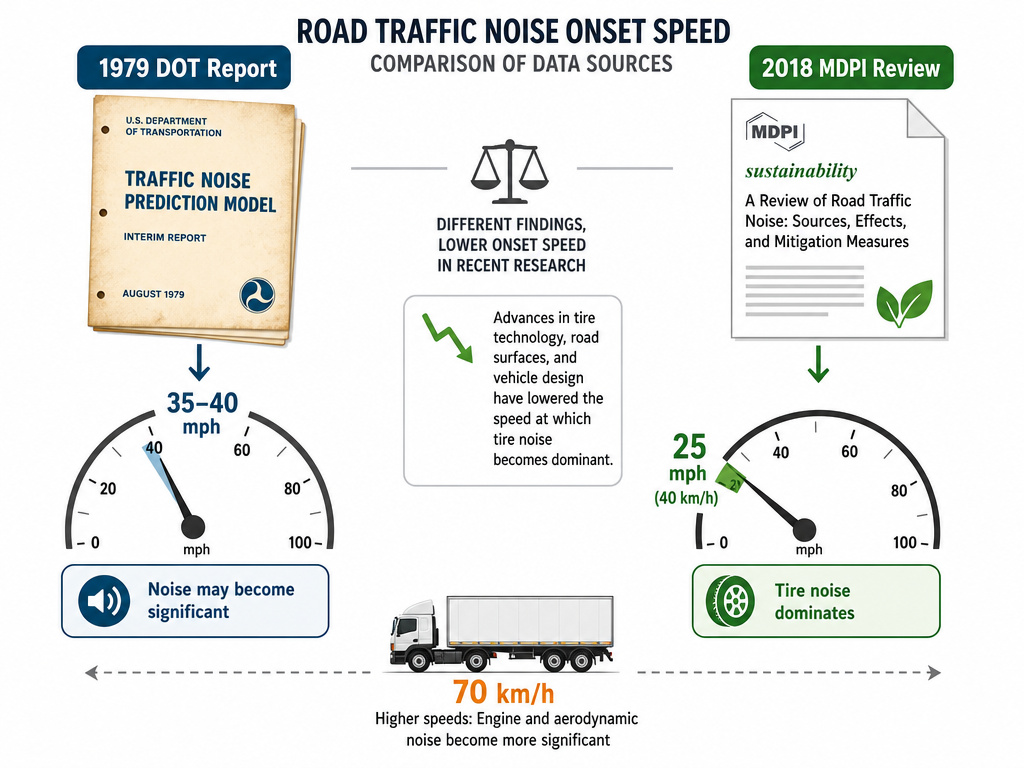
Two documents give different thresholds, and both are useful.
| Source | Passenger-car threshold | Read it as |
|---|---|---|
| U.S. DOT report (1979) | 35-40 mph (56.3-64.6 km/hr) | Noise may become significant |
| MDPI review (2018) | Above 40 km/h (approx. 25 mph) | Tire-pavement noise dominates |
| MDPI truck note | Above 70 km/h | Trucks change the balance |
A 2018 MDPI review article on tire pavement noise defines TPIN as tire-pavement interaction noise. It says TPIN dominates passenger vehicles above 40 km/h (approx. 25 mph). For trucks, it says the threshold is above 70 km/h.
The lower DOT figure is a warning sign. The MDPI figure describes where tire-pavement noise becomes the main event. Road surface and wetness change what you hear.
I won’t swap tires until a rotation test moves the noise. A free spin saves money.
If you’re considering foam-lined tires, check acoustic foam tires before buying them. The acoustics literature is available at a peer-reviewed tire noise study.
How to Diagnose Loud Tires Without Buying Tires
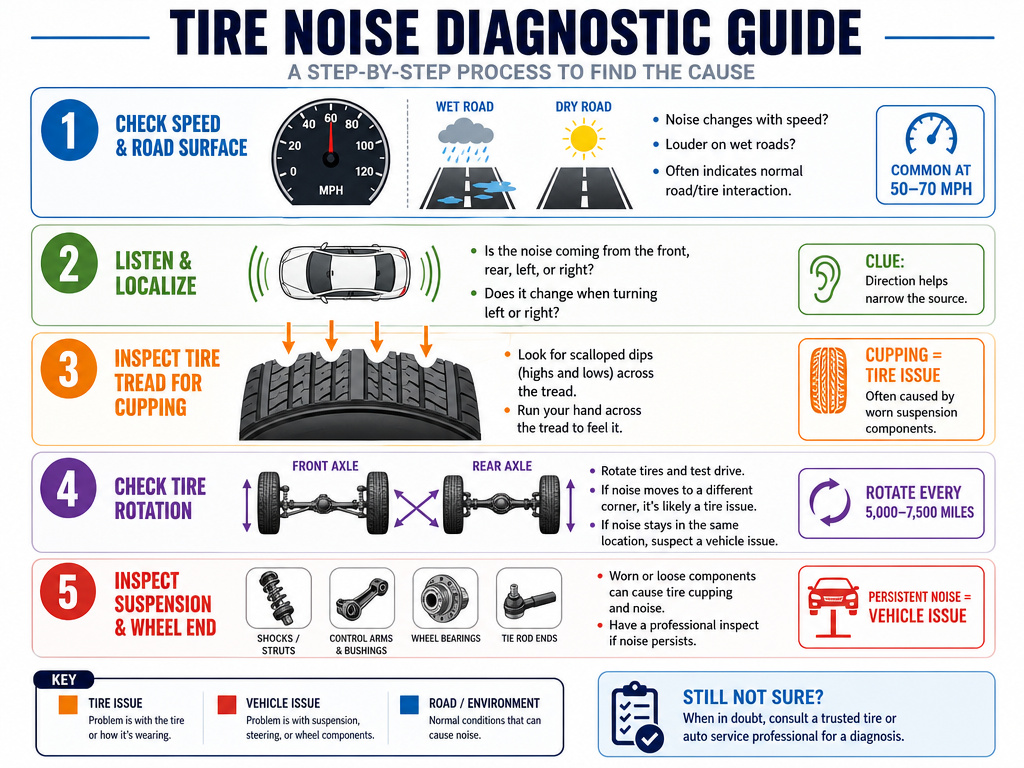
This test costs nothing. I use it before any tire sale.
Before you start: Use a jack stand, not just a hydraulic jack. Chock the wheels before loosening lugs. Let brake rotors cool before touching them; a hot rotor can burn skin in seconds.
- Note the speed and surface first. If the noise changes from dry to wet, you’re hearing water in the tread channels. If it does not, check wear or vehicle parts.
- Check tire pressure at cold. Use the driver door jamb sticker. Skipping this can hide uneven contact and make a new tire sound bad.
- Run your hand over the tread. Feel for cupping or feathering. A scalloped shoulder points to alignment or suspension wear.
- Rotate the tires to the same axle. If the noise moves, the tire is the suspect. If it stays, the wheel, bearing, or suspension is the suspect.
- Drive slowly in an empty lot and turn left and right. A bearing whine can change with load. A tire hum stays steady.
- Inspect the wheel for a bent rim, missing weights, or PNCS (Pirelli Noise Cancelling System) symptoms. If a Pirelli tire with PNCS and an N0 rating shows imbalance or vibration, suspect foam detachment.
The NHTSA technical service bulletin documents foam detachment in Pirelli PNCS tires. The bulletin says the remedy is replacing all four with standard non-noise-cancelling N-Spec tires.
NVH means noise, vibration, and harshness. The 2025 NHTSA NVH diagnostic guidelines say even aftermarket tires of the correct size can change how the vehicle rides and lead to NVH concerns.
When the noise is a one-side whine, wheel bearing noise and tire noise can sound alike. A rhythmic thump is a clue to imbalance or tread damage, and thumping noise deserves a close look.
Do not swap tires before the rotation test. If the noise stays, the vehicle is the suspect, and the new set can hum too.
Do not ignore a thump after miles on Pirelli PNCS tires. The foam can detach, causing imbalance and vibration.
What Road Surface, Wetness, and Age Do to Tire Noise
Three things move the sound: surface, water, and age.
Wet pavement raises noise because water enters tread channels and the tire pumps it out. The Volkswagen service manual states the noise level on a wet road is much higher than on a dry road.
For practical fixes, the list of ways to reduce road noise covers pressure, tread, and alignment.
Normal Loudness, Abnormal Loudness, and When to Stop Shopping
A little tire noise is normal. The cabin decides how much reaches your ears.
- Normal: steady hum that settles after break-in, wet-road hiss, coarse-road roar.
- Abnormal: new thump, one-side whine, vibration in the wheel, noise that changes after a rotation test.
Most loud-tire complaints are wear pattern or alignment. Rotate first. Check second. Buy last.
For a quiet daily-driver swap, compare touring tire models, then look at pattern and compound data. If you want a shop check, ask about their alignment equipment and process.
If the noise is a chirp when turning, treat it as tire squeal instead of rolling noise.
How to Tell If a Bad Wheel Bearing Is Causing Tire Noise
Can Tire Imbalance Make My Tires Loud?
The fact sheet notes that even aftermarket tires of the correct size can change how the vehicle rides and lead to noise and vibration concerns. A specific technical bulletin mentions that a tire’s internal noise-cancelling foam can detach, causing imbalance and vibration.
Can Worn Suspension Parts Cause Loud Tire Noise?
Frequently Asked Questions
Should I be able to hear my tires while driving?
Yes. A federal DOT report gives 35-40 mph (56.3-64.6 km/hr) as the speed where tire noise can become significant. How loud it sounds depends on the road, the tread, and the cabin.
Is it normal for new tires to be loud?
New tires are louder until they wear in. The DOT report cites a 1978 study that found noise stabilizes after 200 miles (321.8 km). If the noise gets worse after that, check wear and alignment.
Why do my tires sound like an airplane?
Why does my car get loud at 60 mph?
Do foam-lined tires fix loud tires?
They reduce noise, but they add a repair issue. A NHTSA bulletin documents foam detachment in Pirelli PNCS tires with an N0 rating.
The Bottom Line
If you keep asking why are my tires so loud, stop at the first cheap check. Rotate the tires. If the noise moves, the tire is the suspect. If it stays, the wheel, bearing, or suspension is the suspect.
One trigger matters: if the noise settles after 200 miles (321.8 km), break-in is the explanation. If it appears after 1,000 miles (1,609 km), check wear, pressure, and alignment before buying.
This all changes if you run Pirelli PNCS tires with an N0 rating. Foam detachment can cause imbalance and vibration, and the documented remedy is replacing all four with N-Spec tires.
I would rather hear a hum that a rotation test clears than buy a new set based on a guess. Specs first, opinions second.
