
Why OEM Tires Wear Out Fast: The Warranty Gap Explained
This post contains affiliate links. As an Amazon Associate, we earn from qualifying purchases.
Why OEM tires wear out fast traces to a trade-off: automakers tune the original set for grip, ride, and load rather than maximum tread life. GM says no usable tread-life warranty is offered. That doesn’t mean every set fails early; wear rate still depends on compound, inflation, alignment, and driving style.
GM’s bulletin says OEM tires are evaluated for handling, ride, load, and traction demands. Different tire types experience different rates of wear, per the same bulletin.
The rest covers the compound trade-off, the warranty gap, the age rules, and a checklist for telling normal wear from a problem.
Key Takeaways
- GM lists no usable tread-life warranty. GM says no warranty is offered on usable tread life.
- 2/32 inch marks worn out for light vehicles. USTMA says tires at 2/32 inch or less are worn out.
- 4/32 inch applies to front axles over 10,000 lbs GVWR. Federal regulation sets 4/32 inch for front-axle tires on vehicles over 10,000 lbs GVWR.
- Inspect after 5 years; replace after 10. NTSB and Bridgestone guidance point to inspection after 5 years and replacement after 10.
- Check tread monthly and rotate tires as recommended by your vehicle or tire manufacturer. NHTSA says check tread monthly;
Why OEM Tires Wear Out Fast?
A crossover can roll into a shop with the original tires near 2/32 inch. The owner expected more miles. That gap is the whole question. I don’t call that a defect without a wear check.
GM says OEM tires are evaluated for various criteria. Handling, ride quality, load carrying, and traction demands can all shape the choice. Different tire types wear at different rates. GM offers no warranty on usable tread life. That means the original set is tuned for the whole vehicle, not only for tread depth.
The GM Technical Service Bulletin 20-NA-159 says OEM tires are evaluated for handling, ride, load, and traction.
The tread grooves look shallow, and the raised treadwear indicators sit flush with the rubber.
That is NHTSA’s replacement signal.
GM says some tire weathering and superficial cracking is normal. It is not a warranty replacement condition.
Minor sidewall indents are also normal, per GM. They come from manufacturing splices and don’t hurt performance.
Does a Treadwear Warranty Cover OEM Tires?
GM’s bulletin says no warranty is offered on usable tread life.
That line matters.
A new-car buyer may expect the original set to match a long mileage promise, but GM’s document gives none.
The NHTSA TireWise safety guide explains UTQG (a government rating system) and says a control tire gets grade 100. A tire grade of 200 should wear twice as long as the control tire.
That is a comparison, not a mileage guarantee.
UTQG can compare:
- Treadwear grade, where 100 is the control tire.
- Traction grade.
- Temperature grade, which reflects heat resistance under test conditions.
For daily drivers, performance tires can look appealing until the tread-life trade-off appears.
Check it, don’t assume it.
Are Replacement Tires Better Than OEM Tires?
A replacement tire can solve a tread-life complaint, but it changes the tuning. The debate about OEM vs aftermarket tires gets noisy because better depends on the job.
| Decision factor | OEM original set | Replacement tire |
|---|---|---|
| Tread-life warranty | GM: no usable tread-life warranty | Check tire-maker warranty terms |
| Wear rate | GM: varies by tire type and habits | Compare UTQG treadwear grade |
| UTQG baseline | 100 is control; 200 wears twice as long | Use sidewall grade, not brand alone |
| Fitment | Vehicle manual gives replacement instructions | Match size, load, speed rating |
I would not buy a tire based on brand alone. The sidewall grade and your actual driving matter more.
The choice of tire type depends on the specific driving demands and vehicle. Touring tires are examples of a tire type one might check first.
How to compare before you buy
Start with the sidewall, not the brochure.
The OE tire markings can help identify an original version. The DOT TIN date code tells how old that version is.
Compare the UTQG grade, load rating, and speed rating to your vehicle manual. A higher speed rating isn’t automatically better for a daily driver.
I used to believe a higher speed rating always meant a better tire. A higher speed rating does not automatically mean a better tire for a daily driver. Now I match the rating to the driving rather than chasing the highest letter.
How Do You Tell Normal Wear From a Problem?
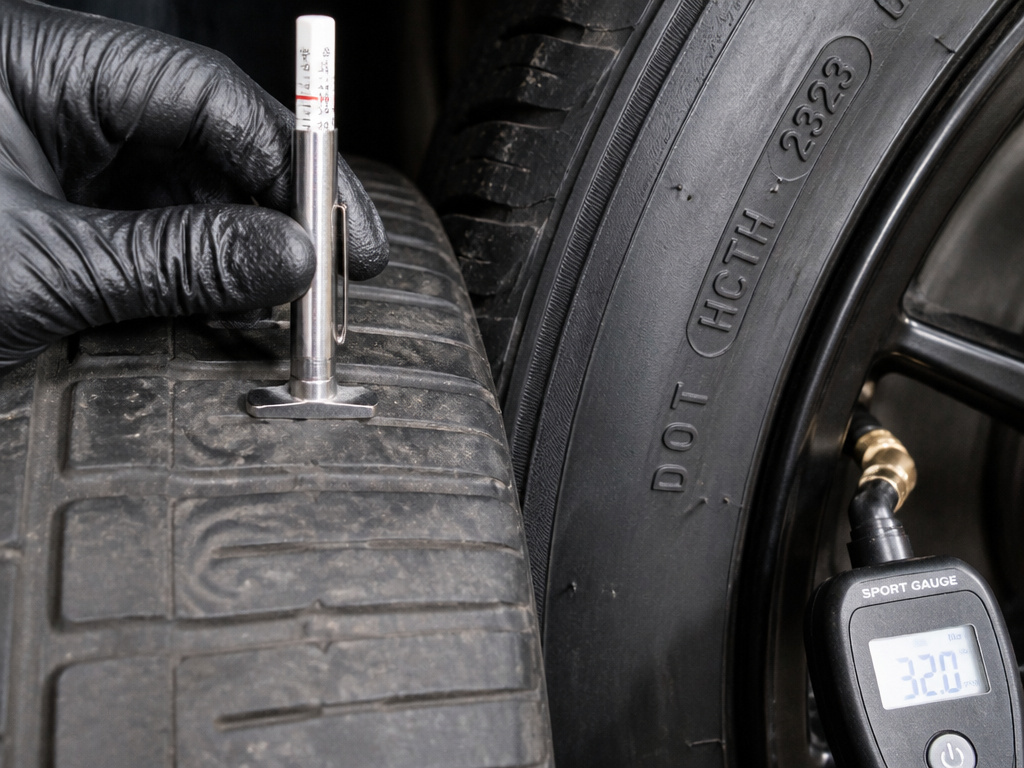
Three checks matter: pressure, wear pattern, and date code. I rotate tires around 5,000 to 7,500 miles. The difference shows up in how evenly the tread ages.
NHTSA says only 19 percent of consumers properly inflate their tires. Properly inflated tires can extend the average life by 4,700 miles.
Practical tire longevity tips start with pressure and rotation. When owners don’t rotate tires,
Before you start: Check tire pressure, inspect for cuts, bulges, or exposed cord, and keep hands clear while rotating. A damaged tire can fail suddenly.
| Wear sign | Source-backed cause | Next check |
|---|---|---|
| Even wear to 2/32 inch | Light vehicle wear-out limit | Replace or inspect |
| Pronounced diagonal wear | Damaged, worn, or misaligned suspension | Alignment and parts |
| One tire faster | Local irregular wear may signal separation | Qualified innerliner inspection |
| Sidewall cuts or bulges | Impact damage or exposed cord | Remove from service until inspected |
A 6-step wear check
Follow this order, and skip no step.
- Check tire pressure. NHTSA links poor maintenance to flat tires, blowouts, or tread separation. If you skip this, underinflation damage may not show until the tire fails.
- Measure tread depth at several points. If you skip this, a worn spot below 2/32 inch can hide while the rest looks fine.
- Look for treadwear indicators. If the tread is level with the indicator, replacement is due. Ignoring it keeps you on a tire that has reached the wear-out limit.
- Compare left and right wear. If a pronounced diagonal pattern shows up, a damaged, worn, or misaligned suspension part may be at fault.
- Check the DOT TIN date code. If the last four digits show a tire over 10 years old, replace it as a precaution. Ignoring age can leave you on rubber that NTSB says is more prone to failure.
- Inspect the innerliner if the tire is off the wheel. If hidden bead or innerliner damage stays unseen, USTMA warns the tire can suddenly fail in service.
Reading tire wear patterns tells you whether the compound or the vehicle is at fault. That is where checks for alignment and tire wear matter more than brand names. If only one tire wears faster, suspect a suspension part or hidden damage.
Common mistake: Buying tires by brand alone while ignoring the DOT date code. A tire stored for five years can show harmful property changes before it reaches 2/32 inch.
When Should Age Force a Replacement?
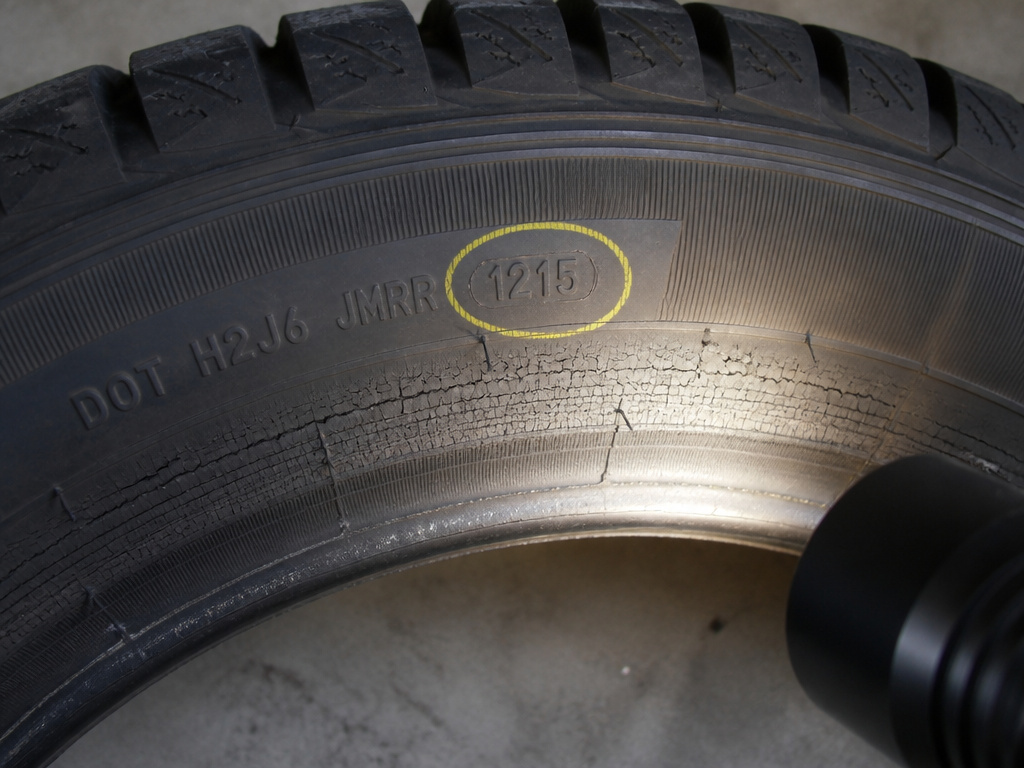
Age can end a tire before tread does.
I check the date code before I judge tread life.
The wear-out number also splits by vehicle class. The USTMA tire care manual says tires at 2/32 inch or less are worn out. Federal regulation sets 4/32 inch for front-axle tires on vehicles over 10,000 lbs GVWR. GVWR means gross vehicle weight rating.
The NTSB tire safety investigation says most, but not all, vehicle manufacturers recommend replacement after 6 years, while NHTSA TireWise notes some recommend 6 to 10 years, and Toyo Tires recommends replacement at 10 years. NHTSA’s TireWise page says some vehicle and tire manufacturers recommend replacing tires six to 10 years old, regardless of treadwear.
Toyo Tires recommends replacement at 10 years from manufacture. Bridgestone/Firestone recommends inspection after 5 years and replacement after 10 years, including spares. Nissan advises having tires over 6 years old checked by a qualified technician.
Age guidance does not match in one line:
- NTSB: most manufacturers say replace after 6 years.
- NHTSA: some recommend 6 to 10 years, regardless of treadwear.
- Toyo: replace at 10 years from date of manufacture.
- USTMA: no scientific data sets a specific minimum or maximum service life.
The date code tells the real story
The DOT Tire Identification Number (TIN) ends with four digits that show week and year of manufacture. If the TIN reads 0308, the tire was made in the third week of 2008. Check both sides, because the TIN may not be on both.
A five-year tire can look new and still show superficial cracking. GM says some weathering and superficial cracking is normal, not a warranty replacement.
Storage matters.
USTMA recommends temperate ambient storage with a minimum of circulating air. Poor storage can age rubber before the tread wears.
Easy to miss: A spare tire ages even without use, and NTSB cites a Ford warning that spares should be replaced due to time. After 10 years, replace it as a precaution; USTMA discusses general storage conditions instead of singling out spares.
Do OEM tires start with less tread?
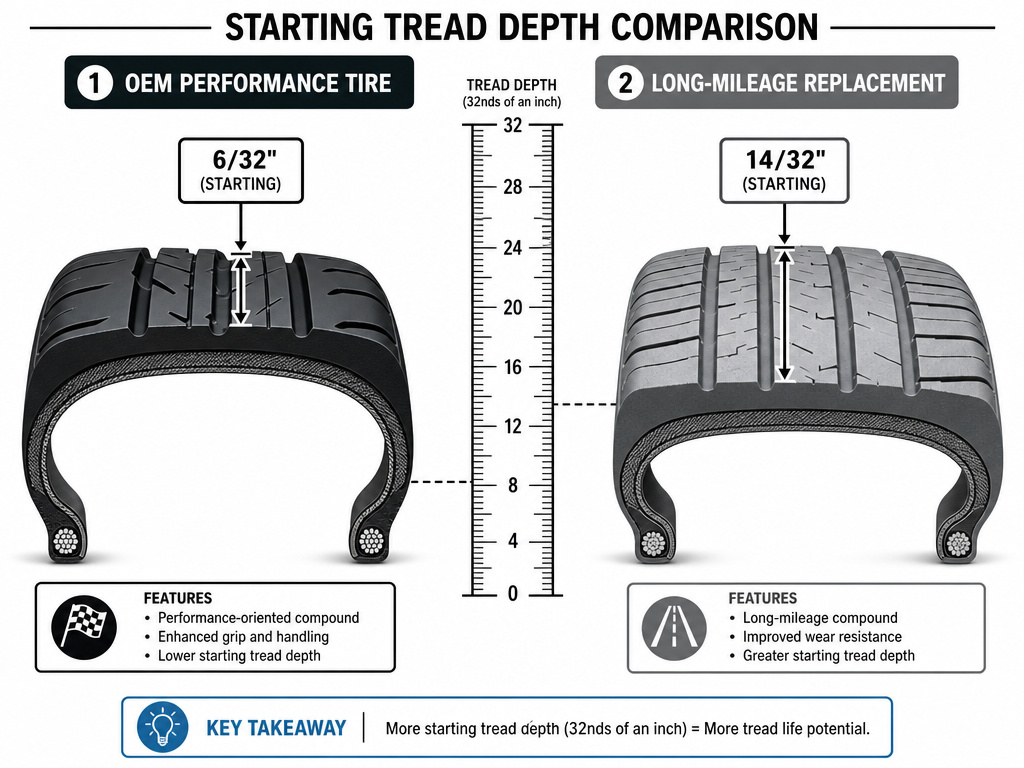
OEM tires are selected to meet specific demands for a vehicle, which can include optimizing handling, ride quality, or traction. This focus on performance often comes as a trade-off for tread life. Different types of tires will experience different rates of wear. Since the original tread depth is a starting point for total tire life, a tire chosen for a softer, grippier compound or a specific performance characteristic will inherently have less usable tread material to wear through from the beginning compared to a tire designed purely for long mileage.
Are OEM tires tuned for my specific car?
Yes, the original equipment tires on a new vehicle are evaluated for many criteria to match that specific model. Manufacturers select a tire to optimize handling, ride quality, and load carrying for the car’s exact alignment, suspension setup, and weight distribution. This precise tuning is why the tires feel perfectly matched when the car is new. However, this specific optimization is a balance, and the chosen tire compound and construction may prioritize that initial feel and performance over achieving the maximum possible tread life.
Frequently Asked Questions
Do OEM tires wear out faster?
They can, but GM says the reason is not a single defect. OEM tires are evaluated for handling, ride, load, and traction, and different tire types wear at different rates.
How many miles should OEM tires last?
GM says tire wear greatly varies by tire type and driving habits. Tire service life cannot be predicted accurately based on calendar age, according to USTMA.
Which brand of tire lasts the longest?
No brand wins for every vehicle. NHTSA’s UTQG compares a tire to a control tire, where grade 200 should wear twice as long as grade 100. Michelin Defender T+H, Continental TrueContact Tour, and Bridgestone Turanza QuietTrack are common touring examples, but compare the sidewall grade and fitment.
Why are my tires wearing out so quickly?
Start with pressure, rotation, and alignment. GM links uneven wear to damaged, worn, or misaligned suspension parts, and NHTSA links poor maintenance to premature failure.
Should I replace all four OEM tires at once?
If the remaining tires are near 2/32 inch or show irregular wear, a full set is easier to manage. If only one tire failed, have a qualified tire service professional inspect the vehicle and tire before replacement.
Before You Go
If your original set has reached 2/32 inch at any point, the tire is worn out. If it is over 10 years old, treat it as replacement time even when the tread looks usable.
For a five-year tire with even wear, get a qualified inspection first. NTSB and Bridgestone both point to inspection after 5 years.
This week, read the DOT TIN on both sides.
Read the date code before you buy, install, or trust a new tire.
For a vehicle over 10,000 lbs GVWR, the 4/32 inch front-axle rule changes the math. I would not chase a tread-life warranty number on a new car. I would compare wear left to right, then decide whether the original set or a touring replacement fits the next few years. That is how I answer why OEM tires wear out fast.
