
Wide Single vs Dual Tires: Which Is Right for Your Rig?
This post contains affiliate links. As an Amazon Associate, we earn from qualifying purchases.
Wide single tires replace a dual-wheel assembly with one wider tire, offering weight savings and potential fuel economy gains, while dual tires provide built-in redundancy and have been the traditional standard for decades. For most over-the-road fleets focused on line-haul efficiency, wide singles are the better buy. For mixed-service, off-highway, or owner-operator rigs where a single flat could strand a load, duals remain the safer, more flexible choice.
That weight saving—roughly 900 lbs per tractor-trailer combination—isn’t just a spec sheet number. It translates directly to payload capacity or fuel not burned hauling extra wheels. But the trade-off lives in a single point of failure, a key consideration in the debate over wide single vs dual tires. One puncture on a drive axle with a wide single means you’re stopping right there. With duals, you can often limp to the next exit.
What follows is a breakdown of where the data agrees, where it fights, and where your specific operation tips the scales. This section addresses fuel and weight, traction and stability, the actual costs beyond the tire price, and the essential hardware for running wide singles.
Key Takeaways
- Fleet data shows 2–6% fuel economy improvements with wide singles, but real-world gains hinge on perfect inflation and alignment.
- A wide single failure on a drive axle means the axle is disabled, requiring an immediate stop, whereas with duals, a failure on one tire may allow the vehicle to limp to a service point, as argued by some owners and operators.
- On straight unpaved roads, some research indicates wide singles generate less dust than duals, but on tight curves, that advantage can reverse. However, other research suggests dust generation is directly proportional to the number of wheels, and wider tires cause larger dust emissions per tire.
- You must run a Tire Pressure Monitoring System (TPMS) with wide singles to monitor pressure, as they are sensitive to under-inflation.
- The long-term cost-per-mile may favor wide singles for high-mileage fleets due to fuel and weight savings, but duals may be preferred for low-mileage or severe-service operations due to redundancy and forgiveness, according to trade press and operator reports.
The Fuel & Weight Savings (And Where They Disappear)
Trade press reports from fleets document fuel economy improvements of 2–6% after switching to wide singles. The mechanics are simple: you’re reducing rolling resistance and cutting vehicle weight. The reduction in tire and wheel count in the wide single vs dual tires choice contributes to weight savings of ~900 lbs per tractor-trailer combination. That’s weight you can convert into payload.
But here’s where owners disagree with the manufacturer’s positioning. That 2–6% window is huge. Hitting the top end requires religious maintenance. A study from the University of Alaska Fairbanks transportation research center notes that dust generation—a proxy for energy loss—is directly tied to tire contact and surface interaction. If your alignment is off or your pressure is low, you’re scrubbing away those savings and heating up the casing.
Where this goes sideways: Chasing fuel savings without a TPMS. A single wide-base tire running 10% under-inflated can lose a disproportionate amount of its fuel benefit and overheat the sidewall, accelerating wear.
The savings are real for line-haul fleets running predictable routes. For a dump truck running in and out of a quarry or a livestock hauler on winding farm roads, the stop-start, turning-heavy cycle eats into the aerodynamic and resistance gains. The fuel math only works if your driving cycle looks like the test cycle.
Handling & Traction: Not a Simple Swap
This is the most contested area. OEMs like Michelin and Bridgestone claim equivalent or superior handling for their wide-base products. Independent test data tells a more nuanced story.
An SAE International technical paper (SAE 2005-01-3550) presented test data showing wide-base singles can have lower lateral stability under certain loaded conditions compared to duals. The dual setup, with its two contact patches spaced apart, may provide greater lateral stability under certain loaded conditions in the wide single vs dual tires comparison, as indicated by SAE test data.
| Condition | Wide Single Tendency | Dual Tire Tendency | Why It Matters |
|---|---|---|---|
| High-Speed Cornering (Loaded) | More lateral flex, lower stability | Higher lateral stability, less roll | Impacts driver confidence and control in evasive maneuvers |
| Straight-Line Tracking | Excellent, less scrub | Slightly more rolling resistance | Better for fuel on highway, but a non-issue for handling |
| Unpaved Road, Straight | Less dust generation (loosens road surface less) | More dust generation | Critical for mining, logging, or municipal roads |
| Unpaved Road, Curved | May generate more dust | May generate less dust | Performance reverses in tight turns like quarries or yards |
The unpaved road data is specific. That same University of Alaska Fairbanks research states that under the same loading, dual tires have a much higher loosening effect on road surfaces of straight roadways than wide single tires. But it adds a crucial caveat: on curved road sections, the opposite is true. If your operation involves tight, constant turning on dirt, wide singles might kick up more dust and offer less predictable grip.
For general highway use, the handling difference may not be pronounced in all conditions. But if you’re pushing limits in mountains or on slick construction sites, the dual’s stability edge is physical, not theoretical.
Safety, Redundancy & the Roadside Reality
This is the single biggest argument against wide singles, and it comes straight from the drivers. A manufacturer’s brochure talks about reliability. An owner-operator talks about the time a belt separated on I-80.
With dual tires, a puncture or blowout on one tire often leaves the companion tire intact to carry the load. You can reduce speed and drive to a safe stopping point or a service center. This limp-home capability is a massive operational safety net.
With a wide single, there is no companion. A catastrophic failure like the belt separation cited in NHTSA Recall 22T009 for certain Bridgestone R197 tires means an immediate loss of support on that axle. You’re stopped wherever it happens, likely requiring a costly tow and causing major downtime.
The part nobody mentions: The tow bill from a wide single blowout on a remote highway can wipe out the fuel savings from an entire year. For an owner-operator, that single event changes the calculus.
This vulnerability underscores the importance of using a Tire Pressure Monitoring System (TPMS) with wide singles. On a wide single, a small leak can lead to under-inflation, which increases the risk of failure, making pressure monitoring critical. A TPMS provides pressure monitoring to help detect issues before they lead to failure.
Cost Analysis: Price, Life, and Cost-Per-Mile
Looking at just the tire price is how fleet managers lose money. The right metric is cost-per-mile over the total life of the casing.
Initial Cost: Wide singles may have a different upfront cost compared to dual tires, but the total initial outlay depends on the number of tires purchased. However, since wide singles replace dual assemblies, the total number of tires purchased is reduced, which can affect the total initial outlay.
Maintenance & Life: Here’s where the paths diverge.
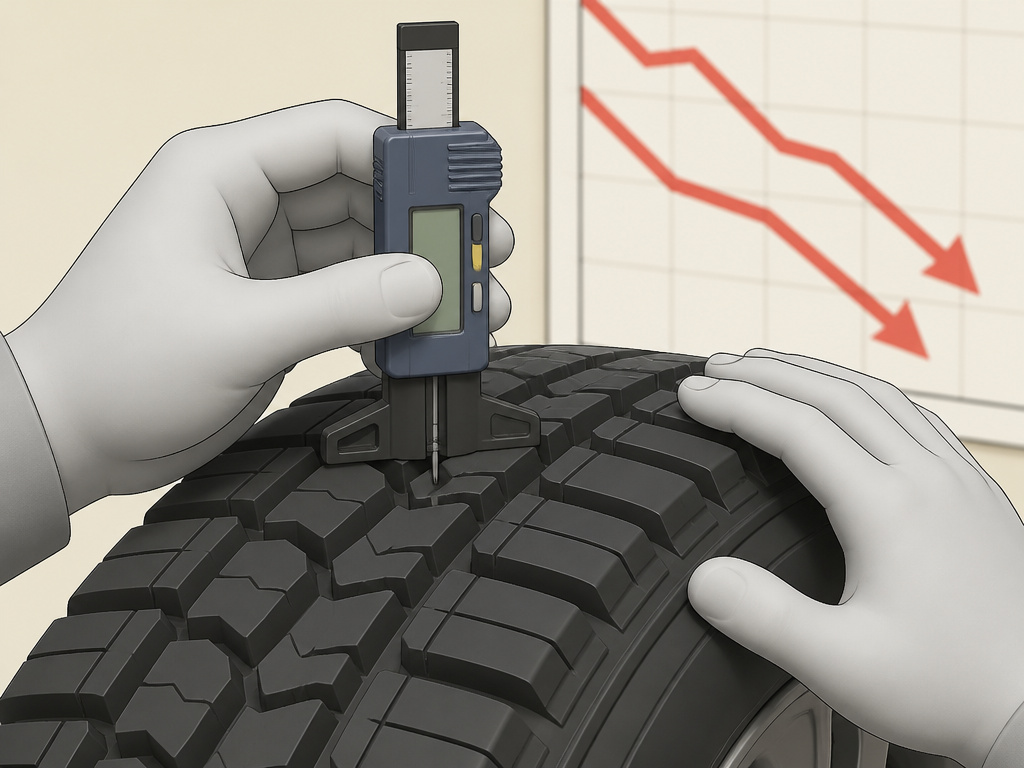
- Wide Singles: Fewer tires to check, rotate, and balance. But they are more sensitive to improper inflation and alignment. A Michelin X One® XDA5 has a 24/32-inch tread depth; a Bridgestone R197 has 26/32. That’s deep, but it won’t last if it’s scrubbing.
- Dual Tires: More components to maintain, but they are forgiving. Dual assemblies may offer some redundancy in case of a single tire failure, but maintaining proper inflation in both tires is still important. They are the known quantity for every shop.
Trade press reports cite fleets achieving documented fuel economy improvements and weight savings with wide singles, which can contribute to lower operating costs for some operations. The tires wear evenly, and the casings are often robust enough for multiple retreads.
For lower-mileage, severe-service, or irregularly maintained vehicles, the redundancy and perceived reliability of duals may be advantageous, as argued by some owners and operators. The operational vulnerability of a single tire failure on a wide single, as argued by some owners and operators, is a consideration for some fleets.
The .095 vs .105 Trade-Off That Burns Out Electric Motors
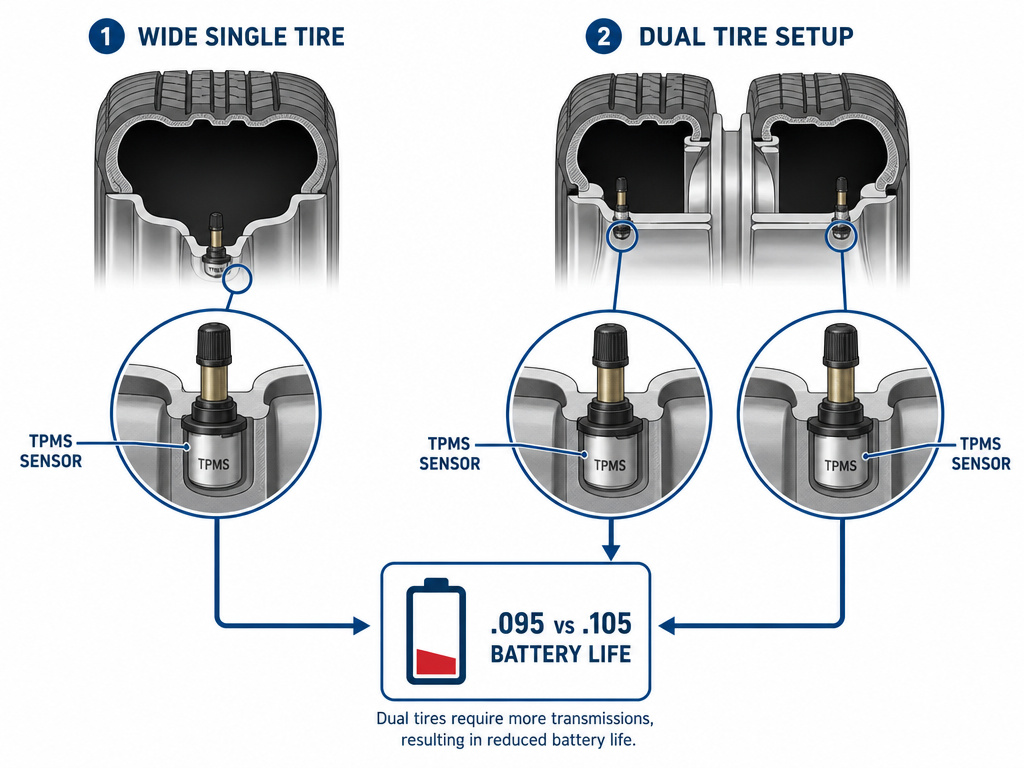
This isn’t about tire size. It’s about the Tire Pressure Monitoring System (TPMS) sensor batteries. TPMS sensors have varying battery lives; selecting a reliable system is important for continuous monitoring.
TPMS sensor failure can compromise monitoring, emphasizing the need for a reliable system and regular verification.
Investing in a reliable TPMS system is a critical part of operating wide singles safely and effectively.
Compatibility & Conversion: More Than Just Bolting On
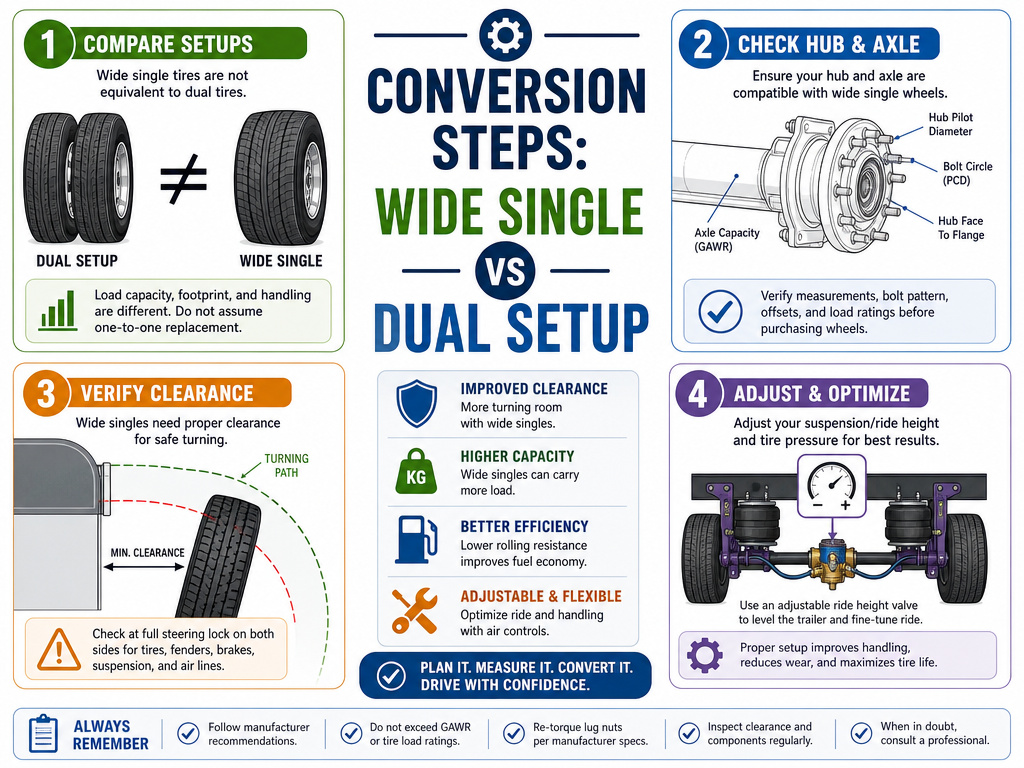
You can’t just put wide singles on a truck designed for duals. The conversion involves specific, matching components.
- Rims: You need rims specifically designed for wide single tires, which differ from those used for dual wheels.
- Hubs & Axles: The hub and axle must be compatible with the wide single rim, which may require modifications.
- Fenders & Clearance: You must ensure adequate clearance for the wider tire at all suspension and steering positions.
- Suspension Tuning: The ride dynamics change. Some fleets report needing to adjust suspension pressures or settings to compensate for the different load distribution and maintain ride quality, especially on trailer applications where cargo damage from harshness is a concern.
Skipping any of these steps leads to rapid, uneven wear or catastrophic clearance issues. This is a professional conversion, not a DIY weekend project. The rule for fitting wider tires on passenger cars applies tenfold here: the entire system must be engineered to work together.
Soil Compaction and Flotation for Farm Work
Research on unpaved surfaces shows that the relationship between tire choice and soil impact is not straightforward. On straight sections, dual tires can have a greater loosening effect on the surface compared to a wide single under the same load. However, on curved sections, this dynamic can reverse, with wide singles potentially causing more disturbance. Dust generation is influenced by both the number of wheels and tire width. More wheels generally mean more dust, but wider tires also contribute to higher dust emissions per tire. For practical use, consider your field’s layout and soil moisture, as wetter conditions naturally reduce dust regardless of tire setup.
Frequently Asked Questions
Are super singles better than duals?
It depends entirely on your use case. For fuel-focused, on-highway fleets with disciplined maintenance, super singles (wide-base singles) are often better for lowering cost-per-mile. For mixed-service, off-road, or operations where a flat tire would cause major disruption, duals are the better, safer choice due to their built-in redundancy.
What are the downsides of using wide tires?
The main downsides are the lack of limp-home capability after a puncture, higher sensitivity to improper inflation and alignment, and potentially lower lateral stability when fully loaded compared to duals. They also require a mandatory TPMS investment and may not be suitable for constant tight-turning on unpaved surfaces.
Can you run a single tire on a dually?
No, not safely or legally. A “dually” truck has a rear axle specifically designed for two tires per side. The hubs, rims, and brake components are spaced for a dual assembly. Putting a single wide tire in that space is not possible without a complete axle, hub, and rim conversion, which is a major engineering change.
Does a wider tire give a better ride?
Not necessarily. Ride quality is determined by sidewall flex, inflation pressure, and suspension. A wide single tire often runs at higher pressures to carry the same load as duals, which can transmit more small road imperfections into the chassis. Some drivers report a firmer, sometimes harsher ride with wide singles, particularly on trailers with no suspension.
The Bottom Line
The wide single vs dual tire debate isn’t about which technology is superior. It’s about which tool fits the job in your yard.
For the large fleet manager running millions of highway miles a year, the data is clear: wide singles, paired with rigorous pressure management and alignment checks, will lower your overall cost-per-mile. The fuel savings and weight reduction are real and bankable.
For the owner-operator, the regional hauler with mixed routes, or anyone who spends time on rough sites, the security blanket of dual tires is worth the slight fuel penalty. The ability to drive on a flat long enough to get off a busy interstate is a feature you can’t price until you need it.
Before you commit, do the math for your own routes and maintenance capability. And if you go with wide singles, budget for the best TPMS you can buy first. That sensor is your new dual tire.
