
Signs of Low Tire Pressure: What to Check First
This post contains affiliate links. As an Amazon Associate, we earn from qualifying purchases.
Signs of low tire pressure include a TPMS light, longer braking, vague steering, uneven wear, and a flapping sound. Federal rule requires the light within 20 minutes when one or more tires hit 25% below recommended cold pressure, yet a gauge still decides the fix.
That 20-minute warning is a legal floor, so use the gauge as your daily check. The placard gives the target, and you’ll see whether the tire is actually there.
What follows: early physical signs, driving symptoms, TPMS traps, and the cold-air math that shows why the dashboard lies.
Key Takeaways
- Check cold pressure with a gauge before trusting the TPMS light.
- 25% below the placard triggers the federal low-pressure light within 20 minutes.
- 1-2 psi disappears per 10 F drop, and 1-2 psi per month under normal use.
- A blinking light that stays solid after about one minute points to a TPMS fault.
- Skip bleeding warm tires to match cold pressure; a hot tire at placard pressure is underinflated.
What are the first signs of low tire pressure?
I learned to check before the car has moved. A warm tire reads high enough to hide a real problem.
The federal rule requires the low tire pressure warning telltale to illuminate within 20 minutes. The threshold is 25 percent below recommended cold inflation pressure. The Table 1 value overrides that threshold when higher. The telltale stays lit while ignition is on and pressure remains at or below that threshold.
Physical cues before the light comes on
The sidewall, the sound, and the steering give the first warnings.
- A sidewall looks bulged near the tread.
- Steering feels vague, like the front end is wandering.
- A flapping or slapping sound changes with speed.
- The ride feels soft, especially over small cracks.
- The tire looks round, but the gauge says it is low.
If you want to check tire pressure, you’ll need a tire pressure gauge before the light becomes a debate. The NHTSA tire safety guide says to check monthly and inspect for damage.
The gauge settles the argument
Specs over slogans. For a quick monthly habit, a reliable dial gauge is enough; if you want a shop-grade number, a high-quality digital gauge is the better buy.
Which driving symptoms mean the pressure is already too low?
Handling, braking, and fuel tell the same story
A soft pedal, a wandering lane, and a longer stop all point to the same problem. The difference between underinflated tires and normal tires shows up in the contact patch. How pressure impacts driving starts with steering weight, then braking feel.
A low tire flexes more, heats the sidewall, and squirms under load. That extra sidewall movement makes steering feel vague and lengthens braking. Under-inflation also reduces fuel efficiency by increasing rolling resistance.
| What you notice | Likely pressure link | First check |
|---|---|---|
| Steering feels vague | sidewall flex and contact patch | cold gauge reading |
| Braking feels longer | underinflation affects stopping ability | placard versus gauge |
| Flapping or slapping sound | low tire sidewall movement | inspect tread and pressure |
| Uneven shoulder wear | edge overload from low pressure | measure all tires |
| Fuel economy drops | rolling resistance rises | monthly gauge habit |
Use the table as a diagnostic shortcut. Confirm with the gauge.
Why does the TPMS light lie about low tire pressure?
AAA found the light arrives late in some cases. The 49 CFR 571.138 TPMS standard requires the low-pressure telltale within 20 minutes. The warning activates at 25% below recommended cold pressure, or the Table 1 value, whichever is higher.
The 2013 NHTSA TPM service bulletin says that pattern is normal operation. The light comes on cold and fades after driving. That is a temperature story.
I treat the light as a late alarm. AAA measured displayed pressure 1.2-1.5% off actual, depending on tire location. In its October 2023 test, only 5 of 11 vehicles lit at 75% of placard pressure. Five of six others needed 70.3-72.9%. One stayed dark even at 65%.
GM says if one or more sensors stop transmitting for 18 minutes, the system sets a code. It then displays a message. The light blinks for about one minute, then stays solid. GM designs sensors to last 10 years or 240,000 km (150,000 miles). GM also says tire pressure sensors are incompatible with commercially available tire sealants.
Common mistake: Treating the TPMS light as a maintenance plan. It warns at a threshold, and AAA found some systems illuminate late.
| Question | Source position | Practical takeaway |
|---|---|---|
| When does the light come on? | 49 CFR: 25% below; AAA: some delayed | Gauge wins |
| How long after adding air? | Tesla: drive at least 15 mph | Volvo: 20 min at 40-100 km/h |
| What counts as cold? | USTMA: 3 hours or under 1 mile | Tesla: 1 mile warms tires |
| Should you set for winter? | GM: lowest seasonal temp | USTMA: current cold pressure |
The disagreement matters. The light is a warning, so the gauge is your daily record.
How do you confirm low tire pressure with a gauge?
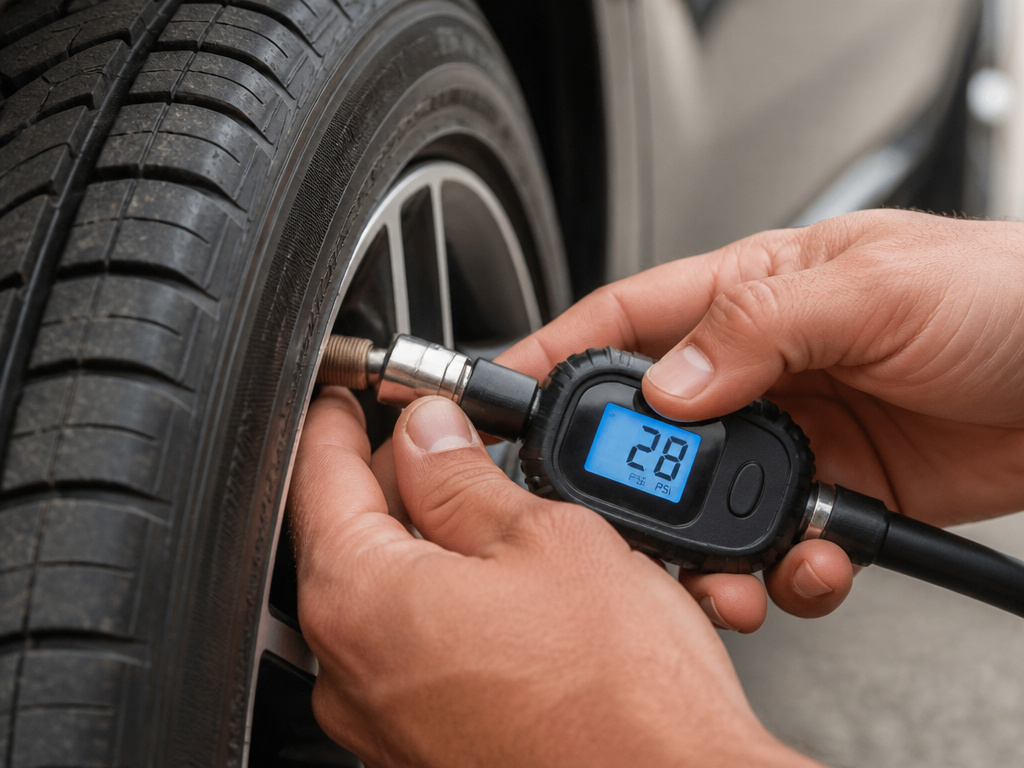
Cold readings, then air
Measure before the car has moved. When to check tire pressure matters as much as the gauge you use. A monthly checklist keeps the habit from becoming a panic repair.
I check cold before moving, because a warm reading hides a low tire.
Before you start: Park on level ground and set the parking brake. Let the brakes cool before touching wheels. Use a gauge for the number. Skip your foot and visual guesses. Skip bleeding a warm tire to match a cold number.
- Read the placard on the driver door edge or pillar. Skipping it leaves you guessing, and guessing wears the wrong part of the tire.
- Check when the tires are cold. USTMA says cold means parked at least three hours or driven less than one mile. Tesla says one mile warms tires enough to affect pressure.
- Press an accurate gauge onto the valve. A loose gauge reads low, so you’ll add air you don’t need.
- Compare each reading with the placard target. Different tire sizes than the placard size require separate pressure determination.
- At a service station, add air to the placard target. Use the placard target as your normal setting. The sidewall number is maximum permissible inflation pressure.
- Recheck with the gauge after adding air. An unverified fill still leaves one tire low.
- If one tire drops more than 2 psi per month, get a professional leak check. Ignoring it turns a slow leak into a puncture repair.
The USTires tire care guide defines cold tires and the 1-2 psi monthly loss. That loss needs professional checking. The USTires tire care guide also covers normal tire care.
If the valve stem is stiff or leaking, a valve core tool seats or releases air without guessing. For a number I trust, an Intercomp digital gauge is the better buy. For ordinary daily driving, the service station pump does the job.
When should you stop driving on a low tire?
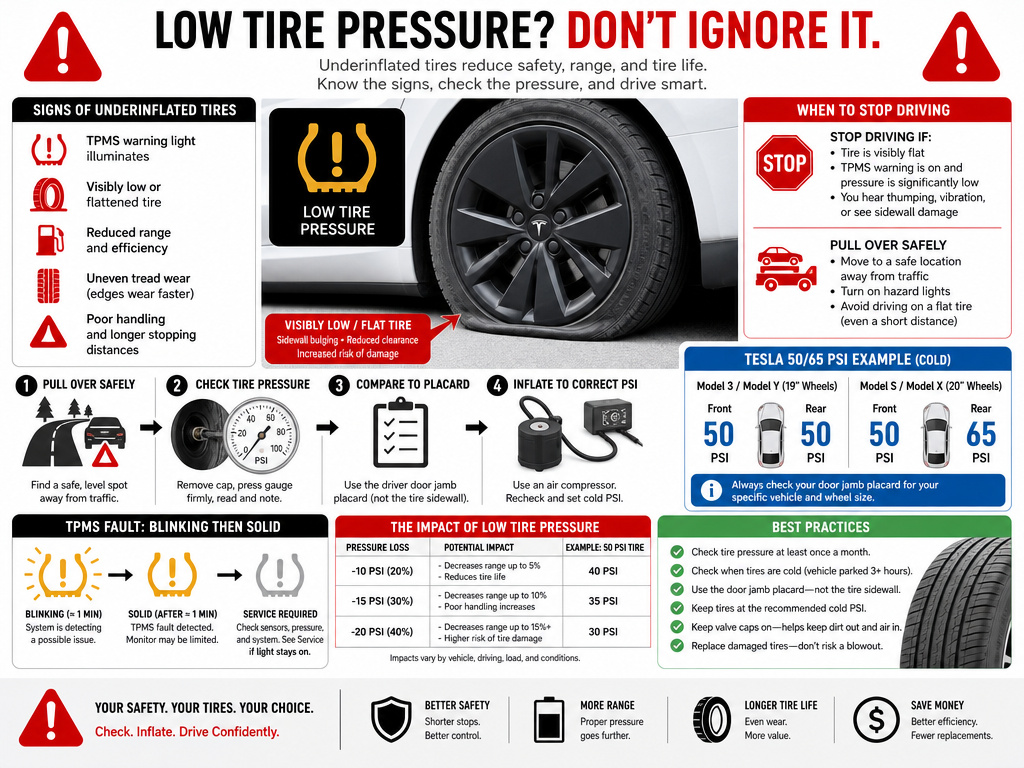
Stop as soon as you can safely, then measure. I pull over first, then measure. The NHTSA tire pressure maintenance study found about 28 percent of light vehicles had at least one underinflated tire. That number explains why the dashboard alone is a weak daily check.
Ignoring the signs ends with a tire blowout. Tesla says under-inflation is the most common cause of tire failures. It causes overheating, cracking, tread separation, or blowout.
For the Tesla Cybertruck, Tesla lists 50 psi for normal load on 20-inch All Season tires, and 65 psi for GVWR load on 20-inch All Terrain tires. If you tow a trailer, Tesla says use the published towing pressure instead of the Tire and Loading Information Label.
If the gauge and the placard disagree, the gauge tells you what to fix; the placard tells you where to aim.
When not to keep going:
- Avoid keeping speed up on a tire far below the placard target. Under-inflation overheats the tire and leads to cracking, tread separation, or blowout.
- Avoid bleeding warm tires to match cold pressure. Tesla says a hot tire at or below recommended cold pressure is dangerously under-inflated.
- Treat a blinking light that stays solid as a TPMS fault. GM says that pattern points to system malfunction.
- Use the placard target as your normal setting. The sidewall number is maximum permissible inflation pressure.
Is it a leak, the cold, or a puncture?
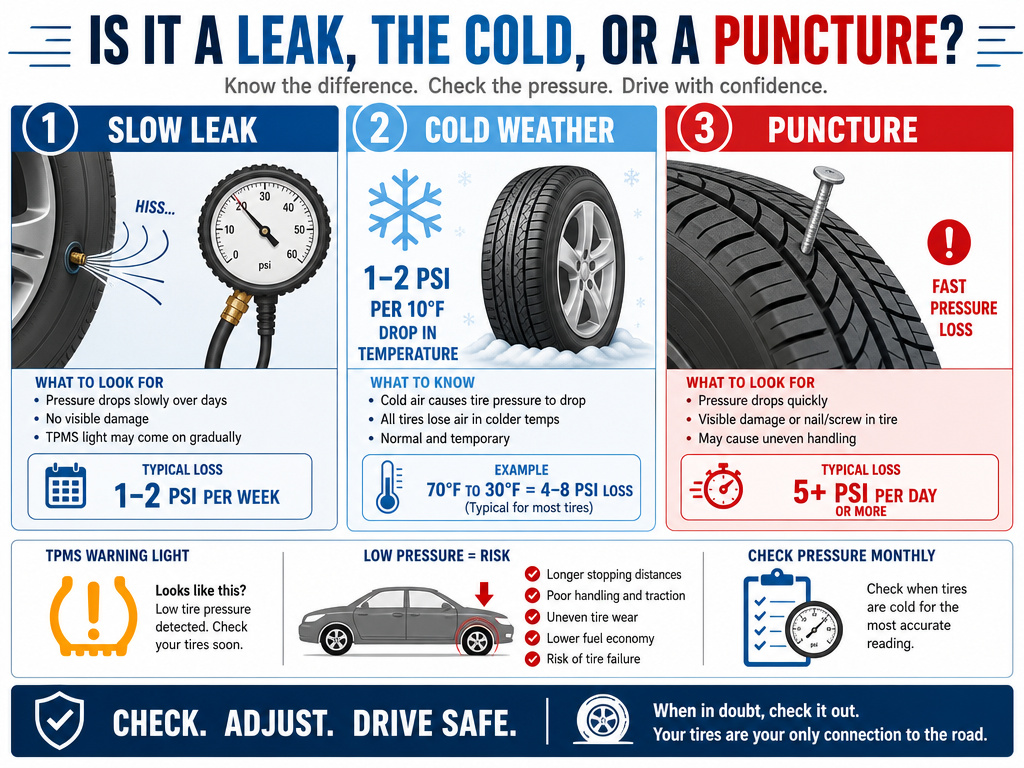
Three things steal pressure. A tire losing air over weeks needs a leak check. If you need to find a leak, look for a screw, a nail, or tire damage from a pothole. A slow hiss is the tell.
Cold weather is different. USTMA lists 1-2 psi loss per 10 F drop, and GM gives 1 psi per 10 F. Understanding how temperature changes PSI helps you separate weather from damage.
I separate weather from leaks by checking all four tires. If the whole car drops together, temperature is the first suspect. If one tire drops faster, get it checked. USTMA says move stored vehicles every three months to change the tire flex area. NHTSA says check the spare monthly, even when the TPMS misses it.
How does low tire pressure cause uneven tire wear?
Low tire pressure causes the tire to flex excessively, especially along the sidewalls. This concentrated flexing wears down the outer edges of the tread more quickly than the center. Over time, this leads to a visibly uneven wear pattern, which can shorten the tire’s overall lifespan. The U.S. Tire Manufacturers Association notes that tires naturally lose a small amount of pressure each month and with temperature drops, accelerating this wear if not corrected. Regularly checking and maintaining the recommended cold inflation pressure is the best way to promote even wear and get the most miles from your tires.
Can low tire pressure cause a blowout?
Yes, consistently driving on underinflated tires significantly increases the risk of a blowout. A soft tire flexes more as it rolls, generating excessive heat within the tire structure. This heat can break down the internal components, like the rubber and fabric cords, leading to a sudden failure. The federal TPMS standard exists to warn drivers of this danger, as the system must illuminate a warning when pressure falls too low. However, the system is not a substitute for maintenance. It is the driver’s responsibility to maintain correct tire pressure, as a hot tire at or below the recommended cold pressure is considered dangerously under-inflated.
Why does my car pull to one side with low tire pressure?
If your vehicle begins to pull or drift to one side, a tire with significantly lower pressure than the others is a common culprit. The underinflated tire has a larger and softer contact patch with the road, creating more rolling resistance. This imbalance in resistance can cause the vehicle to steer toward the side with the low tire. Before suspecting a more complex alignment issue, check the pressure in all four tires using an accurate gauge when they are cold. If the pulling persists after correcting the pressures, a professional inspection is needed to check for other problems like worn suspension components.
Frequently Asked Questions
Do I need a gauge if I have a TPMS light?
Yes. The light warns at 25% below recommended cold inflation pressure, but it misses smaller drops. AAA found some systems illuminated late. Use a gauge for the actual number.
What should I do if the light blinks for one minute then stays solid?
Treat that as a TPMS fault. GM says the system sets a code and displays a service message. Get it diagnosed before trusting the pressure readout.
Why did my TPMS light come on then go off?
GM says a cold tire heats up after driving and rises above the warning threshold. That is normal operation. Inflate to the placard when the tires are cold.
Is the sidewall maximum the right pressure?
The sidewall number is the maximum permissible inflation pressure. Use the placard as the vehicle target. Tesla says keep tires at the recommended pressure even if it differs from the tire sidewall.
What if one tire loses more than 2 psi per month?
USTMA says that tire needs a professional leak check. More than 2 psi per month is outside normal diffusion and temperature loss. Don’t ignore it.
Before You Go
If you see any of these signs of low tire pressure, stop and measure cold before the next trip. A gauge takes one minute and tells you what the dashboard misses.
Use the door placard as the target. Treat the sidewall maximum as a limit. The placard is the recipe. Check the spare too. NHTSA includes it in monthly tire checks, even when the TPMS misses it.
One hard trigger: if a tire loses more than 2 psi in a month, get it checked. That is the point where normal leakage stops being normal.
