
Is It Safe to Drive on a Plugged Tire? What a Plug Can Do
This post contains affiliate links. As an Amazon Associate, we earn from qualifying purchases.
Is it safe to drive on a plugged tire? Only for a short, slow trip to a shop. USTMA, Goodyear, Continental, and Michelin require a plug plus an inner-liner patch for a permanent repair. A plug alone is a temporary stopgap, not a trusted fix.
That inner-liner patch matters because the plug only fills a hole. The patch seals the tire’s airtight layer from the inside, where air pressure pushes outward. A plug-only repair leaves the injury channel open to moisture and hidden damage.
What follows: the repair-zone limits, the plug-versus-patch split, the speed warning, and the post-repair checks that decide whether a tire stays on your car.
Key Takeaways
- Drive under 50 mph only to a shop. AAA says a temporary plug is for reaching repair, not normal service.
- Demand a plug plus patch. USTMA, Goodyear, Continental, and Michelin reject plug-only repairs as permanent.
- Check the injury size and location first. The puncture must sit in the tread and be no wider than 1/4 inch.
- Treat sidewall or shoulder damage as replacement work. Michelin says sidewall damage cannot be safely repaired.
Is It Safe to Drive on a Plugged Tire?
A plugged tire can hold air, but that doesn’t make it roadworthy. The safety question turns on whether the plug is a temporary stopgap or a permanent repair.
Tire repair standards from the U.S. Tire Manufacturers Association and Goodyear limit repairs to the tread area. The standards require tire removal from the wheel. The standards require a rubber stem plus inner-liner patch. A plug alone is an unacceptable permanent repair. Run-flat tires need manufacturer policy review before repair.
The USTMA tire repair basics guide puts the burden on inspection. A shop has to remove the tire from the wheel and look for inner-liner damage before saying the plug is safe.
Goodyear warns that improperly repaired tires can fail. Tread-belt separation is a layer coming apart. Ask the shop whether it follows USTMA repair procedures.
I treat a plug as a trip plan, not a repair. If it holds, the job is not done. The job is an inside check.
What Counts as a Safe Repair Area?
Look at the tread rectangle. The shoulder curve is not part of it. The repair zone is a small, boring rectangle. It sits in the tread, away from the shoulder and the sidewall.
USTMA says repairs are limited to the tread area. Goodyear adds that a shop must not repair an injury extending into the shoulder or belt edge area. Before you ask a shop to plug anything, check the guide to the tire repair zone.
The shoulder is the curved area where tread meets the sidewall. It flexes with steering and load. A plug that sits too close to that curve has no stable seat.
AAA says multiple repairs must be at least 16 inches apart to maintain balance. Goodyear and Continental also say a shop should never repair a tire worn to 2/32 inch tread depth.
Shoulder, Sidewall, and Belt Edge
A repair in the sidewall fails because the sidewall flexes with every rotation. Michelin states a shop cannot safely repair sidewall damage. A repair in the shoulder fails because the belt edge takes steering load. USTMA and Goodyear say injuries there require removal from service.
Michelin says a shop should repair only a tire that has not been driven on when flat. A sidewall bulge means stop, because Michelin says it risks a sudden blowout.
| Injury Location | Repair Status | Action |
|---|---|---|
| Tread center, under 1/4 inch | Potentially repairable | Remove for inspection |
| Shoulder or belt edge | Not repairable | Scrap or replace |
| Sidewall | Not repairable | Replace tire |
| Angled over 25 degrees | Needs two-piece system | Specialist review |
If a tire already has an improper repair, USTMA says scrap it.
Plug vs. Patch: Which One Is Actually a Repair?
Can a plug be a repair? AAA says it’s temporary, while standards require a patch-plug. A plug fills a hole. A patch-plug seals the liner and fills the hole. That difference decides whether the tire is safe for normal service.
AAA describes a plug as a sticky rubber cord forced through the puncture with a reamer and insertion tool. It creates no chemical bond. No vulcanized bond. The tire’s air pressure jams the plug against the channel. Moisture can rust the tire’s internal steel belts.
A patch, combined with a plug, seals the inner liner from the inside. The names confuse drivers: a plug cord looks like a sticky string, while a combination unit has a stem and patch molded together. Goodyear says a common unit is a one-piece combination stem and patch.
For the core decision, understanding the difference between a tire plug and a patch matters. A plug is a road trip. A patch-plug is a repair.
A plug is a road trip. A patch-plug is a repair.
| Repair Type | What It Does | Status |
|---|---|---|
| Plug only | Fills puncture channel | Temporary stopgap |
| Patch only | Seals inner liner | Unacceptable alone |
| Plug plus patch | Fills channel and seals liner | Accepted permanent repair |
What AAA Says
The sources disagree on how far a plug can go. AAA says a plug’s lifespan is never certain. Some plugs hold for thousands of miles, while others fail suddenly and without warning. That is why AAA calls a plug a temporary, emergency fix.
The industry standards go further. USTMA, Goodyear, Continental, and Michelin all state a plug alone is not an acceptable permanent repair. Continental also says a consumer should never repair a damaged tire; only a trained tire specialist should assess it.
For a temporary roadside kit, I would keep a plug kit, but only to reach a shop. A tire sealant can mask a leak and complicate inspection, so I treat it as a last resort.
A plug is like a lid on a boiling pot: it holds the mess down, but it doesn’t fix the burner.
How Long Can You Drive on a Plugged Tire?
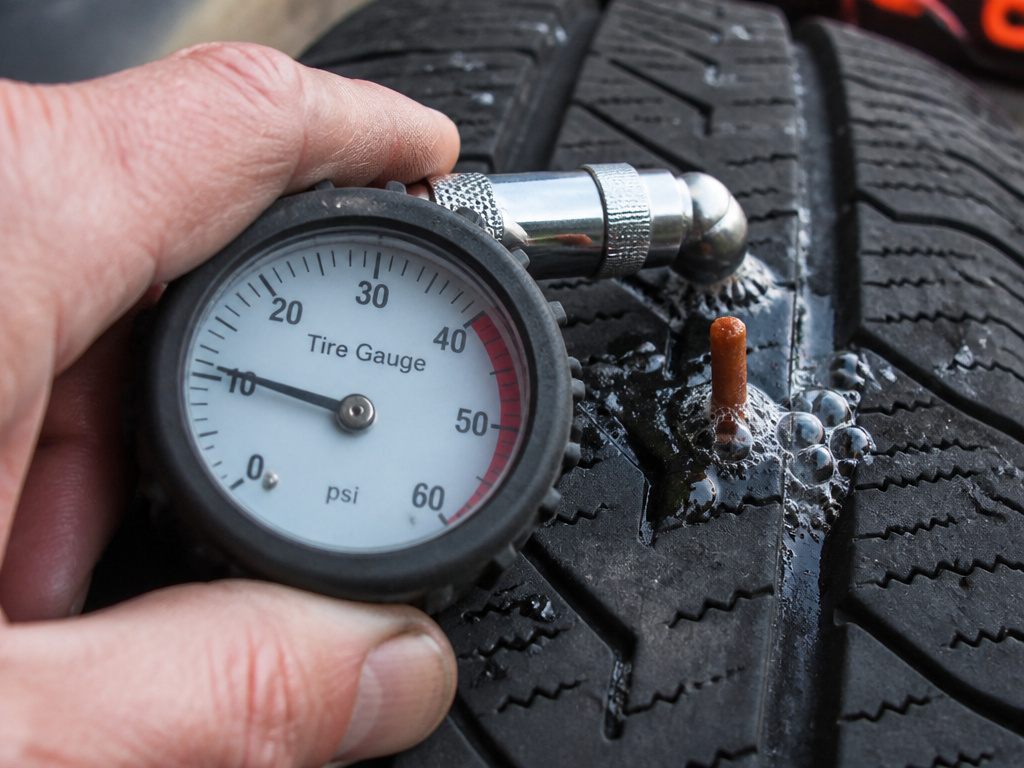
AAA gives no reliable mileage figure for a plug. It says a temporary plug should stay under 50 mph and cover only the distance to a repair shop.
I would not treat a plug as a mileage promise. If you are weighing the question of how long a tire plug lasts, focus on the failure pattern. A leak shows as a thin hiss near the tread. A soap-solution check can reveal bubbles at the repair. A cold-pressure drop after topping off is the quiet sign.
- Listen for a thin hiss. A plug that fails to seal can let air out in a steady stream.
- Look for soap bubbles. Goodyear’s inspection method uses water or a soap solution to find leaks.
- Check cold pressure. A hot gauge can hide a leak, because driving raises tire temperature and pressure.
- Watch the plug tail. If the plug looks loose, cut short, or pushed out, stop driving and inspect.
Easy to miss: A hot tire reading at or below recommended cold pressure can mean dangerous under inflation. USTMA says check pressure when the vehicle has been parked for at least 3 hours or driven less than one mile at moderate speed.
What a Full Repair Involves (and What to Do in the Meantime)
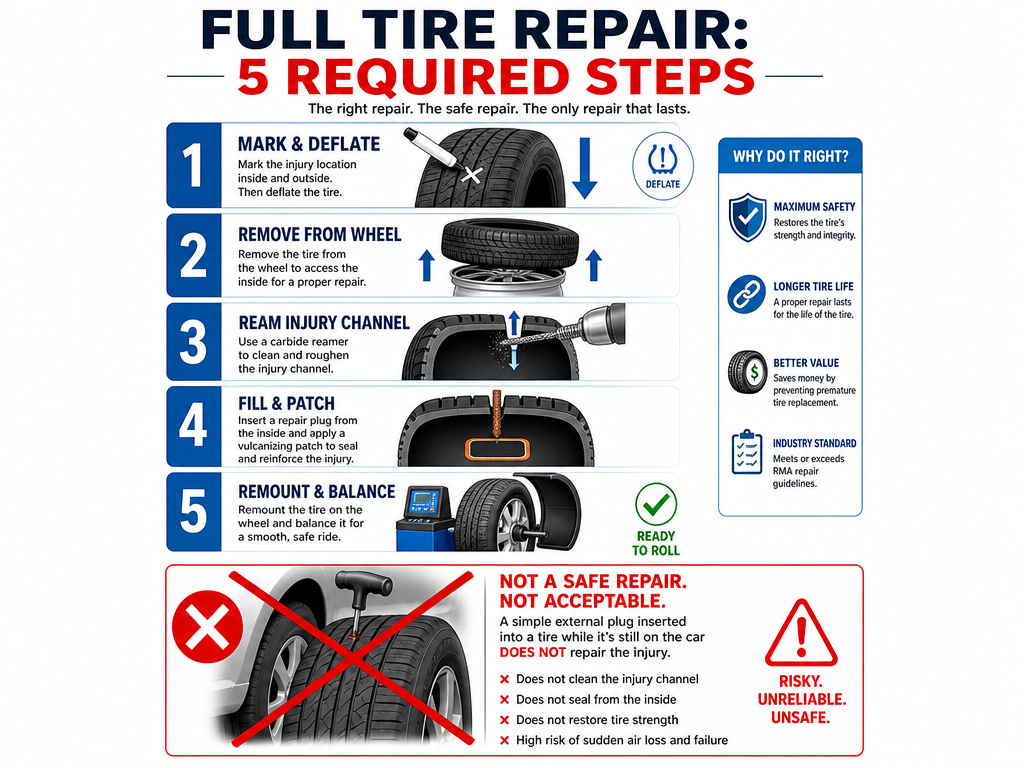
Three things happen in order: inspection, filling, sealing. A full repair starts with the tire off the wheel.
If you have a spare, use it to fix a flat tire by installing it and leaving the suspect tire for inspection. A tire with a nail in it can become a plugged tire if the nail is pulled and no accepted repair follows. The main risk of the process of plugging a tire is a skipped inspection.
A shop performs the repair using proper equipment. Goodyear says don’t mix repair products from different manufacturers.
Before you start: Tire changing can burst a damaged assembly with explosive force. Goodyear warns that underinflated tires can suffer sidewall zipper ruptures. A zipper rupture is a sidewall split that can burst. Use a trained person, a restraining device, or call for help before inflating a suspect tire.
Temporary Roadside Choices
If a trained technician is unavailable, treat a plug as a last resort. Continental says a consumer should never repair a damaged tire, while USTMA and Michelin focus on the requirement that a tire be removed from the wheel for inspection prior to repair. USTMA and Michelin say an on-the-wheel or outside-in plug is improper.
A trained technician does the following steps. Skipping one leaves a hidden failure path.
- Mark and deflate the tire. Without this, the leak hides and bead damage stays hidden.
- Remove it from the wheel. USTMA and Michelin say internal inspection must happen before repair.
- Ream the injury channel. Goodyear says a technician must remove all damage. Use a drill to ream the injury channel; leftover material can rust and weaken the repair.
- Fill the channel and apply the inner-liner patch. A plug alone leaves air pressure pushing against an unsealed liner.
- Remount, inflate, and balance. An unbalanced repaired tire can vibrate and hide a slow leak.
Michelin says even a short distance driven while flat can damage the sidewall and carcass. The carcass is the tire’s structural body.
If the plug fails and the tire must be replaced, AWD and 4WD owners need extra care. The USTMA care manual warns that small differences in outside diameter may cause drivetrain damage. I have told drivers not to replace just one tire when the others have noticeably less tread. That mismatch can upset handling and strain the drivetrain.
Run-Flat, Speed-Rated, and Warranty Limits
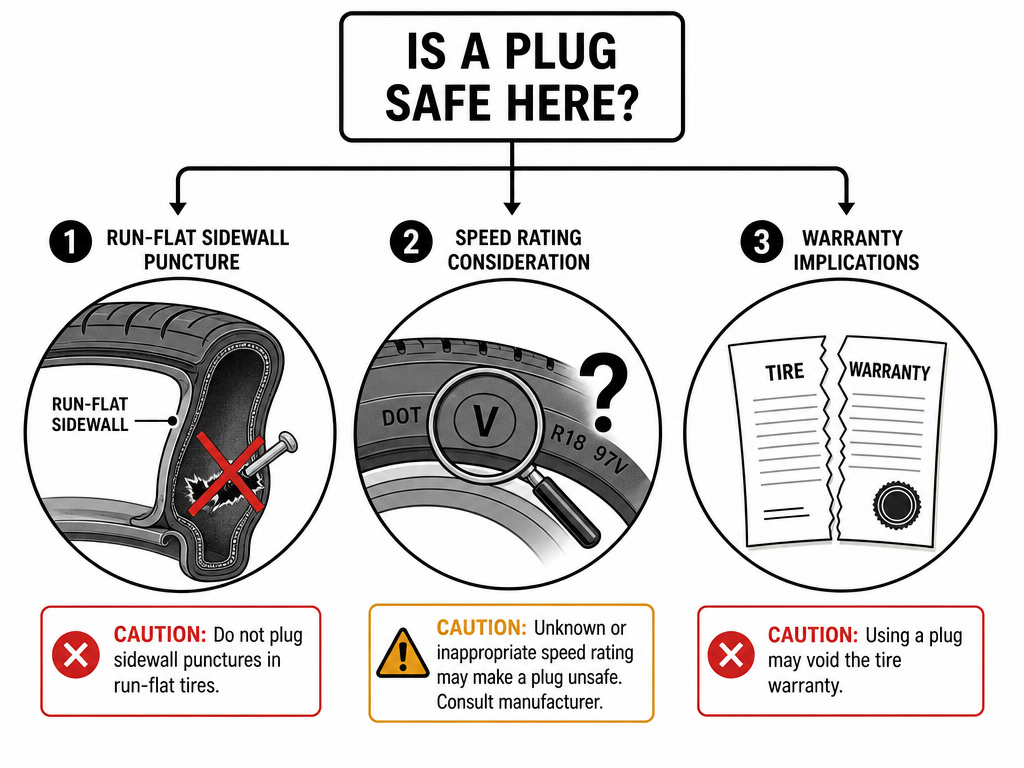
1/4 inch is the easy limit. The harder limits are run-flat technology, speed ratings, and warranty policy.
Goodyear says some run-flat tires can’t be repaired; the tire maker must review the repair policy. Continental goes further: it doesn’t recommend repair or reuse of its SSR self-supporting run-flat tires. A repair for a sidewall puncture is already outside the standard repair zone, so run-flat sidewall damage is a replacement question.
For speed-rated tires, Goodyear says a shop must contact the tire manufacturer about repair policy and whether the speed rating stays after repair. A speed symbol is the letter in the service description, such as H, V, or W, that marks the tire’s rated speed.
Continental says a repair to one of its tires invalidates the manufacturer warranty. The buyer needs the tire maker’s written policy before accepting a plug or patch.
I would not ask a shop to plug a run-flat until the maker’s policy is clear.
- Run-flat: Goodyear says some can’t be repaired; Continental doesn’t recommend repair or reuse of SSR tires.
- Speed rating: Goodyear says the tire maker must review repair policy and whether the rating stays.
- Warranty: Continental says a repair invalidates its manufacturer warranty.
What to Check After a Plug or Repair
A repaired tire still needs cold-pressure checks. The first cold morning after a repair is the honest test. A warm gauge can read higher because driving heats the tire.
The light truck tire care standards say check all tires with an accurate gauge at least once per month. They also say check before each trip and each morning during a trip. That cadence catches a slow leak before it becomes a roadside decision.
I trust a monthly gauge check more than a dashboard light. Simple. Inspect.
- Check pressure cold. Parked for at least 3 hours, or driven less than one mile at moderate speed.
- Inspect the repair area. Look for bubbles, hiss, loose plug material, bulges, or tread cracking.
- Watch tread wear. Michelin recommends regular tire rotation and alignment checks.
- Compare tires on AWD and 4WD vehicles. A single replacement can create a diameter mismatch that stresses the drivetrain.
Common mistake: A plug-only repair can look tight for thousands of miles, then fail suddenly and without warning. AAA says its lifespan is never certain.
What do people say about driving on a plugged tire?
Online forums are full of personal stories about tire plugs. Many users report driving for years on a plug without issue, often describing it as a cheap and effective fix they did themselves. Others share cautionary tales of plugs failing, leading to slow leaks or sudden blowouts, especially at highway speeds. These experiences highlight a key divide. While a plug can seem to work, industry standards are clear that a plug alone is not a permanent repair. The consensus among professionals in these discussions is that personal success stories do not override the need for a proper, internal inspection and a combined plug-and-patch repair performed by a trained technician to ensure long-term safety.
What does a proper tire plug look like?
A simple, string-like plug inserted from the outside is a temporary emergency fix. A proper, permanent repair is a combined plug-and-patch unit, often called a patch-plug or a radial patch. This repair is installed from the inside of the tire after it has been removed from the wheel. You will not see the patch from the outside; you will only see the plug stem filling the hole in the tread. The critical difference is the internal seal. Industry guidelines state that using only an external plug or only an internal patch is an unacceptable repair for a puncture.
Frequently Asked Questions
How long can you drive on a tire that’s plugged?
AAA says only the distance needed to reach a repair shop, staying under 50 mph. It gives no reliable mileage for a plug used beyond that.
How many times can you have a tire plugged?
USTMA says repairs cannot overlap. Goodyear says the number of repairs depends on manufacturer policy and tire condition after inspection.
Can you trust a plugged tire?
You can trust a plug only as a temporary stopgap. USTMA, Goodyear, Continental, and Michelin require a plug plus patch for a permanent repair.
How long should I let a tire plug dry?
Plug itself doesn’t dry. Goodyear says cement must dry per repair material instructions, and cold or humid conditions can require more time.
The Bottom Line
When you ask, is it safe to drive on a plugged tire, the honest answer is: only while you get to inspection. A plug without an inner-liner patch and an inside check is unfinished work.
If the plug was inserted from the outside and the tire never came off the wheel, treat it as a warning light. Check cold pressure now, then book an inside inspection before the next highway trip.
If you have a full-size spare and safe storage, using the spare is the cleaner choice. I prefer to see a replaced tire than a years-old plug.
