
Tire Puncture Repair Zone Explained: What Can Be Fixed?
This post contains affiliate links. As an Amazon Associate, we earn from qualifying purchases.
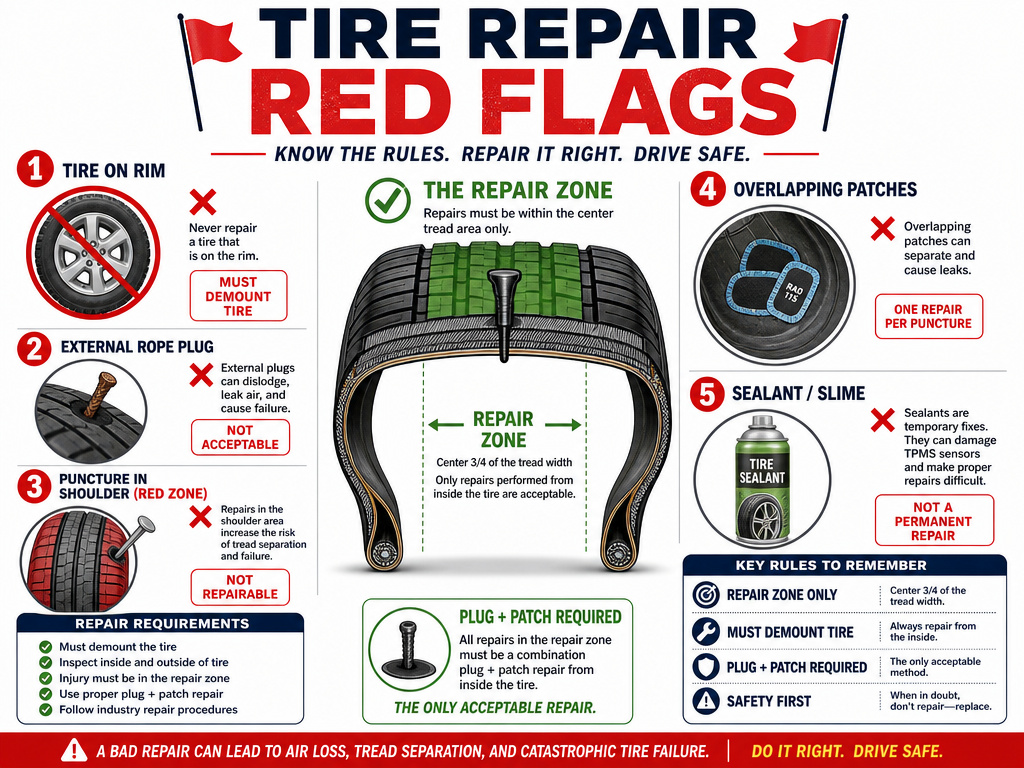
The tire puncture repair zone explained by USTMA is the tread area only, not the shoulder or sidewall. A puncture up to 1/4 inch (6mm) can be repaired from inside, with a plug stem and patch. Outside-in plugs aren’t accepted.
That tread area is narrower than a quick look suggests. It doesn’t include the shoulder or sidewall. The 1/4 inch limit is tied to the injury size. The repair unit must fill the channel, and the patch must seal the innerliner (the rubber layer that holds air).
What follows: the zone boundaries, the plug and patch rule, the brand and tire type exceptions, and the checks that keep a shop honest.
Key Takeaways
- Repair only the tread area, not the shoulder, belt edge, sidewall, or bead.
- Demount the tire for a full inside inspection before any repair.
- Use a plug stem and patch, not a plug alone or patch alone.
- Check tire maker policy for run flats, sealant tires, and speed rated tires.
- Replace a tire with an existing improper repair or damage that touches the shoulder.
Tire Puncture Repair Zone Explained: Where Does It Begin?
The zone starts at the tread crown and stops before the shoulder. The USTMA puncture repair procedures (U.S. Tire Manufacturers Association) define it as the tread area only. A puncture in the sidewall or bead is outside the zone. Damage that reaches the shoulder or belt edge is also outside the zone.
A passenger or light truck tire puncture repair is limited to the tread area. The tire must be removed from the rim for internal inspection. The injury cannot exceed 1/4 inch in diameter. A rubber stem must fill the puncture channel, and a patch must seal the innerliner. Plug only or patch only repairs aren’t acceptable.
The boundaries are simple, but they decide the whole job.
- Tread crown: the center contact area is the only repairable zone.
- Shoulder and belt edge: if the puncture touches this area, the tire is out of service.
- Sidewall and bead: the standard says not to repair damage in these areas.
The standards don’t give a separate distance from the tread edge. They say don’t repair if damage extends into the shoulder or belt edge.
A sidewall puncture can’t be fixed by the standard. If a shop says it can, stop. The USTMA wall chart says repairs are limited to the tread area.
Why the 1/4 Inch Hole Limit Is Not a Suggestion
The 1/4 inch limit is a hard line. USTMA and Continental cite 1/4 inch (6mm) for passenger and light truck tires through Load Range E (a light truck load category). Continental cites the RMA (Rubber Manufacturers Association) wall chart. Toyo states the same 1/4 inch size, but it writes the metric value as 6.4mm, while USTMA and Continental cite 6mm. That small difference matters when a shop measures a hole after preparation.
| Source | Maximum Puncture Size | Scope in the Document |
|---|---|---|
| USTMA | 1/4 inch (6mm) | Passenger and light truck tires |
| Continental (citing RMA) | 1/4 inch (6mm) | Through Load Range E |
| Toyo Tires | 1/4 inch (6.4mm) | Passenger and light truck tires |
A 1/4 inch hole can look like a pencil eraser. The plug stem can feel tight through the rubber. If the hole is larger, the standard doesn’t allow the repair.
The diameter line
The size limit applies after preparation. A hole larger than the limit can’t be repaired.
The angle line
Goodyear says an injury over 25 degrees needs a two-piece repair system. The two-piece system is a repair limit.
The overlap line
Repairs can’t overlap. If a new patch touches an old patch, the tire fails the rule.
What a Proper Plug and Patch Repair Must Include?
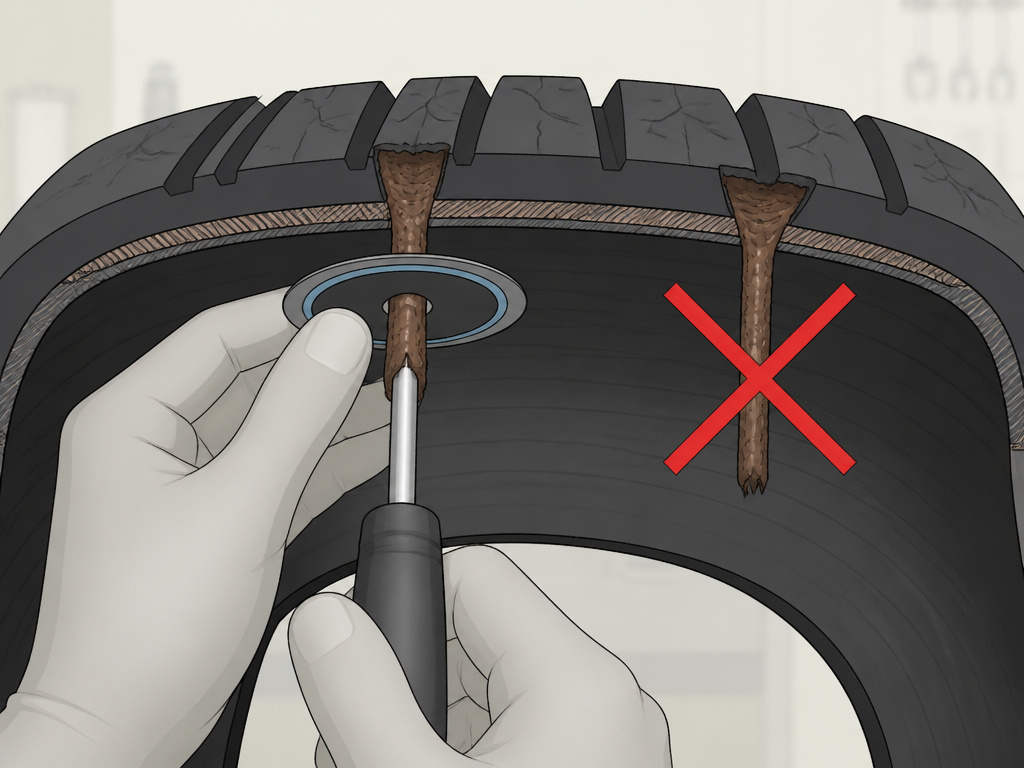
A proper repair uses a plug stem and a patch. The plug stem fills the puncture channel. The patch seals the innerliner. The USTMA tire repair basics page repeats the same rule. A plug alone doesn’t seal the innerliner. A patch alone doesn’t fill the puncture channel.
Before you start: Only trained tire service personnel should remove and repair a tire. An improperly repaired tire can fail in service. If aerosol sealant was used, vapors can ignite during demounting and cause serious injury.
The shop should follow a sequence. If one step is skipped, the repair can become unsafe.
- Remove the tire from the rim. If this is skipped, innerliner damage can stay hidden.
- Inspect the inside of the tire. A missed cut or abrasion can make the tire unsafe.
- Confirm the puncture is in the tread zone and under the size limit. A shoulder injury or larger hole can’t be repaired.
- Install a combination plug and patch. A plug only or patch only isn’t acceptable.
I won’t accept a plug only repair from a shop. The standard requires a plug stem and an inside patch.
A plug only repair is like sealing a pot with tape. It can stop a drip, but it can’t take the heat.
For the parts themselves, a shop should understand the difference between a plug and a patch before it touches your tire. If the job is done right, the internal patch seals the innerliner. The tire plug fills the puncture channel.
A combination plug and patch kit is required for a standard repair. Aerosol sealants are temporary and not a combination plug and patch repair.
Which Tire Types and Brands Change the Rules?
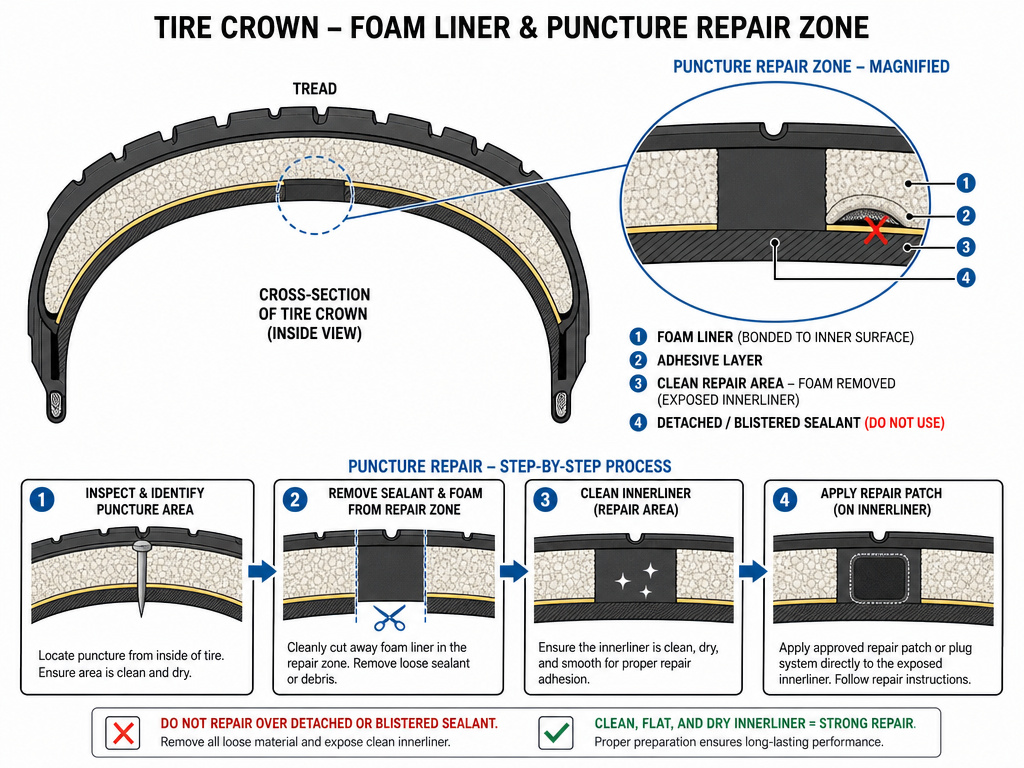
A foam-lined tire taught me to ask before the tire is on the lift. Foam is bonded inside the crown of some tires. The adhesive area has to be clear. Some shops cut the foam away locally, and others refuse the job. I now treat a sidewall or large crown puncture on a foam-lined tire as a replacement.
Run flats and sealant tires have different policies. The NHTSA technical service bulletin adds steps for Bridgestone B-Seal tires (a Bridgestone innerliner sealant). It says to remove the sealant from the repair area, clean the innerliner, then follow USTMA procedures. If the sealant is blistered, lifting, or detached, the tire should not be repaired.
| Tire Type or Condition | What the Source Says | Practical Move |
|---|---|---|
| Continental SSR run flat | No repair or reuse | Replace |
| Goodyear run flat | May be repaired per wall chart | Ask for USTMA steps |
| Bridgestone B-Seal | Repair only after sealant removal and inspection | Replace if sealant detached |
| H and above speed rating | Goodyear allows one repair to maintain rating; Toyo reduces rating to H | Confirm policy before repair |
Speed ratings also change. Toyo says original speed ratings Y, W, Z, V, VR, and H become H, with a maximum speed of 130 mph, after a puncture repair. Sources differ: Goodyear says for H and above speed rated tires, it allows only one properly performed puncture repair for the speed rating to be maintained, while Toyo Tires states the speed rating will be reduced (e.g., to H with a maximum speed of 130 mph).
How Do I Know If a Shop Did the Repair Right?
Ask one question before the tire leaves the shop: “Did you remove the tire and install a plug stem and patch?” If the answer is no, the repair isn’t proper. If the shop used a plug from the outside only, it didn’t follow the standard.
If you wonder whether it is safe to drive on a plugged tire, the repair standard says no when a plug only was used. The durability of a tire plug depends on whether the patch seals the innerliner. Don’t let a shop plug the tire from outside only. The innerliner stays exposed, and the tire can fail in service.
A tire with 2/32 inch (1.6mm) or less tread remaining is worn out. USTMA, Continental, and Toyo all say it can’t be repaired.
Red flags:
- A shop refuses to demount the tire.
- The repair is only a rope type external plug.
- The puncture touches the shoulder, belt edge, sidewall, or bead.
- There is an older plug or patch in the same area.
- The tire has aerosol sealant and the shop doesn’t clean and inspect it first.
The Bottom Line
The tire puncture repair zone explained by USTMA is narrow. It is the tread area, under the size limit, and repaired from the inside. The plug and patch pair is the only accepted method in the standard.
If a puncture touches the shoulder or belt edge, replace the tire. If a shop leaves a plug only repair, ask for a combination plug and patch repair performed with the tire removed from the wheel or seek another shop. For foam-lined tires, ask about the foam before the tire is on the lift.
One rule I won’t bend: no demount, no accepted repair. The inspection finds hidden innerliner damage.
Plug vs. Patch comparison
Using only a plug or only a patch is not an acceptable repair. Industry standards from the U.S. Tire Manufacturers Association require a combination repair. A rubber stem, or plug, is used to fill the puncture channel from the inside. A separate patch is then applied to the inner liner to create an airtight seal. This two-part system addresses both the injury path and the inner sealing surface. Rope-type repairs inserted from the outside are considered improper. A proper repair always requires the tire to be removed from the wheel for internal inspection and application of both components.
Specific distance from tread edge (e.g., 1/2 inch rule)
Repairs are limited to the tread area and must stop before the shoulder. The shoulder is the curved area where the tread meets the sidewall. Damage that extends into the shoulder or belt edge area cannot be repaired. A puncture that angles into the shoulder is also outside the safe repair zone. The exact distance from the tread edge is not a fixed number in industry guidelines; it is defined by the tire’s specific construction. If the injury is near the edge of the tread pattern, a professional must inspect to confirm it is fully within the flat tread area and does not reach the shoulder.
Frequently Asked Questions
Can you patch a 1/4 inch hole in a tire?
Only if the hole is in the tread area and the tire is removed for inspection. The repair must use a plug stem and a patch. A larger hole is outside the accepted limit.
What area of a tire cannot be patched?
The shoulder, belt edge, sidewall, and bead are outside the repair zone. Damage that extends into the shoulder at an angle is also not repairable.
Is a tire plug safe as a repair?
Plug alone isn’t an accepted repair. It must be paired with an inside patch after the tire is demounted and inspected.
Can a run-flat tire be repaired?
Sources differ. Continental doesn’t recommend repair or reuse of its SSR run-flat tires. Goodyear says run-flat tires may be repaired using the USTMA wall chart method. Ask the tire maker before accepting work.
Does a repaired tire keep its speed rating?
It depends on the tire maker. Goodyear says one proper repair can maintain the speed rating for H and above tires. Toyo says Y, W, Z, V, VR, and H ratings become H, with a maximum speed of 130 mph.
