
Tire Chunking and Chipping Explained: How to Inspect Tires
This post contains affiliate links. As an Amazon Associate, we earn from qualifying purchases.
Tire chunking and chipping explained: chunking is rubber tearing from tread blocks, while chipping is smaller surface fragments breaking away. Some standards call chunking a test artifact; U.S. Regulations treat it as a failure. The fix depends on depth, location, and whether reinforcing materials are exposed.
That depth-and-location distinction is what separates a tire you keep from one you scrap. Michelin’s own service bulletin splits decoupling groove damage into three classes, and the cutoff between “keep driving” and “remove from service” sits at a specific millimeter measurement.
What follows: the two failure modes and how they look, the mechanism behind rubber tearing, the standards fight over whether chunking matters, a step-by-step inspection you can do in your driveway, and the repair-versus-replace rules that decide your next purchase.
Key Takeaways
- Chunking tears rubber from tread blocks; chipping removes smaller surface fragments. Depth and location decide severity.
- FMVSS 139 S.6.3 fails tires for chunking; ISO 10191 calls it a test artifact. U.S. And international standards disagree on whether it matters.
- Michelin’s 2mm splitting threshold separates “keep driving” from “remove from service.” Measure the groove bottom.
- Dismount the tire and check the inner liner after any hard impact. Damage shows inside before it shows outside.
- Tires six to 10 years old face higher failure risk regardless of tread depth. Read the DOT code on the sidewall.
Tire Chunking and Chipping Explained: What You See on the Tread
You’re washing the car on a Saturday and notice a ragged edge on the shoulder block. A small piece of rubber hangs loose, barely attached. That’s chipping. Now picture a gouge the size of a dime torn clean out of the tread face, leaving a rough crater. That’s chunking.
Parasitic Tread Block Chunking, as defined in ISO 10191:2021, is a non-structural, test-induced artifact not seen in real-world operation. GB/T 4502-2023 describes the same phenomenon as rupture or tearing of rubber inside a tread block without exposure of reinforcing materials. Both standards classify the event as a testing byproduct, not a driving hazard.
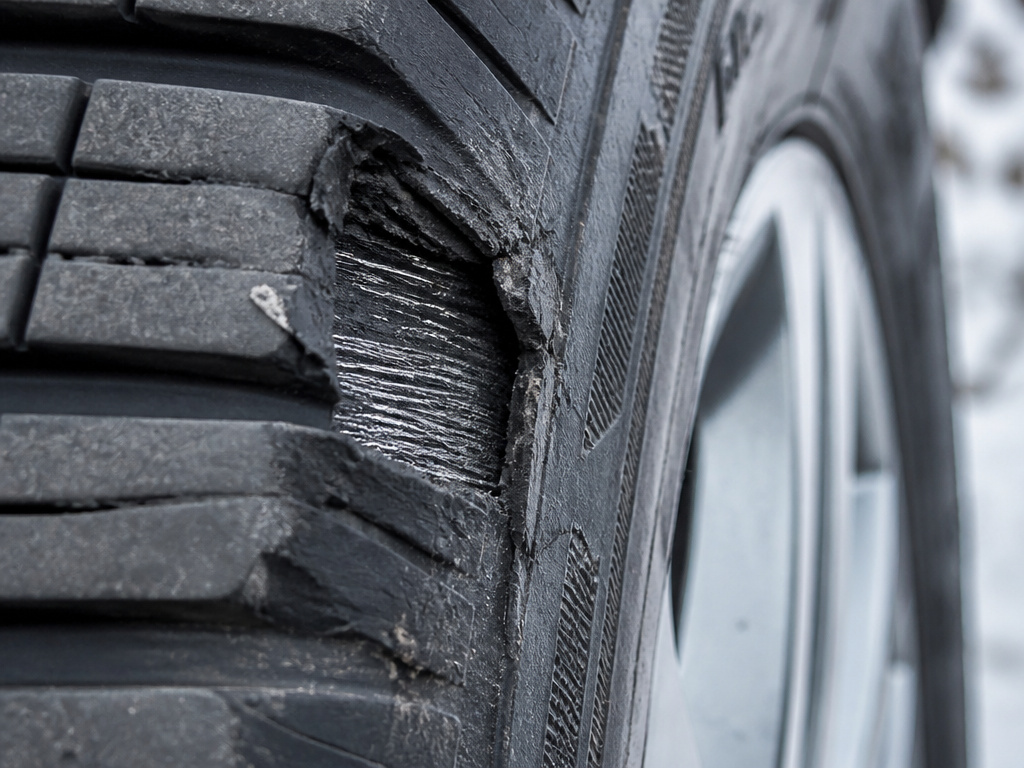
The visual gap between these two damage types is where most drivers get confused, which is why a clear tire chunking and chipping explained guide is essential. Chipping shows up as tiny nicks along groove walls or block edges. You can catch them with a fingernail. Chunking removes a meaningful volume of rubber in one piece, and the crater has hard, jagged edges you feel under your thumb.
Chunking vs. Chipping: The Practical Difference
| Damage Type | What You See | Structural Risk |
|---|---|---|
| Chunking | Rubber torn from tread blocks, crater-like edge | High if reinforcing materials exposed |
| Chipping | Small fragments missing from block edges, groove walls | Low to moderate |
| Tread separation | Tread peels off in long strips, exposing belt cords | Critical, immediate failure |
For daily driving, chunking is the one to worry about. Chipping is cosmetic and you can monitor it over several oil changes. Chunking means the block is losing structural rubber, and the remaining tread flexes harder under load. Once the shoulder block loses enough material, the adjacent blocks tear more aggressively. The damage spreads.
If you’re comparing this to other forms of irregular tread damage, the mechanism differs. Cupping and feathering come from suspension or alignment issues. Chunking comes from the rubber itself failing under stress. The tire wear patterns guide covers those distinctions in more detail.
And if you’re seeing long strips of tread peeling away rather than individual blocks losing chunks, that’s a different failure entirely. Tread separation involves the bond between the tread and the belt breaking down, and it’s an emergency regardless of depth.
Why Rubber Tears Out of Tread Blocks
The shoulder blocks take it worst. Every time you turn the steering wheel, the outer shoulder flexes, scrubs against the pavement, and generates heat. Over thousands of cycles, the rubber at the block base fatigues. Eventually a chunk breaks free.
Think of the rubber compound like a cooking sauce. The polymer and silica ratios set how the tread handles heat and flex. A compound that’s too stiff for the conditions cracks and chips under repeated scrub, the same way a sauce with too little fat scalds and sticks to the pan. No amount of brand name on the sidewall fixes a compound that’s wrong for your climate.
Inflation pressure drives a lot of this. I stopped treating the maximum pressure stamped on the sidewall as a target. That number is a limit for the tire, not a recommendation for your car. I start from the door placard instead. Underinflation causes the sidewall to flex too much, creating heat that weakens the shoulder rubber and leads to tearing. Overinflation concentrates the load on the center ribs and starves the shoulders of proper contact, but the scrub stress at the edges still builds.
The Michelin technical bulletin identifies four probable causes for sacrificial rib and decoupling groove damage: zero-speed turning, over-flexing in high-scrub applications, hazards like potholes and curbs, and operating at excessive temperature. All four concentrate stress at the groove bottom, where the rubber is thinnest.
That last one matters more than most drivers realize. A sustained highway run with underinflated tires can lead to operating at excessive temperature, which is a probable cause for sacrificial rib/decoupling groove damage. The rubber softens, the blocks deform, and the shoulder tears. Pothole damage accelerates this because the impact creates a stress riser at the block base, and the next flex cycle pulls a chunk free from that weakened point.
The U.S. Tire Manufacturers Association lists proper inflation, loading, rotation, and inspection among the factors that govern tire service life. Their tire maintenance and service manual is blunt about it: most premature damage traces back to maintenance gaps, not manufacturing defects.
Is Tire Chunking Actually a Safety Failure?
Here’s where the article gets complicated, because the sources genuinely disagree.
| Standard or Regulation | Treats Chunking As | Consequence |
|---|---|---|
| ISO 10191:2021 | Non-structural test artifact | No failure flag |
| GB/T 4502-2023 | Test-induced, not seen in driving | No failure flag |
| FMVSS 571.139 S.6.3 | Test failure | Recall and replacement |
| Transport Canada (winter tires) | Removed as failure mode | No recall for PTBC |
FMVSS 139 is the U.S. Federal standard that governs new radial tires for light vehicles. Section 6.3 states that a tire fails the endurance test if “chunking of the tread rubber” occurs. That’s not a guideline. That’s a pass-or-fail criterion, and NHTSA has used it to pull tires off the road.
The recall report 25T008 documents 6,888 Michelin AGILIS Cross Climate DT tires, size 185/60R15C 94T, recalled because internal surveillance testing in March 2025 found “chunking of the tread rubber at the base of the shoulder blocks.” The tires were produced from October 1, 2023 through April 26, 2025. Michelin filed the report on May 21, 2025.
What the Recalls Actually Show
Goodyear’s Dunlop SP50 recall, campaign 16T-011, covered 16,757 tires in size P205/70R15 95T. Those were manufactured between December 2, 2012 and February 1, 2014. Goodyear filed the recall on August 10, 2016, citing potential “tread chunking in service” as noncompliance with FMVSS 139.
Numbers don’t have a marketing department. Six thousand eight hundred and eighty-eight tires and sixteen thousand seven hundred and fifty-seven tires were pulled for failing FMVSS 139 due to chunking.
ISO and GB/T say the chunking is a bench artifact from roadwheel testing. Transport Canada agreed enough to remove PTBC as a failure mode for winter tires specifically. But NHTSA hasn’t amended FMVSS 139 to reflect that position.
For your daily driving, the practical takeaway is simple: if your tire size and DOT code match a recall, stop reading and call your dealer. The rest of this article assumes you’re checking for damage outside a recall context.
How to Inspect for Chunking Before It Gets Worse
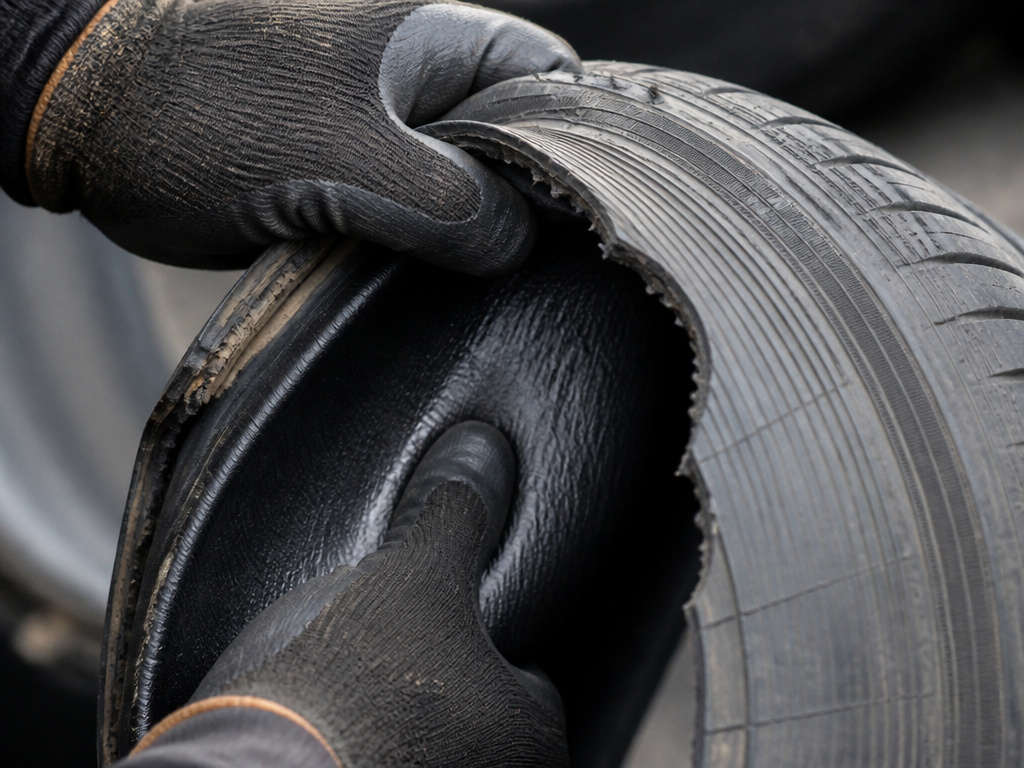
Before you start: Fully deflate the tire before breaking the bead; a pressurized sidewall can rupture and cause serious hand or face injury. Wear cut-resistant gloves when handling tread with exposed cords, since torn rubber edges are sharp. Do not test a suspected structural failure by driving on it. If chunking has reached the reinforcing layer, the tire can delaminate under load within minutes.
Check the sidewall. The DOT Tire Identification Number’s last four digits tell you the week and year of manufacture. A code reading 0308 means the third week of 2008. NHTSA notes that some vehicle and tire manufacturers recommend replacing tires six to 10 years old, regardless of tread depth. If you’re checking a tire that’s eight years old and seeing any chunking, the compound has already hardened and lost flexibility.
Here’s the sequence I use after a hard pothole hit, even when the air pressure seems fine:
- Pull the tire off the rim. A tire inspection that stops at the outer surface misses the damage that matters most. Impact breaks show on the inner liner before they show on the tread.
- Run your hand across the tread face. Chunking feels like a scoop of rubber is missing. You’ll find a hard edge where smooth tread used to be. Chipping feels like sandpaper grit along groove walls.
- Press the inner liner with your thumbnail. A soft spot or a raised bump means cord damage. If you find one, the tire goes.
- Check the shoulder blocks at the base. This is where the recall documents show chunking starts. Check for a rough, torn crater rather than a clean cut.
- Measure any groove splitting with a caliper or a folded business card. The 2mm threshold (from Michelin’s bulletin) is the line between “monitor” and “remove.”
I’ve come around on step one. For years I’d glance at the outer tread and call it fine if the pressure held. Then I started pulling tires off the rim after pothole hits and found inner-liner scarring that would have gone unnoticed. Run-flats are the worst offender here: Continental’s repair guidance notes that internal structural damage from driving underinflated may not be visible on the surface at all.
Can You Repair a Chunked Tire?
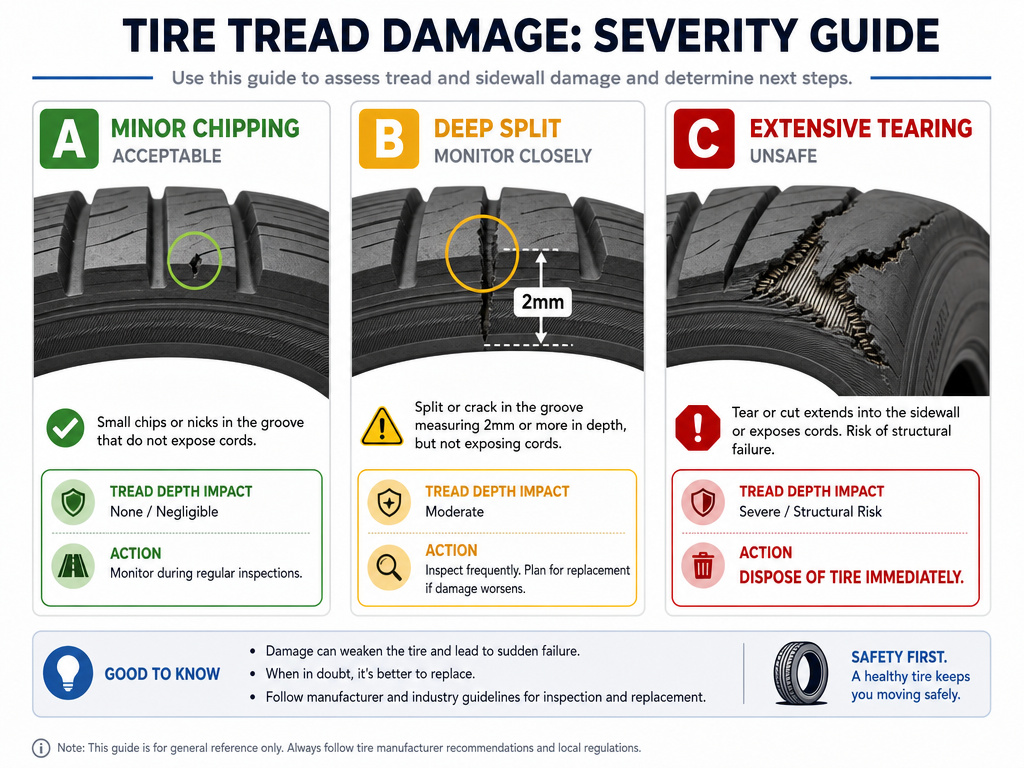
Two millimeters. That’s the line.
Michelin’s bulletin classifies sacrificial rib and decoupling groove damage into three severity levels.
| Class | Groove Condition | Action |
|---|---|---|
| A | Chipping, no splitting at groove bottom | Keep in service |
| B | Splitting deeper than 2mm at groove bottom | Remove, evaluate for retread |
| C | Extensive tearing, sidewall rubber opens | Remove and dispose |
The bulletin covers commercial Line Haul tires, and my fleet experience is thin. But the three-class model applies the same logic to any tire with a decoupling groove or sacrificial rib design.
The Repair Rules That Actually Matter
Continental’s repair guidance, built on Rubber Manufacturers Association standards, draws hard lines:
- Never repair a tire worn to 2/32 inch remaining tread depth in any area. That’s the wear indicator level.
- Puncture repairs are limited to injuries of 1/4 inch (6mm) diameter in the tread area. Anything extending into the shoulder or belt edge means the tire is scrapped.
- Never plug from the outside. The tire must come off the rim for internal inspection, and the injury must be filled with vulcanizing material plus a patch on the inner liner.
If you’re wondering whether to repair or replace, the answer for chunking is almost always replace. A chunked block has lost structural rubber. Filling a crater with vulcanizing compound doesn’t restore the block’s flex pattern, and the adjacent blocks will tear next. Continental states plainly that a consumer should never repair a damaged tire, and that repair invalidates the manufacturer’s warranty.
For Class C damage, the tire is done. Disposal and tire recycling is the only path. Don’t let a shop talk you into a “temporary fix” on a tire with sidewall tearing.
And here’s my blunt opinion on when to replace tires after chunking: if the crater exposes any fabric or steel cord, the tire is a tire blowout waiting for the next highway exit ramp. The exposed cord degrades within a few wet drives, and the structural failure follows fast.
Why Winter Tires Get Special Treatment (and Why Tire Age Matters)
Transport Canada will remove PTBC as a failure mode specifically for winter tires in high-speed endurance and low-pressure tests. The agency won’t extend that removal to all tire types at this time. One stakeholder suggested the change for all tires. Transport Canada declined, citing the “unique performance characteristics” of winter compounds.
Here’s the mechanism. Winter tires run softer rubber with higher silica content so the tread stays flexible in cold conditions. That same soft compound flexes more under the endurance test conditions: a 34-hour run at 110 km/h with inflation pressure 25 percent below maximum and loads cycling through 85, 90, and 100 percent of maximum. After that, a 90-minute low-pressure test runs at 110 km/h with pressure about 42 percent below maximum at 100 percent load.
The soft compound tears on the test bench. On a snowy road, it doesn’t. ISO 10191 and GB/T 4502-2023 both say the chunking is a testing artifact. Transport Canada agreed for winter tires. The USTMA petitioned NHTSA in February 2020 to remove PTBC as a failure criterion for all tires, while NHTSA’s FMVSS 139 S.6.3 currently fails tires for ‘chunking of the tread rubber’.
Transport Canada’s position is that a targeted exception for winter tires is warranted, while not extending the removal to all tire types. The USTMA has petitioned for a broader removal. The Dunlop SP50 recall was based on ‘tread chunking in service’.
Tire age compounds the problem. NHTSA’s TireWise data shows that temperature grades (A, B, or C) indicate a tire’s resistance to sustained heat. A grade C tire deteriorates faster under hot, long-distance driving. When rubber hardens over time, the shoulder blocks can no longer flex enough to handle scrub stress. An older tire with minor chipping may be more susceptible to damage due to rubber hardening with age. Check the DOT code. If you’re past the six-year mark and seeing any edge damage, factor that into your replacement timing.
What Causes Tire Chunking from Off-Roading?
Driving off-road subjects tires to extreme forces that can lead to chunking and chipping. This damage is typically caused by the high scrub and over flexing that occurs when navigating obstacles like rocks, ruts, and uneven terrain. The rubber at the edges of tread blocks and decoupling grooves can be pinched, torn, or gouged by sharp impacts. Operating at excessive temperatures from low tire pressure or high loads can further weaken the rubber compound, making it more susceptible to tearing. Unlike some test-induced phenomena, this real-world damage from hazards is a clear sign of stress and requires a careful inspection.
Frequently Asked Questions
Is it safe to drive with a chunking tire?
Minor chipping on groove edges is a monitor-it situation. Chunking that has torn a visible crater from a tread block is not safe for highway use. If the crater exposes fabric or steel cord, the tire can delaminate under sustained load within a short drive. Replace it before your next highway trip.
What causes tire chunking and chipping?
The main drivers are underinflation or overinflation, zero-speed turning (cranking the wheel while parked), hard impacts from potholes and curbs, excessive heat from sustained high-speed driving, and a rubber compound that’s too stiff for the conditions. Aggressive shoulder scrub on tight turns accelerates all of these.
Can a chunked tire be repaired?
Not in any meaningful way. A chunked tread block has lost structural rubber, and filling the crater doesn’t restore the block’s flex pattern. Michelin’s own bulletin classifies splitting deeper than 2mm at the groove bottom as a remove-from-service condition. RMA repair standards limit puncture fixes to 1/4 inch injuries in the tread area, not block-level chunking.
What does the DOT code tell me about tire age?
The last four digits of the DOT Tire Identification Number on the sidewall encode the week and year of manufacture. For example, 0308 means the third week of 2008. Some vehicle and tire manufacturers recommend replacing tires at six to 10 years regardless of remaining tread. Check both sidewalls; the code may appear on only one.
Before You Go
One rule most guides skip: if you find splitting deeper than 2mm at the bottom of a decoupling groove or a shoulder block crater, the tire comes off. Not next week. Not after the next oil change. Remove it now. All the advice here depends on finding damage before it gets that serious.
The PTBC debate tells you something useful: not every chunk you see on a test bench predicts a real-world failure. But that argument is about regulatory classification, not about your tire. The 6,888 Michelin tires and 16,757 Dunlop tires that got recalled weren’t test artifacts. They were production tires that failed a federal endurance standard.
My honest advice: after any hard pothole hit, pull the tire and look at the inner liner. Pressure alone won’t show you cord damage. And read the DOT code before you buy. A tire that’s been sitting on a shelf for three years has already lost some of the flexibility that keeps the shoulder blocks from tearing.
