
Tire Traction Ratings Explained: How to Use Them
This post contains affiliate links. As an Amazon Associate, we earn from qualifying purchases.
Tire traction ratings are the AA, A, B, and C grades mandated by the U.S. DOT’s Uniform Tire Quality Grading (UTQG) system. They measure a tire’s straight-line wet braking grip on government-specified asphalt and concrete surfaces. An AA-rated tire must achieve a traction coefficient above 0.54 on asphalt and above 0.38 on concrete, while a C-rated tire is graded when its adjusted traction coefficient is 0.38 or less on asphalt OR 0.26 or less on concrete. The rating is a narrow snapshot of new-tire performance and does not account for cornering grip, dry traction, or snow performance.
The numbers behind those letters are locked in federal law. They come from a controlled lab test that simulates a locked-wheel slide on a wet surface. This is not a measure of how a tire feels or handles a corner. It’s a single, repeatable data point about stopping power. This is how tire traction ratings explained.
What follows is a breakdown of the legal test thresholds, the critical limitations every driver should know, and how this rating fits, or doesn’t, into a real tire traction ratings explained buying decision. We’ll also cover what happens to that rating as your tread wears down.
Key Takeaways
- The UTQG traction grade is strictly a wet, straight-line braking test, it says nothing about dry grip, cornering, or snow traction.
- A tire is graded C if its traction coefficient is ≤0.38 on asphalt OR ≤0.26 on concrete per federal regulation 49 CFR § 575.104.
- To earn an AA grade, a tire must exceed 0.54 on asphalt AND 0.38 on concrete, a threshold most high-performance summer and ultra-high-performance all-season tires meet.
- The rating is for new tires only; traction performance degrades as tread depth decreases.
- You cannot directly compare a UTQG AA grade to a European tire label’s “A” wet grip rating; the tests and scales are different.
How the Government Defines Tire Traction
Forget marketing claims about “exceptional grip” or “sport handling.” The legal definition of traction, for the sidewall stamp, is brutally specific. The Uniform Tire Quality Grading standards in 49 CFR § 575.104 spell it out: traction is “the tire’s ability to stop on wet pavement as measured under controlled conditions on specified government test surfaces of asphalt and concrete.”
The test is conducted under controlled conditions on specified government test surfaces for the tire traction ratings explained. A test tire is mounted, inflated, and tested under controlled conditions on specified government test surfaces of asphalt and concrete. The wheel is locked, and sensors measure the friction force during the slide. This gives a traction coefficient, a g-force number. That number is used to assign a grade according to federal thresholds.
The traction grade assigned to this tire is based on braking (straight ahead) traction tests and does not include cornering (turning) traction. . Official warning from the 2024 DOT tire quality grading guide
That warning is printed in the federal guide for a reason. A tire can have a fantastic AA rating for straight-line wet braking but feel numb or unpredictable in a fast corner on a damp road. The test doesn’t measure that. It also ignores hydroplaning resistance, which is more about tread pattern and groove depth.
The Four Traction Grades and Their Legal Thresholds
The grades aren’t arbitrary. Each one corresponds to a minimum traction coefficient a tire must achieve on two surfaces. The law sets the floor. Here are the exact numbers from the official 2024 49 CFR PDF:
| Traction Grade | Minimum Adjusted Traction Coefficient (Asphalt) | Minimum Adjusted Traction Coefficient (Concrete) | What It Typically Means |
|---|---|---|---|
| AA | Greater than 0.54 | Greater than 0.38 | Highest wet braking performance. Common on max-performance summer tires and many ultra-high-performance all-season tires. |
| A | Greater than 0.47 | Greater than 0.35 | Very good wet braking. The most common grade for touring and standard all-season tires. |
| B | Greater than 0.38 | Greater than 0.26 | Acceptable wet braking. Often found on some all-terrain truck tires or budget-focused passenger tires. |
| C | 0.38 or less | 0.26 or less | Marginal wet braking. May be the legal minimum for some specialty tires (e.g., certain trailer tires). |
A tire must pass the thresholds for both asphalt and concrete to earn a grade of AA, A, or B. A tire is graded C when its adjusted traction coefficient is 0.38 or less on asphalt OR 0.26 or less on concrete. Notice the jump between A and AA. That 0.07 g-force difference on asphalt is significant in testing terms. In the real world, that could translate to several car lengths of stopping distance from highway speed.
Most tires you’ll shop for are A-rated. It’s the baseline for competent wet braking. An AA rating signals a compound and tread design engineered for higher grip, often at the expense of tread life. A B rating isn’t necessarily dangerous, but it tells you wet braking wasn’t the priority. You’ll see it on tires where other factors, like off-road durability or extreme mileage, took precedence.
What the Traction Rating Doesn’t Tell You
This is the part that gets buyers into trouble. They see “AA” and assume they’re getting the best wet-weather tire money can buy. The rating is more limited than that.
First, it’s a measure of peak sliding friction on a smooth, wet surface. It doesn’t test how the tire behaves as it approaches the limit, how it communicates feedback, or how it handles a mix of dry and wet patches. The physics of tire traction is more complex than a single slide test.
Second, the test is run on new tires. A tire’s traction capability declines as the tread wears. The grooves that channel water away become shallower. By the time you hit the legal minimum tread depth of 2/32 of an inch, a tire’s wet stopping ability is a fraction of its new performance. A tire’s traction capability declines as the tread wears. Tires are not safe and should be replaced when the tread is worn down to 2/32 of an inch.
Third, it has no relation to snow and ice traction. A tire with the Three-Peak Mountain Snowflake symbol can have a B traction rating. The UTQG test uses warm water on asphalt and concrete, not packed snow. For winter capability, you need to look for the Three-Peak Mountain Snowflake symbol, not the traction grade.
Common mistake: Choosing a tire based solely on its UTQG traction grade for winter driving. The AA grade is useless on ice. Look for the mountain snowflake symbol instead.
Finally, the rating is self-certified by manufacturers following the federal test protocol. While the NHTSA does spot-check ratings, there’s no central agency testing every tire model. Consistency between brands is generally good, but it’s not an absolute guarantee.
UTQG Traction vs. Other Grip Ratings
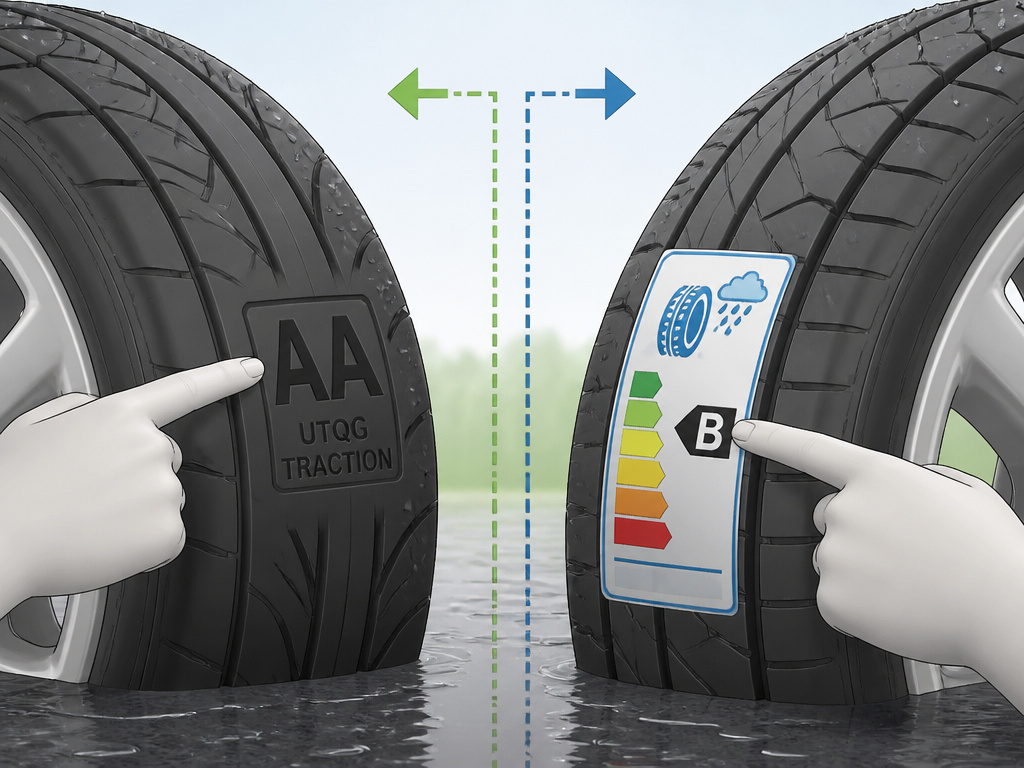
If you’re looking at tires online, you might see two different grading systems: the U.S. UTQG and the European tire label. They both have a grade for wet grip, but they are not the same.
The EU tire label uses a scale of A to E for wet grip. It’s also a straight-line braking test, but the test procedure, surface, and speed are different from the U.S. Test. An “A” on the European label does not equate to an “AA” on the UTQG scale. You cannot directly translate one to the other. A tire sold globally will have both ratings on its spec sheet, and they often don’t align perfectly. For example, a tire might be EU Label “B” and UTQG “A”.
The other two parts of the UTQG system are related but separate. The treadwear rating is a wear-life estimate. The temperature rating (A, B, C) measures heat resistance at high speeds. A tire can have an AA traction grade but a B temperature grade if its compound gets too hot during sustained high-speed driving.
How to Use Traction Ratings When Buying Tires
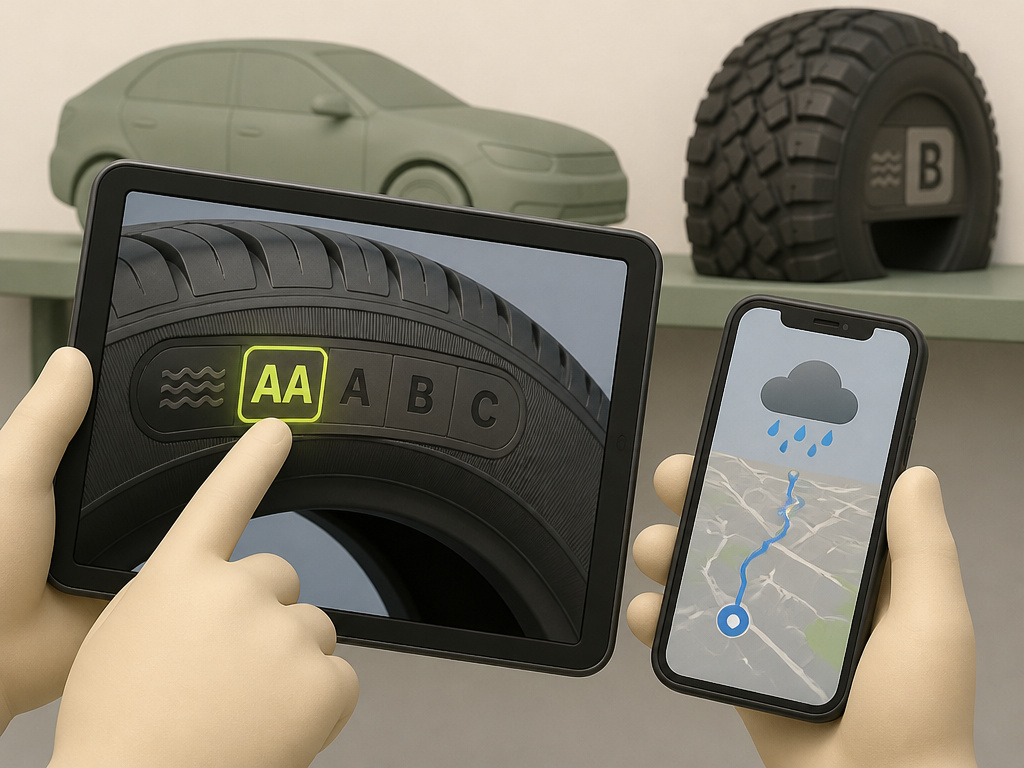
So, with all these caveats, is the traction grade useful? Yes, but as one data point among many.
For a daily driver in a rainy climate, prioritizing an A or AA grade is smart. It’s a verified indicator of strong wet braking. If you’re comparing two all-season tires from reputable brands like Michelin or Continental, and one is A while the other is AA, the AA model likely uses a stickier compound. That often means shorter wet stopping distances, but it may also mean faster tread wear.
For a performance car, an AA rating is typical for summer tires. It confirms the tire meets a high grip standard. But for track use or aggressive driving, you’d dig deeper into specific tire performance testing results and owner reviews about feel and predictability.
For a truck or SUV, don’t sweat a B rating on an all-terrain tire. The trade-off for that rating is often deeper, more durable tread blocks that work off-road. The wet pavement braking will be adequate, not exceptional.
Always remember to cross-reference the traction grade with the tire’s intended use. A high-performance summer tire with an AA rating will be terrible in cold weather. The compound hardens below 40°F, rendering that AA grade meaningless and making the tire dangerous on cold, wet roads.
What grades do most tires on the market have?
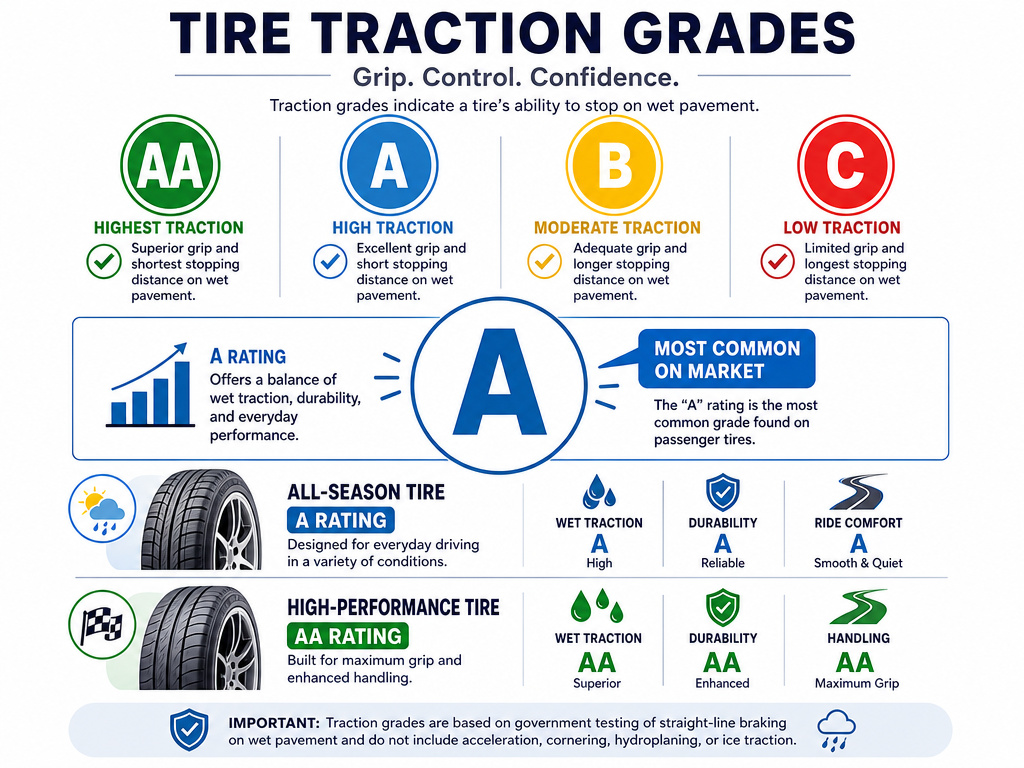
You won’t find a C-rated tire for your passenger car. The legal traction grading system has four levels: AA, A, B, and C. However, the vast majority of tires sold for normal road use achieve a grade of A. This is because the performance thresholds for each grade are set by federal regulation. A tire must meet the minimum traction coefficient on both wet asphalt and wet concrete to earn a B, A, or AA rating. The C grade represents a very low level of wet stopping power, essentially reserved for specialized tires not intended for standard highway use. When you shop, you’ll primarily see A-rated all-season and touring tires, with AA ratings more common on high-performance summer models designed for maximum wet grip.
Frequently Asked Questions
Is a tire with a “C” traction rating unsafe?
Not necessarily unsafe, but it indicates marginal wet braking performance for a passenger car tire. A C grade is the legal minimum under the UTQG system. Some specialty tires, like certain trailer tires, may carry a C rating because their design prioritizes other factors. For a primary vehicle, most drivers should look for at least a B rating, with A or AA being preferable for wet-weather security.
Do winter tires have traction ratings?
Most dedicated winter/snow tires are exempt from UTQG grading, so you often won’t see a traction grade on their sidewall. Their snow and ice performance is instead indicated by the Three-Peak Mountain Snowflake symbol. If a winter tire does have a UTQG rating, it’s usually a B or A, as the soft, pliable compounds needed for cold weather don’t always score the highest on the warm wet-surface test.
How much stopping distance difference is there between an AA and an A tire?
The federal test doesn’t publish stopping distances, only traction coefficients. The federal test doesn’t publish stopping distances, only traction coefficients.
Why do some high-end tires only have an “A” traction rating?
The UTQG traction test is very specific. A tire engineered for exceptional dry grip, steering response, and high-speed stability might use a tread compound or pattern that sacrifices a fraction of its wet sliding friction. The tire might feel vastly superior in dynamic driving but score just below the AA threshold on the standardized slide test. The rating is a narrow metric, not a full assessment of performance.
The Bottom Line
The UTQG traction rating is a useful, if limited, tool. It gives you a government-standardized peek at one aspect of a new tire’s performance: straight-line wet braking. An AA or A traction grade is a good sign for wet-weather safety.
But never let it be the only sign. Read the sidewall for the full story, the speed rating, the load index, the date code. Remember that the rating fades with tread wear. And understand that it tells you nothing about snow traction, cornering grip, or how the tire communicates with the driver.
For most drivers shopping for all-season tires, an A rating is the sweet spot, proven wet braking without sacrificing too much tread life. If you live where rain is frequent and heavy, stepping up to AA is a logical move. Just make sure the rest of the tire’s specs match your car and your driving. The details decide it.
