
Why Front Tires Wear Faster Than Rear Tires?
This post contains affiliate links. As an Amazon Associate, we earn from qualifying purchases.
Front tires wear faster than rear tires because they handle steering, bear most of the braking force, and support more of the vehicle’s weight. On a typical front-wheel-drive car, studies show front tires can wear faster than the rears, with reported ratios ranging from twice the rate to 2.6 times faster. The exact ratio depends on your drivetrain, driving style, and whether you’re navigating city streets or highways.
That 2:1 wear ratio isn’t a guess. It’s a measured outcome from controlled tests, and it changes if you drive a rear-wheel-drive truck or an all-wheel-drive SUV. Your tire’s lifespan is a physics report, written in tread rubber. Reading it tells you what your car is doing and what maintenance you’ve missed, which is why front tires wear faster than rear tires.
What follows breaks down the three physical forces at work, the hard numbers from tire research, and the specific tire rotation patterns that counter them. You’ll also learn the exceptions, the times when rear tires actually wear out first.
Key Takeaways
- Front tires on a front-wheel-drive (FWD) vehicle wear faster than rear tires, with modern studies reporting ratios from 2.0 to 2.6 times faster.
- The three culprits are steering scrub, weight shift during braking, and engine weight over the front axle.
- Check your owner’s manual for the correct tire rotation schedule and pattern; skipping rotations can void your tire’s mileage warranty.
- Rear tires can wear faster on rear-wheel-drive (RWD) vehicles, heavily loaded trucks, or cars with significant negative camber in the rear suspension.
- Urban driving accelerates front tire wear more than highway cruising due to constant steering and braking inputs.
The Physics at Play: Steering, Braking, and Weight
Look at the business end of your car. Every time you turn the wheel, the front tires scrub sideways across the pavement, a key part of why front tires wear faster than rear tires. That friction shaves rubber. It’s a gentle sanding on a highway ramp, a aggressive grind in a tight parking lot turn.
Braking piles on more work. When you hit the brakes, the vehicle’s weight pitches forward. This load transfer pushes the front tires down with more force, increasing friction and wear, which is central to why front tires wear faster than rear tires. Toyota’s guide notes this directly: front tires may wear out faster because the weight of the vehicle shifts forward during braking. Most of your stopping power comes from the front brakes, so those tires take the heat.
Then there’s the static weight. Most engines sit over the front axle, and the driver usually rides up front. Toyota points out that front tires may bear more weight than rear tires simply because of this layout. More weight means more pressure, and more pressure means faster wear.
The part nobody mentions: This wear isn’t linear. A front tire on a FWD car doing mostly city driving isn’t just wearing faster, it’s living a harder life. The combination of torque from acceleration, steering force, and brake heat creates a compound stress that a rear tire never sees.
The Numbers From the Lab
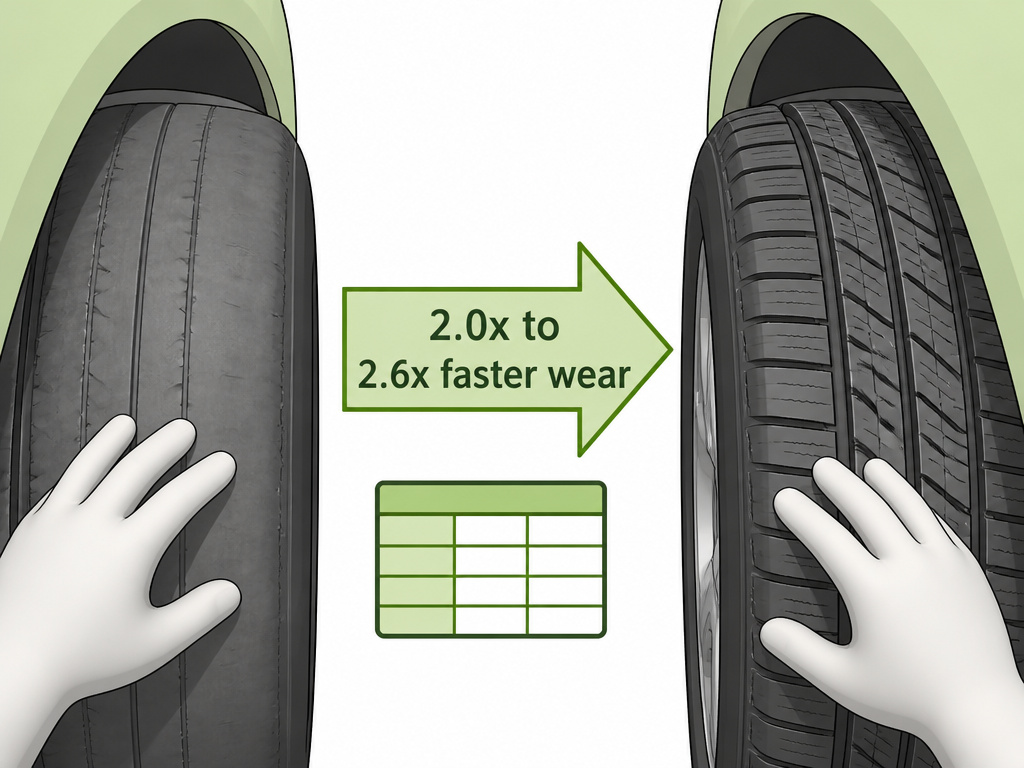
So how much faster? The data gives us a range, not a single number.
A foundational 1982 study for the Uniform Tire Quality Grading system found that on a FWD test vehicle, front tires wore at twice the rate of rear tires. A 2025 review of tire wear studies in the journal Vehicles (MDPI) reported a 2.0 to 2.6 times faster wear rate for front tires, based on data from FWD vehicles. The higher end of that range (2.6x) was observed for winter tires, which use softer compounds.
But here’s where it gets interesting. That same 1982 study found that on a rear-wheel-drive (RWD) vehicle, tires wore at “about the same rate on both sets of wheels.” Toyota’s guidance states that for RWD vehicles, you may notice the opposite, hinting that rear tires might wear faster. However, the 1982 UTQG study found that on a rear-wheel-drive vehicle, tires wore at ‘about the same rate on both sets of wheels.’
A 2024 study in Lubricants added another layer. It measured “mass loss”, the actual rubber worn away, and found front tires contributed 65% of the total. However, when they measured pure tread depth reduction, it was nearly even at 50% front and rear. The authors noted the tread depth data had high uncertainty due to small measurements, but it suggests wear isn’t a single story.
| Drivetrain | Reported Front-to-Rear Wear Ratio | Key Study / Source |
|---|---|---|
| Front-Wheel Drive (FWD) | 2.0 : 1 | 1982 UTQG Research |
| FWD (Summer Tires) | 2.0 : 1 to 2.6 : 1 | 2025 MDPI Review |
| FWD (Winter Tires) | 2.6 : 1 | 2025 MDPI Review |
| Rear-Wheel Drive (RWD) | Approximately 1 : 1 | 1982 UTQG Research |
| All/4-Wheel Drive | Varies; often front-biased | OEM Specific |
The takeaway? If you drive a FWD sedan, plan for your fronts to wear out at least twice as fast. If you drive a RWD sports car or truck, the wear might be more even, or even reversed. This is why a one-size-fits-all tire rotation interval is a myth.
When Rear Tires Can Wear Faster
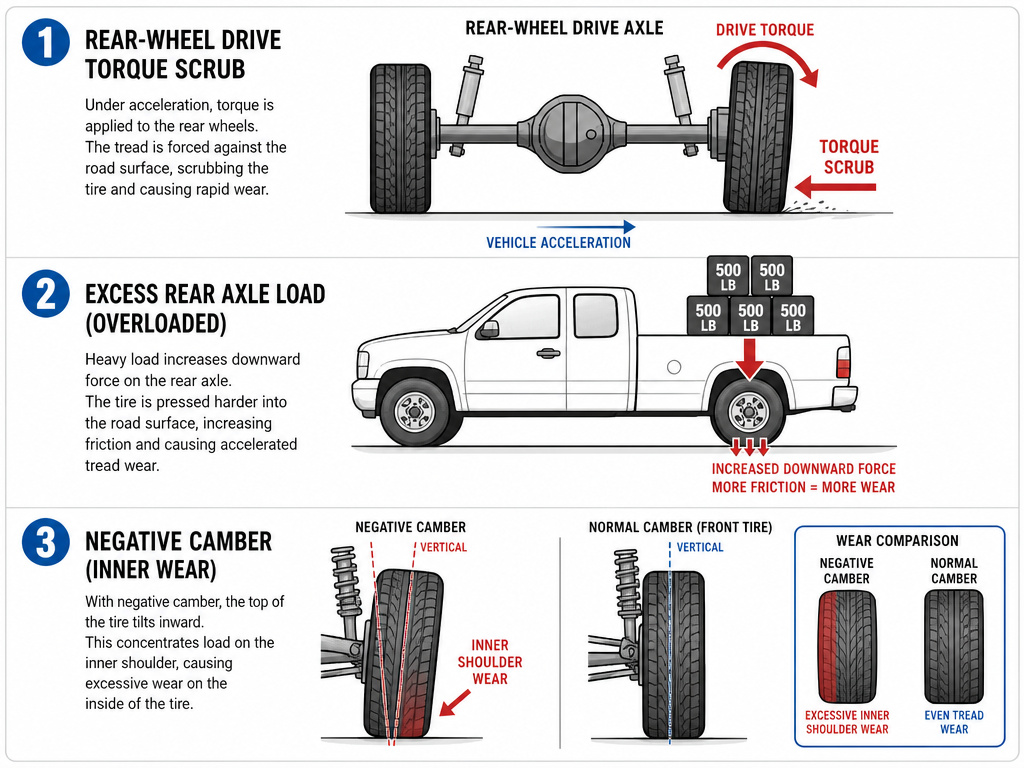
The front tires don’t always lose. Specific conditions flip the script.
Rear-Wheel Drive Vehicles: In a RWD car or truck, the rear wheels deliver power. The twisting force (torque) during acceleration, especially with a powerful engine, can scrub the rear tires faster. This is the “opposite” wear pattern Toyota mentions. If you have a lead foot, your rear tread will disappear first.
Heavy Loads and Towing: Load up a pickup truck’s bed or hook up a trailer. That extra weight sits over or behind the rear axle, pressing those tires into the pavement. Under constant load, they’ll wear down quicker than the lightly loaded fronts. This is a common cause of uneven tire wear in work vehicles.
Aggressive Alignment Settings: Some performance cars have negative camber dialed into the rear suspension for better cornering grip. This tilts the top of the tire inward. If overdone or combined with a lot of highway driving, it can cause the inner shoulder of the rear tire to wear dramatically faster than any part of the front tire. This is a pure alignment and tire wear issue.
Common mistake: Assuming all uneven wear points to the front tires. If your rear tires are balding first, check your drivetrain, your recent cargo, and your wheel alignment status.
Your Driving Style and Environment Are Filters
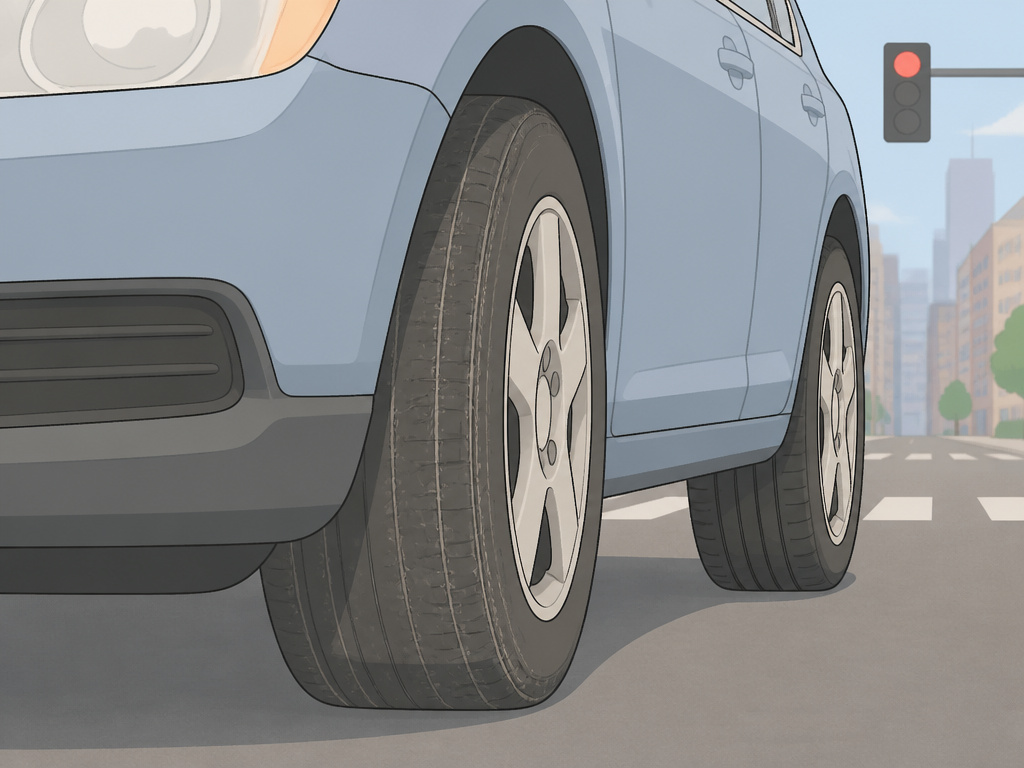
The studies make another critical distinction: where and how you drive acts as a multiplier on these base wear rates.
That 2024 Lubricants study measured wear across urban, rural, and motorway driving. It found total tire mass loss was highest in urban driving and lowest in motorway driving. Stop-and-go traffic, constant low-speed turns, and frequent braking are a perfect storm for front tire wear. The front tire’s contribution to total wear was also lower during rural and motorway trips.
Think about your commute. A 20-mile highway blast is easier on your fronts than a 5-mile trip through downtown with ten traffic lights. The highway tire might see higher sustained speeds, but the city tire faces hundreds of extra micro-stress events.
Your personal style matters, too. Late, hard braking increases weight transfer force. Aggressive cornering multiplies steering scrub. Gentle, anticipatory driving is the single best thing you can do to make your tires last longer.
The Fix: Smart Tire Rotation and Maintenance
You can’t repeal the laws of physics, but you can manage their effects. Tire rotation is the primary tool.
The NHTSA tire safety guide states it clearly: rotating your tires can help reduce irregular wear, which helps them last longer. The NHTSA recommends a rotation every 5,000 to 8,000 miles if suggested by your vehicle manufacturer. Toyota warns that skipping or prolonging rotation may void your tire’s mileage warranty.
But you must rotate correctly. The pattern matters.
- For FWD Vehicles: The standard is a “forward cross.” Move the rear tires straight to the front. Cross the front tires to the opposite rear positions. This ensures all tires spend time on the high-wear front axle.
- For RWD Vehicles: Use a “rearward cross.” Move the front tires straight to the rear. Cross the rear tires to the opposite front positions.
- For AWD/4WD Vehicles: Consult your manual. Many use an “X-pattern,” crossing all four tires to the opposite corner, to keep wear even across all wheels.
Before you start: Check your owner’s manual first. The NHTSA notes that for some vehicles, tire rotation is not recommended, often due to staggered fitments (different front/rear sizes) or directional tire designs. Forcing a rotation where it’s not advised can cause handling issues.
Here is a simple maintenance checklist to combat uneven wear:
- Monthly: Check tire pressure when tires are cold (car hasn’t been driven for at least three hours). Use the PSI number on your driver’s side door jamb’s Tire and Loading Information Label, not the side of the tire.
- Every Oil Change: Visually inspect tread for signs of common tire wear patterns, like inner-edge wear (alignment) or center wear (over-inflation).
- Every 5,000-8,000 Miles: Perform the correct tire rotation for your drivetrain.
- Annually or if wear is uneven: Get a professional wheel alignment. It’s the only fix for wear caused by incorrect camber or toe angles.
This routine turns your tires from consumables into a durable, rotating asset. It’s cheaper than premature replacement.
Frequently Asked Questions
Why are my back tires wearing faster than my front tires?
This is common on rear-wheel-drive vehicles, where power is sent to the rear wheels. The torque during acceleration wears the rear tread faster. It can also happen if you frequently carry heavy loads in the trunk or bed, or if your rear suspension has an aggressive alignment setting like excessive negative camber. Don’t assume the fronts always go first.
Do front tires wear quicker than rear tires on all cars?
No. While it’s true for most front-wheel-drive passenger cars, the pattern can be equal or reversed on rear-wheel-drive vehicles, and it varies for all-wheel-drive systems. The drivetrain is the deciding factor. Always check your specific vehicle’s recommended tire rotation method for a clue.
Why are my tires only lasting 2 years?
Premature wear usually points to a maintenance gap. The most likely causes are chronic under-inflation, a missed alignment issue (causing feathering or shoulder wear), or a complete lack of tire rotation. A tire that never moves from the front-left position on a FWD car will die young. Following the pressure, rotation, and alignment checks above can easily double that lifespan.
Should I put new tires on the front or back?
For most front-wheel-drive cars, you should install the new tires on the rear axle. This is a safety practice, not a wear-based one. The rear axle provides stability; having more tread back there helps prevent oversteer and loss of control in wet conditions. Once the older fronts wear out, rotate the new rears forward and put the next new pair on the rear again. Our guide on where to put new tires explains the physics behind this rule.
The Bottom Line
Front tires wear faster because they do more work. The ratio isn’t fixed, it’s a sliding scale set by your drivetrain, your driving, and your diligence with a tire gauge.
The data gives you a range: on a FWD car, expect front tires to wear faster, with reported ratios from 2.0 to 2.6 times the rate of rear tires. Let that number dictate your rotation schedule. If your rears are wearing first, diagnose the cause, it’s either your driving habits, your vehicle’s design, or a mechanical fault.
Start with the pressure. Move to rotation. Finish with alignment. That sequence, grounded in the official tire maintenance guidelines, turns a set of tires from a mystery expense into a predictable, manageable cost. Your tread will tell you everything, if you know how to read it.
