
UTQG Tire Ratings Explained: The Sidewall Decoder
This post contains affiliate links. As an Amazon Associate, we earn from qualifying purchases.
UTQG tire ratings are a government-mandated, self-certified grading system that compares passenger tire performance in three areas: treadwear (a number like 400), traction (AA, A, B, C), and temperature resistance (A, B, C). The ratings are for comparison only within a brand’s lineup, not a guarantee of real-world mileage or performance.
The system’s stated purpose is to aid consumer choice, but its design, manufacturers grading their own tires against their own control tires, makes direct brand-to-brand comparisons unreliable. The ratings are the result of specific, controlled tests that don’t account for your driving style, road conditions, or vehicle setup. For a clear overview, see UTQG tire ratings explained.
What follows: a breakdown of what each grade actually measures, the surprising specifics of the government test course, the critical limitations every buyer should know, and how to use UTQG alongside other specs like the load index and speed rating.
Key Takeaways
- The treadwear number is comparative, not predictive; a 400-rated tire should last twice as long as a 200-rated tire from the same manufacturer under controlled test conditions, not on your roads.
- Traction grades (AA, A, B, C) measure straight-line wet braking only on specific government asphalt and concrete surfaces, they say nothing about cornering grip, dry traction, or snow/ice performance.
- Temperature grades (A, B, C) indicate heat dissipation; a “C” grade meets the minimum federal safety standard (FMVSS No. 109), while “A” offers the highest resistance to heat-induced failure.
- Winter/snow tires, temporary spares, and tires with a rim diameter of 12 inches or less are exempt from UTQG grading requirements per 49 CFR § 575.104.
- Always check the DOT date code, a tire’s age often matters more than its UTQG rating for safety, as compounds degrade over time regardless of tread depth.
What Is UTQG and Who Created It?
The Uniform Tire Quality Grading Standards (UTQG) are a set of U.S. Department of Transportation (DOT) regulations, codified as 49 CFR § 575.104. The National Highway Traffic Safety Administration (NHTSA) administers them. The regulation’s stated purpose is to aid the consumer in making an informed choice in the purchase of passenger car tires, which is the core of the UTQG tire ratings explained concept.
It’s important to understand what UTQG is not. It is not a pass/fail safety test, that’s the separate Federal Motor Vehicle Safety Standard (FMVSS) No. 109. Think of UTQG as a comparative nutrition label, while FMVSS is the food safety inspection.
Crucially, the government doesn’t test every tire. The system is based on manufacturer self-certification. Tire makers grade their own products by running them through prescribed tests and comparing the results to their own “control” tires. NHTSA conducts spot-check compliance testing, but the burden of assigning the grade lies with the manufacturer. This self-policing aspect is the source of much confusion and the reason you can’t always trust a 400 from Brand A to wear the same as a 400 from Brand B, a crucial detail when you compare a UTQG tire ratings explained chart.
49 CFR § 575.104 specifies that UTQG applies to new pneumatic tires for use on passenger cars. It does not apply to deep tread, winter-type snow tires, space-saver or temporary use spare tires, tires with nominal rim diameters of 12 inches or less, or to limited production tires (under 15,000 units of a specific design per year).
What Do the Three UTQG Grades Mean?
Every graded passenger tire carries a three-part code on its sidewall, like “500 A A”. We’ll examine each part separately.
Treadwear: The Relative Longevity Number
The treadwear grade is a three-digit number, like 300, 420, or 600. By law, these numbers are expressed in multiples of 20. The baseline is 100. In theory, a tire graded 200 should last twice as long as the control tire under the exact conditions of the government test. A 400-graded tire should last four times as long.
The test that generates this number is specific. Treadwear grades are developed by running candidate tires over a selected 400-mile segment of public highway outside San Angelo, Texas. After an 800-mile ‘break-in’ run, the candidate tires are driven over the test course for a total of 6,400 miles in convoys of four vehicles.
The key phrase is “in comparison to a control tire.” The control is a special ASTM F2493 standard reference test tire, known as the Course Monitoring Tire (CMT). The base wear rate for the CMTs is obtained by running them for 16 circuits over the San Angelo, Texas, UTQGS test route 4 times per year. Your tire’s treadwear number is developed by comparing its wear to the CMT’s wear in that controlled environment.
Where this goes sideways: Assuming a 500 treadwear rating means 50,000 miles. The test doesn’t project mileage. Your real-world tread life depends on your alignment, driving style, road surfaces, climate, and maintenance. The number is only useful for comparing two tire models from the same manufacturer.
Traction: The Straight-Line Wet Grip Letter
The traction grade is a letter: AA, A, B, or C, with AA being the highest. This grade measures straight-line wet braking grip only. It does not evaluate cornering, dry pavement performance, or snow and ice capability.
The test involves measuring traction on specified government test surfaces of asphalt and concrete. The grade is determined from tests on specified government test surfaces. Most ultra-high-performance tires achieve the best traction grade: AA. Most car tires get the next best traction grade of A.
The part nobody mentions: A tire with a “C” traction grade meets the minimum legal requirement, but its stopping distance on wet pavement will be significantly longer than an “AA” or “A” tire. For daily driving in rainy climates, prioritize traction grade over a slightly higher treadwear number.
Temperature: The Heat Resistance Letter
The temperature grade is also a letter: A, B, or C, with A being the best. It indicates the tire’s resistance to heat generation and its ability to dissipate heat when run under load at speed. Excessive heat is a primary cause of tire failure, as it breaks down the rubber compound and can lead to structural breakdown.
A “C” grade means the tire meets the minimum performance level required under Federal Motor Vehicle Safety Standard No. 109. Most all-season tires achieve a temperature grade of A. This grade becomes critically important if you regularly drive at high speeds, carry heavy loads, or live in a hot climate.
| UTQG Grade | What It Measures | Scale / Example | Real-World Meaning |
|---|---|---|---|
| Treadwear | Relative wear rate vs. A control tire under test conditions. | Numeric (e.g., 300, 500). Multiples of 20. | A 500 tire should wear slower than a 300 tire from the same maker. Not a mileage promise. |
| Traction | Straight-line wet braking friction on specified surfaces. | AA (Highest), A, B, C (Lowest). | AA stops shorter on wet roads than A. Says nothing about dry grip, cornering, or snow. |
| Temperature | Resistance to heat buildup and failure at speed. | A (Best), B, C (Meets FMVSS 109 min). | An “A” tire is less likely to fail from heat during sustained high-speed driving or when overloaded. |
The Mechanics and Limitations of the UTQG System
Understanding how the grades are generated reveals their biggest limitations. The process is standardized but contains variables that dilute its real-world predictive power.
The San Angelo Test Course & The CMT
The 400-mile San Angelo route is a public highway loop in Texas. The convoy driving is meant to average real-world conditions on the specified test route.
The CMTs used to calibrate this course have strict shelf lives. According to the Federal Register, they must be no more than 1 year old at test commencement and used within 2 months after removal from storage, while the main regulation, 49 CFR § 575.104, states they must be used “within four months after removal from storage.” This aging control is specified in the regulations.
Manufacturer Self-Certification & Grade “Inflation”
This is the elephant in the room. Because each manufacturer tests its own tires against its own control tires, there’s no universal standard for what “100” represents.
The regulation requires that tires meet the performance levels of the grades assigned. NHTSA conducts compliance testing. This is why a Michelin tire with a 500 treadwear rating may not last the same distance as a different brand’s tire also rated 500.
What UTQG Doesn’t Tell You
The system is silent on several critical performance and safety aspects:
- Dry Handling & Cornering Grip: A tire with an AA traction grade might have mediocre dry-road cornering feel.
- Snow & Ice Performance: This is not measured. Look for the Three-Peak Mountain Snowflake symbol for severe snow service.
- Comfort & Noise: A high-performance tire with excellent grades can be loud and harsh.
- Real-World Tread Life: Your driving habits are the biggest variable. The test is conducted under controlled conditions.
- Wet Cornering or Aquaplaning Resistance: The traction test is a straight-line brake slam.
Common mistake: Using UTQG as your sole tire-buying criteria. It’s one data point among many, including user reviews, professional tire tests, and the manufacturer’s treadwear warranty (which, while also limited, is a contractual mileage promise).
Where to Find UTQG Ratings on Your Tire
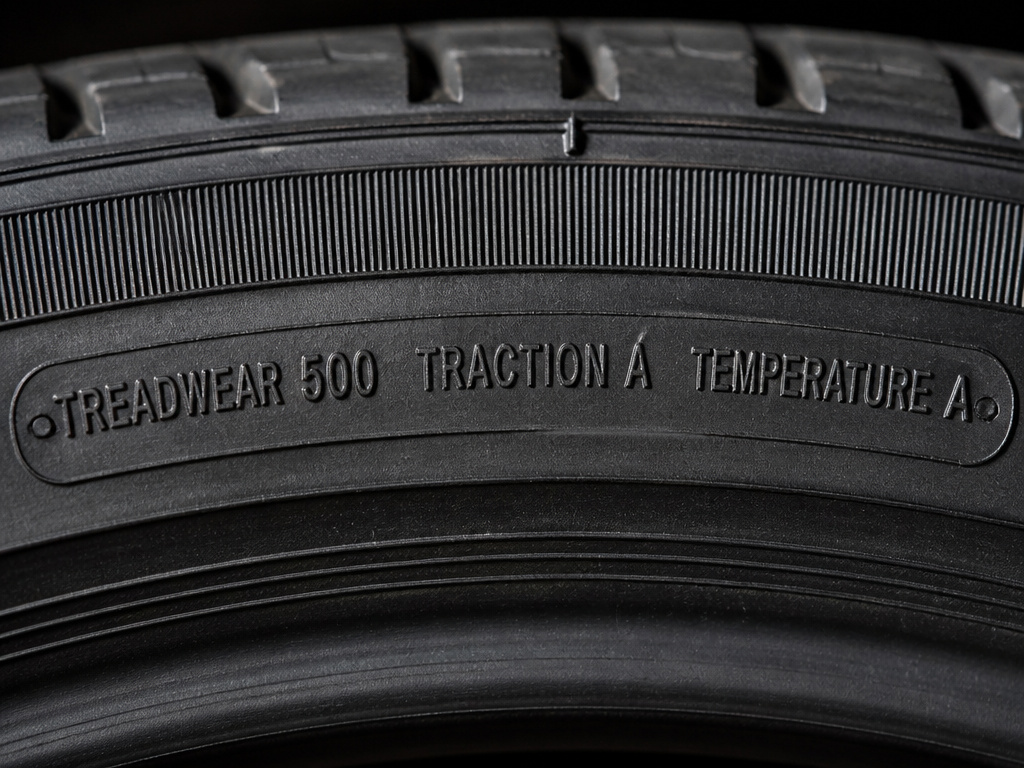
The codes are molded into the sidewall, typically in the area between the tread shoulder and the maximum section width. You’ll see a block that looks something like: TREADWEAR 500 TRACTION A TEMPERATURE A.
The codes are molded into the sidewall. If you’re having trouble finding it, look for the three-part sequence of a number followed by two letters. Remember, the correct inflation pressure (PSI) for your vehicle is on the driver’s door jamb placard, not on the tire sidewall, a point the NHTSA consumer guide stresses.
UTQG vs. Other Tire Markings: How to Prioritize
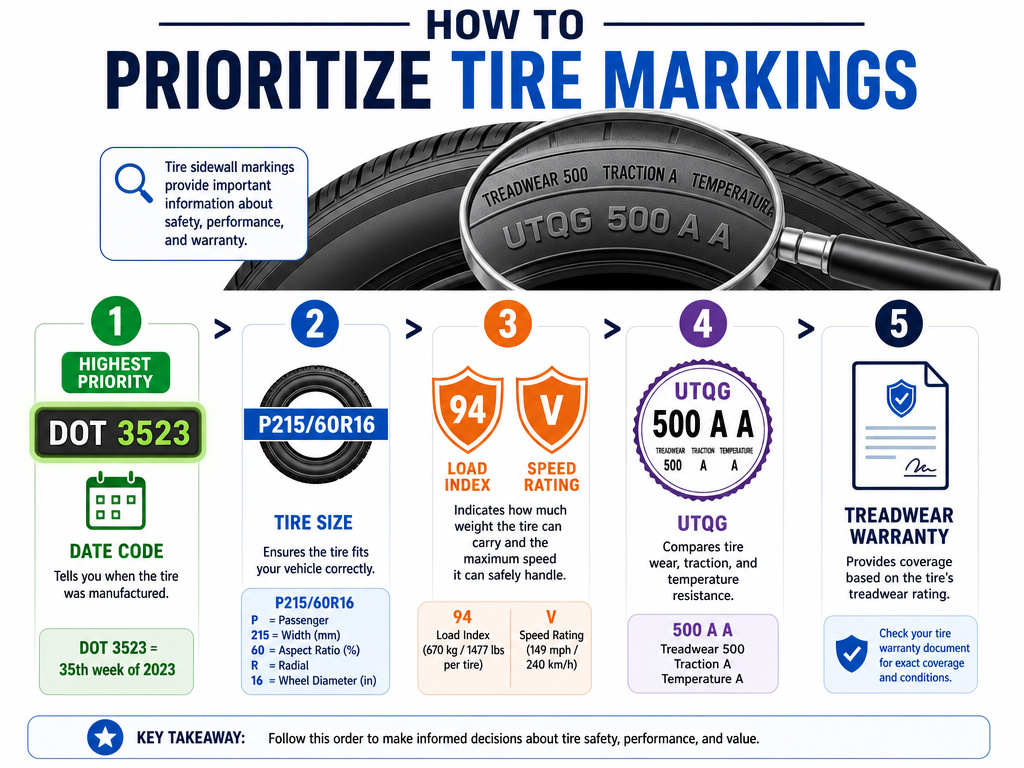
When you’re reading the sidewall, UTQG is just one piece of the puzzle. Here’s how to weigh it against other critical markings.
- DOT Date Code: This is essential. A tire’s rubber compound degrades with age, regardless of tread depth. Find the four-digit code (e.g., “3523” for the 35th week of 2023). This matters more than a high treadwear grade on an old tire.
- Tire Size & Type: Must match your vehicle’s requirements and your driving needs (all-season, summer, etc.). No rating overcomes an incorrect size.
- Load Index & Speed Rating: These are safety-critical. The load index indicates the tire’s load-carrying capacity, and the speed rating indicates its maximum speed capability. Never downgrade these to get a “better” UTQG rating.
- UTQG Ratings: Use these for refinement within a category. Once you’ve narrowed your search to, say, grand-touring all-season tires in the correct size and load range, then compare UTQG ratings among your shortlist.
- Treadwear Warranty: This is the manufacturer’s pro-rated mileage guarantee. It can be a more tangible benchmark than the treadwear grade. Read the warranty’s fine print on exclusions (rotation, alignment, etc.).
| Tire Category | Typical Treadwear Range | Typical Traction Grade | Typical Temp Grade | Primary Use Case |
|---|---|---|---|---|
| Max Performance Summer | 180 – 300 | AA | A | Sporty driving, dry/wet grip priority. |
| Grand Touring All-Season | 400 – 700 | A | A | Comfort, longevity, and all-weather capability for daily driving. |
| Standard Passenger All-Season | 500 – 800 | A | A | Basic transportation, emphasizing value and tread life. |
| All-Terrain (Light Truck) | 400 – 600 | A or B | B | Off-road capability with on-road manners. Often has lower traction grades. |
Frequently Asked Questions
Is a UTQG 500 AA A rating good?
Yes, that’s a very strong rating for a passenger tire. A 500 treadwear suggests good longevity, an AA traction grade indicates excellent wet braking, and an A temperature grade means high heat resistance. It describes a well-rounded, high-performing tire, likely in the grand-touring or ultra-high-performance all-season category.
Can you compare UTQG ratings across brands?
You can, but do so with caution. Due to manufacturer self-certification, a 500 from Brand A and a 500 from Brand B may not wear identically in the real world. The rating is most reliable for comparing different tire models within a single brand’s lineup. For cross-brand comparisons, rely more on professional tire tests and aggregated owner reviews.
Do winter tires have UTQG ratings?
No. Deep tread, winter-type snow tires are exempt from UTQG grading, as are space-saver spares and tires with a rim diameter of 12 inches or less. Winter tires use different rubber compounds and tread designs for cold-weather performance, which don’t align with the UTQG test parameters. Look for the Three-Peak Mountain Snowflake symbol instead.
What is a good treadwear rating?
Context is everything. For a high-performance summer tire, a rating of 200-300 is typical and “good” for that category. For a family sedan’s all-season tire, you’d expect a rating between 500-700. A “good” rating is one that aligns with your priorities: higher numbers for longevity, often (but not always) accepting some compromise in outright grip.
Does the traction grade apply to snow?
No. The UTQG traction grade measures wet braking on asphalt and concrete only. It does not test or indicate performance on snow or ice. A tire with an “AA” traction grade could be dangerously poor in winter conditions if it’s a summer tire. Always match the tire type (all-season, winter) to your climate.
Why is my tire’s treadwear warranty higher than the UTQG number implies?
Because they measure different things. The UTQG treadwear grade is a comparative index from a controlled test. The mileage warranty is a pro-rated promise based on real-world use (with many conditions). Manufacturers set warranties for marketing and competitive reasons, not directly from the UTQG test result. The warranty is a separate promise from the manufacturer.
The Bottom Line
UTQG ratings are a standardized starting point, not a finishing line. The treadwear number gives a hint at longevity, the traction grade tells a specific wet-braking story, and the temperature grade warns about heat tolerance. They are most useful for narrowing choices after you’ve locked in the correct tire size, type, load index, and speed rating for your vehicle.
The system’s biggest flaw is its opacity, manufacturers grade their own work. This makes the treadwear number a relative tool, not an absolute truth. A tire from one brand with a high rating will likely outlast a budget tire with a similar rating due to compound and construction quality the UTQG system doesn’t capture.
So, read the sidewall. Decode the UTQG rating. Then, go read the professional tests and owner forums. The final grade that matters is the one your driving experience gives them.
